


Precision engineering often meets its greatest enemy not in the assembly room, but in the environment itself. A perfectly milled steel component can be rendered useless by a single speck of rust in a hidden internal cavity. Standard spray-based finishes, while effective for exterior surfaces, suffer from a fundamental physical limitation known as the "Faraday Cage" effect, where paint particles refuse to enter deep recesses or tight corners. This is the technical gap bridged by e coat, also known as electrophoretic coating. It is the ultimate solution for components that demand 100% surface coverage, regardless of how complex or labyrinthine their internal geometry might be.

At Jucheng Precision, we integrate CNC machining surface treatment into our core manufacturing philosophy. We understand that for automotive chassis parts, subsea enclosures, and complex industrial brackets, "mostly covered" is simply not enough. E-coating utilizes the relentless logic of electricity to pull a protective resin into every microscopic pore and deep bore of a machined part. This guide explores the sophisticated physics behind electrodeposition, the critical advantages of film uniformity, and why JUCHENG recommends this process for high-reliability components that must survive in aggressive, high-corrosion environments.
Choosing between immersion and spray is a decision that impacts the entire lifecycle of your hardware. While powder coating offers raw impact strength, e-coating offers a level of intricate protection that no spray gun can match. Let us dive into the technical pillars of this liquid-phase electrical armor and how it preserves the integrity of your most complex CNC designs.
Electrical Immersion: The Physics of Electrodeposition
Uniformity Mandate: Covering the Unreachable
Corrosion Defense: Engineering for Extreme Environments
Thin Film Advantage: Maintaining Precision Assembly Fits
JUCHENG’s Integrated Workflow: From Tank to Field
Electrical Immersion: The Physics of Electrodeposition

The power of e coat lies in its departure from mechanical application. In a standard spray booth, paint relies on line-of-sight and air pressure. E-coating, however, is a liquid-phase electrical process. The metal part is submerged in a tank filled with deionized water and epoxy-based resins. An electric current is passed between the part (acting as an electrode) and an opposing electrode. In cationic e-coating, the most common industrial method, the part is negatively charged, attracting the positively charged paint particles in the bath. This is not a passive soak; it is an active, molecular migration.
As the resin particles hit the metal, they lose their charge and become an insoluble, insulating film. This is the "self-limiting" magic of the process. Once a specific area of the part is coated to a certain thickness, it becomes insulated, and the electric current automatically seeks out the remaining uncoated areas. This continues until every square millimeter of the part—no matter how deeply hidden—is covered with a uniform layer. At Jucheng Precision, we calibrate the voltage and immersion time to ensure that the cross-linking of the epoxy is complete, creating a primary bond with the metal that is virtually impossible to peel or flake. Unlike spray-on finishes that sit on top of the surface, e-coating is chemically drawn into the grain of the metal, providing a foundation for survival.
Uniformity Mandate: Covering the Unreachable

Engineers designing complex fluid manifolds or tubular chassis often face a "rust from the inside out" problem. A spray gun cannot reach the interior of a 200mm long tube with a 10mm diameter. Powder coating will build up aggressively on the outside edges while leaving the interior completely bare. This vulnerability is the primary reason for mechanical failure in the automotive and heavy equipment sectors. E coat eliminates this failure mode entirely. Because the part is fully immersed, the liquid resin reaches every internal thread, every blind hole, and every cooling channel.
At Jucheng Precision, we utilize e-coating for parts with intricate internal pockets that must remain corrosion-free. The uniformity of the film is staggering. While powder coating might vary from 60 to 150 microns across a single part, e-coating maintains a consistent thickness—typically between 15 to 25 microns—with less than a 2-micron variance. This precision is essential for parts that require 100% coverage but also have sharp edges. In a spray process, surface tension pulls paint away from sharp corners, leaving "thin spots" where rust begins. In e-coating, the electrical attraction is actually strongest at the sharpest points, ensuring that your machined edges are as well-protected as your flat surfaces. This "wrap-around" reliability is what makes e-coating the mandatory standard for automotive underbody components.
Corrosion Defense: Engineering for Extreme Environments

The true measure of a CNC machining surface treatment is its performance in a salt spray chamber. E-coating is an epoxy-based system, which provides exceptional resistance to salts, acids, and alkalis. For steel components that must survive a 1,000-hour salt spray test (ASTM B117), e-coating is often the primary layer of defense. It acts as both a protective armor and a high-performance primer. In many high-corrosion applications, JUCHENG engineers recommend a "Duplex Coating" strategy: an e-coat base layer for 100% coverage and chemical resistance, followed by a powder-coated top layer for UV stability and impact armor.
This dual-layer approach provides a synergistic defense. If the outer powder coat is scratched, the underlying e-coat prevents "undercutting corrosion"—the phenomenon where rust spreads beneath the paint and causes large flakes to peel off. Because the e-coat is covalently bonded to the metal, it localizes any damage, keeping the rest of the component pristine. For offshore energy equipment or coastal infrastructure, this level of redundancy is the difference between a ten-year service life and a two-year failure. At Jucheng Precision, we manage these complex multi-stage finishing cycles in-house, ensuring that the pre-treatment cleaning is sufficient for the e-coat to bond perfectly, creating a shield that is structurally integrated with your precision-machined substrate.
Thin Film Advantage: Maintaining Precision Assembly Fits

One of the biggest headaches for a CNC machinist is "finish allowance." If you powder coat a precision bore, you might add 100 microns of thickness, which will prevent a bearing from pressing in. You are then forced to manually scrape or re-machine the part, ruining the finish and the tolerance. E coat is a "thin-film" superstar. Because we can control the thickness with extreme accuracy (usually +/- 3 microns), we can provide 100% corrosion protection without significantly altering the part’s geometry.
This thinness is vital for assemblies with interlocking features or internal threads. You can e-coat a threaded hole and, in most cases, the bolt will still thread in perfectly. This eliminates the need for expensive and labor-intensive masking of every hole—a major cost-saving benefit for high-volume production. At Jucheng Precision, we use this thin-film characteristic to deliver "ready-to-assemble" parts. We account for the ~20-micron film in our initial machining offsets, ensuring that after the finish is applied, the dimensions are exactly as specified on your print. This integration of machining and finishing is where our technical rigor provides the most value, reducing your assembly time and eliminating the risks associated with secondary hand-rework.
JUCHENG’s Integrated Workflow: From Tank to Field
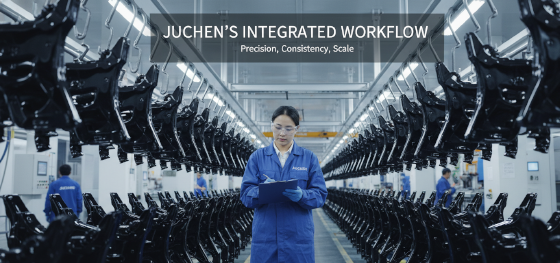
The success of an e-coat finish is decided long before the part hits the tank. It begins with the cleanliness of the metal. Any trace of machining oil or fingerprint grease will prevent the resin from bonding, leading to "fish-eyes" or bald spots. Jucheng Precision operates a multi-stage pre-treatment line, including alkaline degreasing and zinc-phosphate conversion, to ensure the metal surface is chemically active and pristine. We treat the cleaning process with the same level of precision as our 5-axis tool paths.
Our integrated approach means that we manage the accountability for the entire part. We don't just ship you a part and hope the finisher does their job. We provide CMM verification of dimensions both before and after the e-coating process. We perform cross-hatch adhesion tests and thickness audits on every batch. When you receive a component from JUCHENG, it is a finished engineered solution, verified for both dimensional accuracy and environmental survival. Whether you are building high-volume automotive brackets or a single complex prototype for a harsh industrial environment, our e-coating expertise ensures your designs are fully armored. Contact Jucheng Precision today for a technical DFM review and see how our immersion-finishing protocols can clarify and secure your next supply chain challenge.

