


Traditional manufacturing relies on the violent victory of a harder material over a softer one. In most of the cnc machining process, success is determined by the physical strength of the cutter. But what happens when the material you need to shape is as hard as the tool itself? Or when your design requires an internal corner so sharp that even the smallest rotating end mill would leave an unacceptable radius? This is where edm electrical discharge machining steps in to rewrite the laws of physics. It is the art of machining without contact—a process where metal is not cut, but systematically vaporized by a relentless storm of controlled lightning.
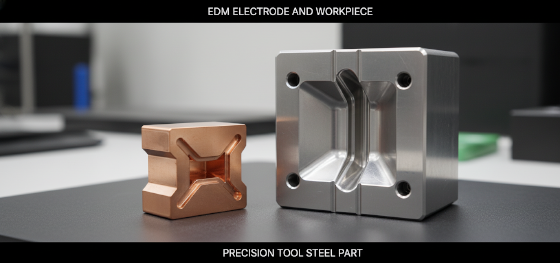
At Jucheng Precision, we integrate EDM technology into our core high-precision workflows to solve the "impossible" geometries found in aerospace fuel nozzles and medical injection molds. We understand that EDM is not just a secondary operation; it is a strategic tool for managing material hardness and geometric complexity. Operating advanced sinker and wire EDM centers, we provide our clients with the ability to shape hardened tool steels and exotic alloys with a level of delicacy and precision that mechanical cutting simply cannot replicate. This guide explores the thermal mechanics of spark erosion, the unique geometric advantages of zero-contact machining, and why JUCHENG utilizes EDM to secure the functional future of your most challenging designs.
Efficiency in advanced manufacturing is found in the ability to ignore physical hardness. In the EDM tank, the strength of the metal's crystalline bond is irrelevant; only its electrical conductivity matters. Let us examine the technical pillars of electrical discharge and how it tames the most stubborn materials on the engineering palette.
Plasma Erosion: The Physics of the Spark
Defying Hardness: Machining the Unmachinable
Geometric Freedom: The Zero-Radius Advantage
Surface Integrity: Managing the Recast Layer
JUCHENG’s Integrated Approach: Rapid Tooling and EDM
Plasma Erosion: The Physics of the Spark
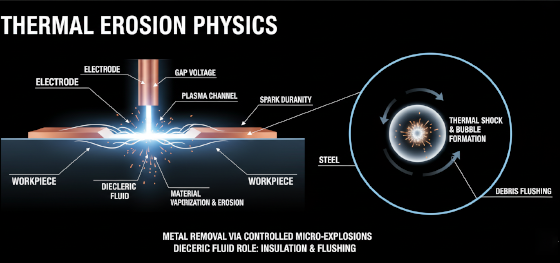
The fundamental magic of edm electrical discharge machining is the complete absence of mechanical force. In a standard milling setup, the tool must physically push through the metal grains. In EDM, the tool (the electrode) and the workpiece never touch. They are separated by a microscopic gap filled with a dielectric fluid—usually a specialized hydrocarbon oil or deionized water. As the machine applies a high-frequency pulsating voltage between the electrode and the part, the electrical potential becomes so great that the dielectric fluid breaks down.
This breakdown creates a plasma channel where temperatures can skyrocket to over 10,000 degrees Celsius in a fraction of a microsecond. This localized heat is so intense that a tiny volume of metal on the part's surface is instantly vaporized and melted. When the pulse ends, the plasma channel collapses, and the dielectric fluid rushes in, flushing away the microscopic solidified metal droplets. At Jucheng Precision, we tune these electrical pulses with surgical accuracy. By controlling the "On-Time" and "Off-Time" of the sparks, we can manage the material removal rate and the resulting surface texture. It is a process of millions of micro-explosions per second, allowing us to erode material with a level of control that no physical blade could match. Because there is no tool pressure, we can machine delicate, thin-walled structures that would simply collapse under the force of a traditional cnc machining process.
Defying Hardness: Machining the Unmachinable
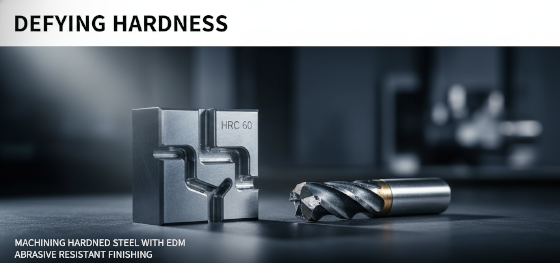
In the hierarchy of manufacturing, hardness is the ultimate gatekeeper. Standard machining tools lose their effectiveness as the material's Rockwell hardness climbs past HRC 45. Cutting hardened tool steel or tungsten carbide requires incredibly slow speeds and expensive consumables. But edm electrical discharge machining is indifferent to hardness. Whether the part is a block of soft copper or a piece of fully hardened D2 tool steel, the erosion rate remains largely the same. The only requirement is that the material must be electrically conductive.
This capability is a game-changer for the mold and die industry. At Jucheng Precision, we often heat-treat our mold blocks to their final hardness before we perform the finishing EDM operations. This eliminates the risk of dimensional warping that often happens when you heat-treat a pre-machined part. By spark-eroding the final features into a stabilized, hardened substrate, we ensure that the tolerances and the surface integrity are locked in. This is why EDM is the mandatory choice for aerospace components that must endure extreme heat and friction. We use the relentless power of electricity to bypass the mechanical limits of the tool, ensuring that your parts are made from the best possible alloys without the "machinability penalty" that standard shops charge.
Geometric Freedom: The Zero-Radius Advantage
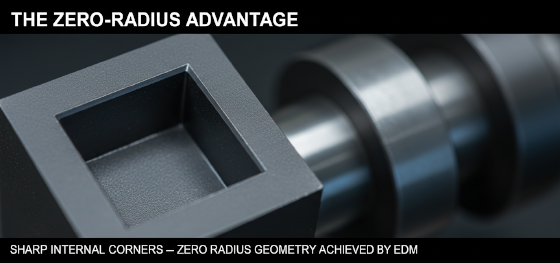
The most frustrating limitation for a design engineer is the "Radius Constraint." All traditional milling tools are round. This means they can never carve a sharp, 90-degree internal corner. There will always be a radius at the bottom of a pocket equal to the radius of the cutter. If your assembly requires a sharp-edged rectangular pin to fit into a blind hole, milling cannot do it. EDM electrical discharge machining, however, is not bound by rotation.
In Sinker EDM, we can machine a copper or graphite electrode into the exact inverse of your final shape. If the electrode has a sharp corner, the spark erosion process will replicate that corner in the steel with near-perfect fidelity. This "Zero-Radius" capability is essential for spline drives, keyways, and complex mold shut-off surfaces. JUCHENG utilizes advanced electrode manufacturing on our high-speed mills to ensure that our EDM process delivers the crisp, sharp geometries your designs demand. This geometric freedom allows engineers to design for performance and fitment rather than for tool access. By removing the radius constraint, we provide the technical path to realize the most intricate internal features of your assembly, ensuring a level of fit and finish that defines world-class engineering.
Surface Integrity: Managing the Recast Layer

Every manufacturing process has a "signature" on the metal’s surface. In EDM, that signature is the "Recast Layer" or the white layer. Because the metal is melted and then instantly cooled by the dielectric fluid, a microscopic layer of altered metallurgy remains on the surface. If managed poorly, this layer can be brittle and prone to micro-cracking in high-vibration aerospace applications. Mastering edm electrical discharge machining requires a deep understanding of this surface integrity.
At Jucheng Precision, we use a multi-stage EDM strategy to minimize the recast layer. We perform aggressive roughing passes to remove bulk material, followed by a series of low-energy finishing "skim" passes. These light sparks gently refine the surface, effectively "polishing" away the previous recast layers until the surface is uniform and stable. The resulting matte texture is actually beneficial for certain applications, such as plastic injection molds, where it can provide natural air venting and hide minor part defects. We provide our clients with surface roughness certificates, ensuring that the cnc machining process results in a skin that is as structurally sound as the core. By engineering the spark energy, we deliver parts that are ready for the extreme stresses of jet engines and surgical robotics.
JUCHENG’s Integrated Approach: Rapid Tooling and EDM

The greatest value of EDM is revealed when it is integrated into a larger rapid tooling strategy. Jucheng Precision operates as a one-stop-shop, meaning we don't just "burn" holes—we design and manufacture the entire mold system. Our EDM department works in perfect synchronization with our 5-axis milling and wire-cutting cells. We utilize centralized job management to ensure that the electrode machined at 2:00 PM is perfectly aligned in the EDM tank by 3:00 PM.
This integrated workflow is what allows us to deliver complex injection molds in weeks rather than months. We use EDM to create the intricate ribbing and sharp corners that make your plastic parts look professional and function flawlessly. By owning the entire cnc machining process, we eliminate the accountability gaps that occur when multiple vendors are involved. We provide CMM verification for both the electrodes and the final cavities, ensuring that the precision we promise is the precision we deliver. Whether you are building an innovative medical device or a high-performance aerospace housing, JUCHENG’s EDM expertise provides the technical edge needed to succeed. Contact Jucheng Precision today for a technical DFM review and see how our electrical discharge protocols can clarify and elevate your next high-precision project.

