


Precision is a pursuit of fewer setups. In the traditional world of manufacturing, complex parts were forced through a gauntlet of different machines, losing accuracy with every re-clamping. What is 5 axis cnc machining represents the ultimate escape from this cumulative error. It is a technology that allows a cutting tool to approach a workpiece from any direction, turning a raw block of material into a finished, complex geometry in a single, uninterrupted operation.
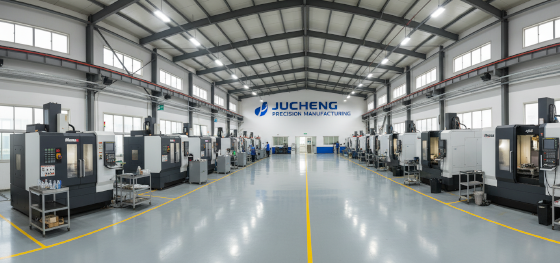
At Jucheng Precision, we have centered our cnc machining process around this multi-axis philosophy, operating a fleet of over 25 high-performance 5-axis centers. We understand that for an aerospace impeller or a titanium medical implant, the ability to tilt and rotate the part is not just a convenience—it is a mandatory requirement for structural integrity and surface excellence. This guide explores the mechanical foundations of the 5th axis, the critical divide between positional and continuous movement, and why JUCHENG’s investment in this technology clarifies the path for your most ambitious engineering designs.
Mastering five axes of motion requires a synergy of high-end software and rigid hardware. It is the art of simultaneous coordination. Let us examine the technical pillars that define this pinnacle of subtractive manufacturing.
Geometry of Motion: Explaining the X, Y, Z, A, and B Axes
Milling Philosophies: 3+2 Positional vs. Continuous 5-Axis
One-Setup Precision: The Short Tool and Accuracy Advantage
Complex Geometries: Handling Impellers and Undercuts
JUCHENG’s Multi-Axis Assurance: Scaling Your Vision
Geometry of Motion: Explaining the X, Y, Z, A, and B Axes
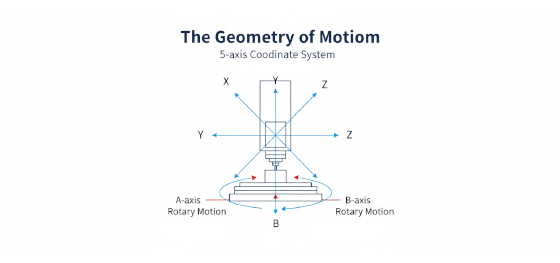
To define what is 5 axis cnc machining, one must first look at the traditional 3-axis baseline. Standard milling centers move in three linear directions: X (left to right), Y (front to back), and Z (up and down). This is efficient for flat plates and simple prismatic parts. But the moment a design requires a hole at an angle or a curved surface that wraps around a cylinder, the 3-axis machine reaches its physical limit. You are forced to stop the machine, rotate the part by hand in a new fixture, and hope that your alignment is perfect. This is where the 4th and 5th axes provide the breakthrough.
The "5-axis" designation refers to the addition of two rotational axes, usually called A and B (or C). The A-axis typically rotates around the X-axis, and the B-axis rotates around the Y-axis. At Jucheng Precision, our advanced trunnion-style and swivel-head machines allow the workpiece to tilt and spin while the spindle remains active. This five-axis coordination means the cutting tool can stay perpendicular to the surface of the part at all times, or it can lean into a corner to access features that are physically hidden from a top-down view. By controlling five points of data simultaneously, the machine behaves more like a robotic arm than a traditional table, carving complex 3D shapes with the fluidity of a sculptor. This geometric freedom is the foundation of modern high-tech components, from the fluid channels of a medical manifold to the weight-saving pockets of an aerospace frame.
Milling Philosophies: 3+2 Positional vs. Continuous 5-Axis
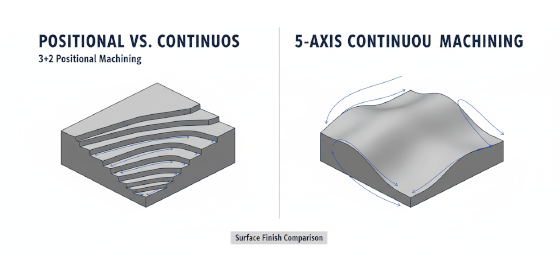
A critical distinction in understanding what is 5 axis cnc machining is the difference between "Positional" and "Continuous" movement. 3+2 Machining (Positional) is a hybrid approach. The machine uses the 4th and 5th axes to tilt the part into a specific orientation, locks them in place, and then performs a standard 3-axis milling operation. Once finished, it tilts the part to a new angle and repeats the process. This is incredibly effective for machining five sides of a part in a single setup, drastically reducing the labor cost and alignment errors associated with multiple fixtures.
Continuous (Simultaneous) 5-Axis Machining is the higher echelon. Here, all five axes move in perfect harmony at the same time. The tool is constantly tilting and rotating while it travels along the X, Y, and Z paths. This is required for complex, flowing surfaces like turbine blades and orthopedic implants. At Jucheng Precision, we use advanced CAM (Computer-Aided Manufacturing) software to simulate these paths, ensuring the tool never collides with the part or the machine. Continuous movement allows for a much smoother surface finish because the tool can maintain a constant contact point relative to the part’s curvature. We help our clients choose between 3+2 and continuous strategies based on their design’s complexity, ensuring that the cnc machining process is optimized for both visual perfection and production efficiency.
One-Setup Precision: The Short Tool and Accuracy Advantage
The most overlooked benefit of 5-axis technology is not the complexity it creates, but the accuracy it preserves. Every time a part is removed from a vice and re-clamped for a second operation, a "tolerance stack-up" occurs. No human or probe can re-align a part to 0.00mm perfection. By completing the part in a single setup, JUCHENG eliminates these cumulative errors. "One-Setup Precision" is why our 5-axis parts are consistently more accurate than those made on 3-axis machines.
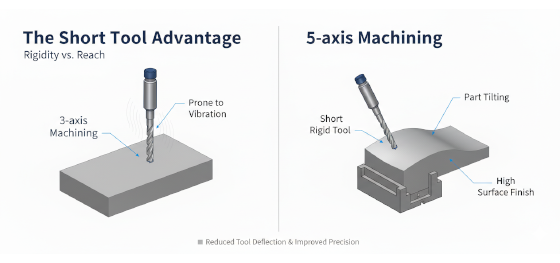
Furthermore, 5-axis movement allows us to use shorter cutting tools. In a 3-axis setup, to reach a deep pocket, you are often forced to use a long, slender end mill that is prone to vibration (chatter) and deflection. Vibration is the enemy of surface finish and tool life. In 5-axis machining, we can tilt the part toward the spindle, allowing a much shorter, more rigid tool to reach the same depth. This rigidity allows for faster feed rates and produces a surface finish that is often mirror-like directly off the mill. For medical and aerospace clients, this means less time spent on secondary hand-polishing and a part that is structurally sound from the core to the skin. We don't just reach the target; we reach it with the maximum possible mechanical stability.
Complex Geometries: Handling Impellers and Undercuts
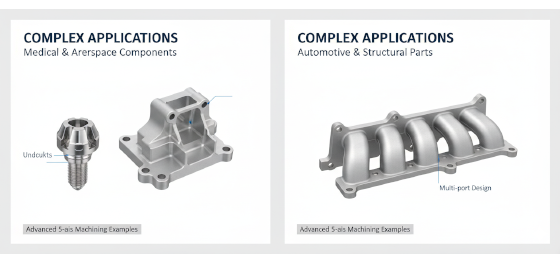
There is a class of parts that are physically impossible to manufacture without 5-axis technology. This includes "Undercuts"—features that are hidden beneath an overhanging lip—and organic, intertwined geometries like impellers and blisks. In these applications, the cutting tool must "snake" its way through narrow openings while constantly adjusting its angle to avoid gouging the material. This is where what is 5 axis cnc machining truly proves its value as an engineering enabler.
At Jucheng Precision, we specialize in these high-complexity components. By utilizing simultaneous 5-axis milling, we can produce impellers with paper-thin blades and complex twists that provide maximum aerodynamic efficiency. We can machine medical implants with "bone-growth" textures that require the tool to enter and exit at hundreds of different orientations. This geometric freedom allows engineers to design for performance rather than for "manufacturability constraints." We remove the "No" from the conversation, providing the technical path to realize shapes that were once thought to be only possible through 3D printing, but with the raw strength and surface integrity that only a subtractive cnc machining process can provide.
JUCHENG’s Multi-Axis Assurance: Scaling Your Vision
The true value of a 5-axis partner is not just having the machine; it is having the capacity to use it. Many shops have one or two multi-axis centers that are constantly backlogged. Jucheng Precision operates more than 25 high-precision 5-axis Haas and Mazak machines. This scale allows us to move from prototype to series production without a drop in quality or an increase in lead time. We treat 5-axis machining as a standard production method, not a "specialty" service.
Our integrated quality protocol means that every 5-axis part is verified on a 5-axis CMM, ensuring that the rotational accuracy of the machine matches the requirements of your digital model. We provide full documentation and DFM feedback, suggesting ways to optimize your part for 5-axis setups to reduce cost without sacrificing complexity. When you receive a component from JUCHENG, you are getting the benefit of optimized physics and massive manufacturing capacity. Whether you are building the next generation of satellite hardware or a life-saving surgical tool, our multi-axis expertise ensures your vision is delivered with absolute precision. Contact Jucheng Precision today for a technical DFM review and see how our 5-axis protocols can clarify and elevate your next manufacturing challenge.

