


Metallic prestige in hardware design is no longer the exclusive domain of solid alloys. When an engineer seeks the cold touch, reflective brilliance, and wear resistance of chrome but requires the complex geometry and lightweight benefits of polymers, the solution lies in the chemistry of electroplating plastic parts. In the uncompromising world of Injection molding surface finishes, electroplating represents the pinnacle of secondary operations, transforming a standard ABS or PC/ABS housing into a premium asset that rivals the appearance of die-cast zinc or stainless steel. Jucheng Precision operates as a high-fidelity manufacturing partner, navigating the delicate molecular interface between organic plastics and inorganic metals. We recognize that a successful plate is not achieved in the dipping tank alone; it is decided in the mold. Mastering this process is the primary defense against the "Blistering and Peeling" failures that plague inferior consumer and automotive components.

Adhesion sovereignty is earned through the management of microscopic "Mechanical Anchors." Amateurs often view plating as a simple paint-like coating, unaware that the metal layer must physically "lock" into the plastic substrate at a nanometer scale. Jucheng Precision eliminates manufacturing doubt by enforcing a strict "Low-Stress Molding" protocol. We understand that internal residual stresses in the plastic act as a ticking time bomb, expanding at different rates than the metal coating and causing catastrophic delamination. By performing a surgical DFM audit and utilizing precision thermal control, we ensure your parts are chemically receptive and structurally stable before they ever touch an etching bath. This guide deconstructs the chemistry of the plating sequence, the mandatory material choices, and why JUCHENG’s integrated approach to molding and finishing is the mandatory insurance policy for high-end hardware.
Microscopic Foundations: The Physics of Chemical Etching
Material Hierarchy: Why ABS and PC/ABS Rule the Plating Tank
Sequence of Sovereignty: From Electroless to Electrolytic
Dimensional Combat: Managing Thermal Expansion Deltas
JUCHENG Protocol: Integrated Molding and Plating Control
Microscopic Foundations: The Physics of Chemical Etching
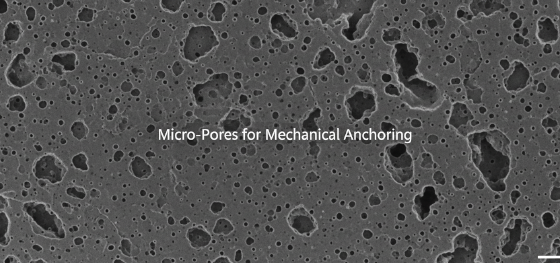
Permanent adhesion in electroplating plastic parts is a byproduct of controlled surface erosion. Unlike metals, which are naturally conductive and receptive to ionic bonding, plastics are inert insulators. To bridge this gap, Jucheng Precision technicians utilize a chromic acid etching bath to "interrogate" the surface of the plastic. In an ABS part, the acid selectively attacks the butadiene rubber nodules, dissolving them and leaving behind a honeycomb-like network of microscopic pits. These craters serve as "Mechanical Anchors." When the first layer of electroless nickel or copper is deposited, it flows into these pits, effectively "rooting" the metal into the plastic matrix. Without this micro-textured foundation, the metal layer would merely sit on the surface, ready to peel off at the first thermal shock. We monitor our etch rates with surgical precision, ensuring the pits are deep enough for bonding but not so aggressive that they compromise the structural modulus of the part wall. We don't just "dip" parts; we engineer a nanometer-scale interlocking geometry that ensures your chrome finish is as permanent as the part itself.
Material Hierarchy: Why ABS and PC/ABS Rule the Plating Tank
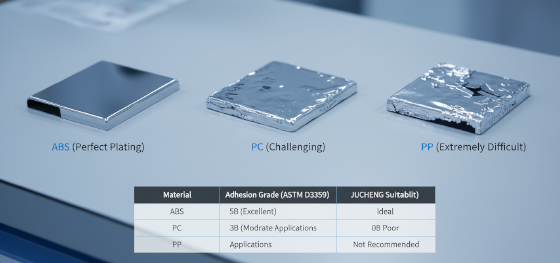
Chemical compatibility dictates the "Success Ceiling" of a plated part. While many Injection molding materials can technically be plated, Acrylonitrile Butadiene Styrene (ABS) remains the undisputed king. The reason lies in the butadiene. Because ABS is a multi-phase polymer, the butadiene nodules act as the perfect sacrificial lambs during the etching phase, creating the ideal porosity for metal anchoring. Other plastics, like Polypropylene (PP) or Nylon, are too chemically resistant or lack the sacrificial phases needed for reliable bonding, often resulting in "Plate-Out" failures where the metal simply won't stick. Jucheng Precision recommends specialized plating-grade ABS or PC/ABS blends for high-requirement applications like automotive door handles or plumbing fixtures. Below is the comparative matrix used by our engineers to guide material selection for plated hardware:
| Substrate | Adhesion Strength | Surface Clarity | Thermal Stability |
|---|---|---|---|
| Plating-Grade ABS | Excellent (9.0+ N/cm) | Superior | Moderate (95°C) |
| PC/ABS Blend | Good (7.0 - 8.5 N/cm) | High | High (115°C) |
| Pure Polycarbonate | Poor (Needs Primer) | High | Excellent (140°C) |
Sequence of Sovereignty: From Electroless to Electrolytic
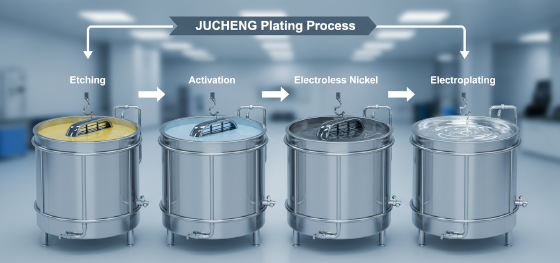
Transforming an insulator into a conductor is a multi-stage chemical marathon. After etching, Jucheng Precision technicians utilize a palladium catalyst to "sensitize" the plastic surface. This is followed by the most critical phase: "Electroless Plating." Unlike traditional electroplating, which requires an electrical current, electroless deposition utilizes a chemical reduction reaction to coat the part in a thin, uniform layer of nickel or copper. This layer provides the electrical conductivity needed for the subsequent electrolytic steps. Once conductive, we can apply thicker layers of bright copper for leveling, semi-bright nickel for corrosion resistance, and finally, the decorative chrome or gold topcoat. Each of these layers has a specific job: copper fills microscopic molding scratches, nickel provides the structural "spine," and chrome provides the hardness and iconic luster. We monitor the "Current Density" in every tank to ensure the metal thickness is uniform across complex 3D geometries, preventing the "Dog-Bone" effect where metal builds up excessively on sharp corners.
Dimensional Combat: Managing Thermal Expansion Deltas

Physics-induced failure is the ghost that haunts the electroplating plastic parts industry. The fundamental challenge is the "CTE Mismatch"—the Coefficient of Thermal Expansion. Plastic expands and contracts up to ten times more than metal when exposed to heat or cold. If a plated part is left in a hot car, the ABS core tries to expand, but the rigid chrome shell refuses to move. This internal combat creates massive shear stress at the interface. If the molding process left high residual stresses or if the etching was insufficient, the part will develop "Blisters" or "Peels." Jucheng Precision solves this through "Thermodynamic Balance." We utilize specialized mold-temperature controllers to ensure the plastic cools slowly and evenly, minimizing the internal energy stored in the part. We also suggest "Plating-Friendly" geometry—avoiding large flat surfaces and incorporating generous radii—to distribute these thermal stresses more effectively. We don't just provide a finish; we provide an integrated engineering solution that survives the real-world thermal cycle.
JUCHENG Protocol: Integrated Molding and Plating Control

Manufacturing excellence at Jucheng Precision is built on the foundation of single-source accountability. Fragmentation in the supply chain—using one vendor for molding and another for plating—is a recipe for failure. When a plate blisters, the plater blames the molder for high stress, and the molder blames the plater for poor chemistry. Jucheng Precision eliminates this "Vendor Finger-Pointing" by housing our elite CNC mold shop, scientific injection bays, and integrated plating lines under a single roof. We audit every stage of the electroplating plastic parts lifecycle, from the sub-micron accuracy of the S136 mold steel to the 48-hour salt spray test in our QC lab. Our IATF 16949 and ISO 9001 certified workflows ensure your metallic prototypes meet the most rigorous automotive and medical standards. Stop gambling your brand's luxury identity with fragmented suppliers. Not sure if your part geometry is suitable for a mirror-chrome finish? Upload your 3D CAD file to JUCHENG today for a Free DFM Review. Our experts will identify Injection molding surface finishes bottlenecks before they cost you money, ensuring your transition to production is seamless, brilliant, and retail-ready.

