


Perceived quality in hardware commercialization is won or lost in the first ten microns of a part's surface. Industrial designers spend thousands of hours sculpting the perfect curvature of a vehicle dashboard or a high-end consumer gadget, but without a sophisticated haptic identity, even the most expensive resin feels like a cheap experiment. In the uncompromising landscape of Injection molding surface finishes, the mold tech texture standard serves as the primary architect of brand authority. Originating from the global leadership of Mold-Tech (a Standex Engraving brand), this system provides a library of thousands of validated grains—ranging from natural leather and exotic woods to advanced geometric micro-patterns. Jucheng Precision operates as a high-fidelity execution house, utilizing both traditional chemical etching and cutting-edge 5-axis laser technologies to ensure your hardware possesses the exact tactile soul and specularity required for market dominance.

Establishing a luxury haptic interface requires moving beyond generic sandblasting. Amateurs often settle for a simple matte "vapor hone" finish, only to find the texture inconsistent across a large production run. Professional mold tech texture application is a surgical process that alters the molecular surface of the tool steel to create a permanent, repeatable grain. This process does not just improve aesthetics; it manages surface energy, reduces light reflection, and provides the "Grippiness" required for ergonomic handheld devices. Jucheng Precision eliminates manufacturing doubt by performing a comprehensive texture-specific DFM audit on every project, ensuring your draft angles are mathematically aligned with the depth of the chosen grain. This guide deconstructs the physics of chemical etching versus laser engraving and the strategic benefits of leveraging the Mold-Tech library to secure high-yield, premium hardware.
Chemical Photo-Etching: The Legacy of Acid and Light
Digital Sovereignty: The Rise of 5-Axis Laser Engraving
Strategic Utility: Hiding Scratches and Molding Defects
Geometric Guardrails: Draft Angles for Deep Grains
JUCHENG Protocol: Physical Verification and Sample Plaques
Chemical Photo-Etching: The Legacy of Acid and Light

Traditional application of a mold tech texture relies on the centuries-old logic of photo-chemical etching. This process involves coating the polished mold steel with a light-sensitive "Photo-Resist" film. A film negative containing the desired grain pattern—such as an automotive leather or a geometric sand—is wrapped around the internal geometry of the tool and exposed to ultraviolet light. The areas not protected by the resist are then subjected to an acid bath, which eats away the steel at a controlled depth (typically between 0.025mm and 0.150mm). This method is remarkably effective for "Natural" grains because the random acid erosion creates an organic variation that the human eye perceives as authentic. However, chemical etching struggles with extreme 3D curvatures; the film negative can stretch or wrinkle in deep corners, leading to "Grain Distortion." Jucheng Precision manages this legacy process with extreme manual care, utilizing master technicians to hand-mask complex shut-off surfaces, ensuring the acid only touches the intended A-side cosmetic faces while protecting the precision of your parting lines.
Digital Sovereignty: The Rise of 5-Axis Laser Engraving

Modern haptic design has entered the era of digital absolute. When a project requires perfectly repeating geometric patterns, such as a precision-mapped mesh on a high-fidelity speaker or a technical honeycomb on a drone chassis, chemical etching is insufficient. Jucheng Precision utilizes advanced 5-axis laser engraving centers to apply mold tech texture directly from a 3D CAD file. This technology eliminates the need for films and acids. A high-frequency fiber laser vaporizes the tool steel layer-by-layer, creating grains with sub-micron consistency across the most punishing 3D contours. Laser texturing solves the "distortion" problem of chemical etching; the 5-axis motion ensures the laser beam is always perpendicular to the surface, maintaining a uniform depth regardless of the part's geometric complexity. This "Digital Sovereignty" allows us to create multi-layered textures—where a fine matte grain is overlaid with a larger structural pattern—providing a depth of field and a "cool-to-the-touch" luxury feel that defines the next generation of consumer electronics and medical devices.
Strategic Utility: Hiding Scratches and Molding Defects

Operational efficiency is a hidden byproduct of textured surfaces. Glossy, polished plastics are the ultimate critics of Injection molding defects. A single weld line, a minor sink mark, or a trace of "blush" near the gate becomes an instant rejection on a high-gloss part. mold tech texture acts as a "Cosmetic Insurance Policy." By scattering light randomly across the surface, the grain masks minor volumetric contractions and flow hesitations, effectively increasing your first-pass yield and reducing scrap rates. Furthermore, textured surfaces are significantly more durable in the field. A VDI or MT textured housing hides the "Micro-Scratches" caused by daily use, such as sliding a device across a table. While a polished surface looks aged and worn within months, a textured part maintains its retail-ready appearance for the entire product lifecycle. We don't just "beautify" your parts; we engineer their surface to survive the messy reality of human interaction, protecting your brand's reputation long after the initial unboxing.
Geometric Guardrails: Draft Angles for Deep Grains

Ejection failure is the unavoidable price of under-drafting. Every mold tech texture consists of microscopic "peaks and valleys" etched into the steel. During the cooling phase, the plastic shrinks onto these features, creating a massive mechanical interlock. If your design features vertical sidewalls with zero taper, the part is physically trapped. When the ejection pins fire, they will physically "Shear" the texture off the part, resulting in ugly "Drag Marks" and shiny streaks that ruin the cosmetic intent. Manufacturing sovereignty mandates the "Draft-to-Grain" rule. For every 0.025mm (0.001") of texture depth, Jucheng Precision requires an additional 1.5 degrees of draft angle over the baseline. A heavy leather grain (MT-11050) might require a staggering 5 to 7 degrees of taper to release without scuffing. Our engineers utilize automated DFM audits during the RFQ stage to flag these risks. We calculate the "Interlock Force" of your chosen MT grain and suggest geometry tweaks to ensure your parts glide out of the tool with surgical precision.
JUCHENG Protocol: Physical Verification and Sample Plaques
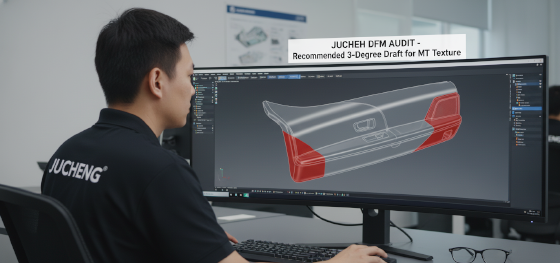
Manufacturing excellence at Jucheng Precision is built on the foundation of physical certainty. We don't rely on digital screen renders to decide your part's haptics; we provide physical "Texture Plaques." Our facility maintains a comprehensive library of Mold-Tech reference cards, allowing you to touch, feel, and conduct scratch-tests on the actual grain before we ever touch your production mold. This physical audit prevents the "Aesthetic Shock" that often occurs when a digital pattern is translated into a physical part. We provide full material lot traceability and Ra inspection reports for every textured batch, ensuring your high-requirement parts meet the strict haptic standards of the automotive and medical industries. Stop gambling your brand identity with vendors who treat texture as an afterthought. Not sure if your draft angles support an MT-11000 finish? Upload your 3D CAD file to JUCHENG today for a Free DFM Review. Our experts will identify the optimal Injection molding surface finishes for your budget, ensuring your transition from prototype to mass production is seamless, beautiful, and retail-ready.

