


Choosing the ideal structural skin for outdoor equipment, telecommunication cabinets, or marine hardware requires a rigorous balance between material acquisition costs and mechanical longevity. Performing an analytical galvanized vs stainless steel sheet metal comparison reveals two fundamentally different metallurgical defenses against moisture oxidation. While carbon sheets protect themselves using a sacrificial barrier, standard stainless alloys achieve their elite corrosion resistance through integrated chemical alloying.

Specifying the incorrect metal state can quickly lead to unexpected field failures and high warranty expenses. A low-cost outdoor enclosure deployed in a highly corrosive marine environment can rust along its laser-cut edges within months, whereas choosing premium high-nickel alloys for a simple indoor bracket can unnecessarily inflate your manufacturing bill of materials. Selecting the optimal steel profile secures both your hardware durability and your market margins.
Let's examine how zinc coating compares to chromium oxide passivation, analyze the real-world lifespans of both materials in atmospheric conditions, and review the cost-performance thresholds to determine when you must upgrade your raw metal selection.
content:
Zinc Coating vs. Chromium Oxide Layer
Lifespan and Maintenance in Outdoor Environments
Budget Considerations: When to Upgrade to Stainless
Get the Right Material for Your Project at JUCHENG
FAQ: Critical Questions About Galvanized vs Stainless Steel Sheet Metal
Zinc Coating vs. Chromium Oxide Layer
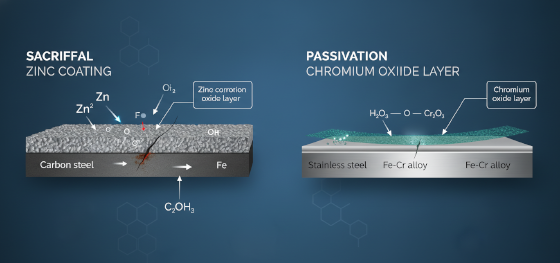
How do the chemical defenses of galvanized steel and stainless steel differ?
Galvanized steel relies on a sacrificial zinc coating that corrodes first to protect the steel, while stainless steel contains chromium to build a permanent, self-healing chromium oxide passive barrier.
These distinct chemistries provide completely different levels of corrosion resistance under cyclic environmental stress. On galvanized steel, the protective zinc layer is chemically more active than the underlying iron core. This galvanic potential gap initiates cathodic protection, where the zinc actively sacrifices itself to block oxygen from oxidizing the bare steel, even along cut edges.
In contrast, stainless steel is an alloy containing a minimum of 10.5% chromium. This integrated chromium reacts with surrounding oxygen to build an incredibly stable, microscopic passive layer across the entire metal structure. If the surface is physically scratched or worn, the chromium instantly reforms this oxide barrier, delivering permanent protection without depleting any sacrificial layers.
Lifespan and Maintenance in Outdoor Environments

How do the outdoor service lives of zinc-coated and stainless steel compare?
Galvanized steel can survive up to 30 years depending on the zinc thickness, while stainless steel easily surpasses 50 years even in harsh marine and industrial environments.
Analyzing galvanized vs stainless steel sheet metal in real-world weathering environments reveals distinct degradation curves. Galvanized carbon steel performs beautifully in mild climates, but its sacrificial zinc layer slowly dissolves over time when exposed to acidic rain or industrial sulfur dioxide, gradually reducing its barrier thickness.
If your hardware is deployed in a high-saline coastal atmosphere, standard zinc coatings will degrade rapidly due to chloride-pitting. Stainless steel (particularly molybdenum-enriched Grade 316) is virtually impervious to chloride pitting, maintaining a pristine, rust-free profile with zero structural maintenance, making it the superior choice for coastal telecommunication frames and marine infrastructure.
Budget Considerations: When to Upgrade to Stainless

What factors determine when to invest in premium stainless steel?
Upgrade to stainless steel when the application requires long-term sterile hygiene, high operating temperatures, exposure to strong acids, or an exceptionally long service life that justifies the higher initial cost.
To optimize your manufacturing budget, understanding the raw material cost-to-performance ratio is critical. While galvanized steel is highly economical and has a low starting price, its zinc coating can limit post-processing, as welding zinc releases toxic fumes and requires extensive grinding and re-coating of the joints to prevent local rusting.
Stainless steel carries a higher upfront cost but completely eliminates the need for zinc-related grinding and anti-rust spray treatments. It can be welded directly and blended to a seamless, golden-satin finish, saving significant manual labor in high-end cosmetic assemblies. Here is a direct physical comparison:
| Selection Variable | Galvanized Carbon Steel | Austenitic Stainless Steel (SUS304) |
|---|---|---|
| Raw Material Cost | Low (Highly cost-effective) | High (Premium material cost) |
| Weldability & Cleanup | Difficult (Requires zinc removal and exhaust) | Excellent (No coating removal needed) |
| Mechanical Strength | Moderate (Standard carbon steel limits) | High (Excellent yield strength and fatigue resistance) |
| Best Environment | Mild outdoor, HVAC ducts, indoor structural frames | Marine, food processing, medical clean-rooms |
Get the Right Material for Your Project at JUCHENG
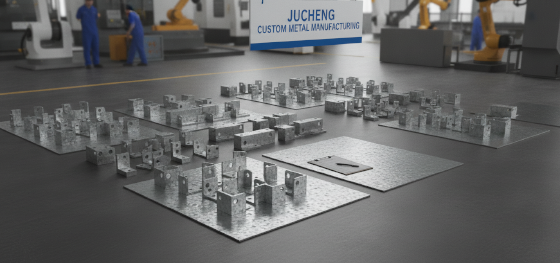
How does JUCHENG help you select and fabricate the ideal corrosion-resistant alloy?
We operate high-power fiber laser cutters and high-tonnage press brakes, utilizing specialized material-specific tooling to prevent steel cross-contamination.
Selecting the correct sheet metal material ensures that your completed hardware maintains its target structural integrity under its specific operating conditions. JUCHENG integrates advanced shearing, punching, and forming systems into our full-service production lines. This allows us to transition your 3D models into fully finished, durable assemblies with extreme dimensional accuracy.
We operate an IATF 16949 and ISO 13485 certified environment, utilizing over 150 high-performance manufacturing machines to execute complex stamping and forming runs. Our engineering team provides a 24-hour free DFM analysis to check your CAD models, checking bend tolerances and clearances before production. Supported by our no MOQ policy and rapid delivery guarantee, we manage your project from initial flat pattern cutting to final packaging and assembly.
FAQ: Critical Questions About Galvanized vs Stainless Steel Sheet Metal
How do you prevent galvanic corrosion when joining galvanized steel to stainless steel?
Joining these metals directly in a damp environment creates a galvanic cell where the zinc coating acts as an anode and corrodes rapidly to protect the stainless steel. To prevent this, we insert non-conductive nylon washers or apply protective zinc-rich coatings to physically isolate the different metals.
Does the zinc coating on galvanized steel peeling off during tight press bends?
High-quality galvanized sheets (such as SGCC) feature outstanding zinc-iron bonding that can handle standard press brake bending. However, bending galvanized steel past its recommended limits or utilizing worn tooling can crack and peel the coating. We prevent this by matching our bending dies precisely to the sheet gauge and maintaining generous bending radii.
What causes carbon cross-contamination on stainless steel parts, and how do we prevent it?
Carbon contamination occurs when stainless steel comes into contact with carbon steel tools, such as grinding wheels or press dies. The carbon particles embed in the stainless surface, disrupting the chromium passive layer and initiating rapid rust. We prevent this by isolating our stainless steel area and utilizing dedicated, certified iron-free grinding discs on our finishing line.
How does JUCHENG help engineers choose between galvanized vs stainless steel sheet metal?
Our technical department analyzes your product's operating conditions during our complimentary DFM stage. If your enclosure experiences mild outdoor weather or standard indoor moisture, we specify cost-effective galvanized steel; if your assembly must handle aggressive chemical washes or saltwater exposure, we recommend upgrading to high-precision stainless steel.

