


Sourcing millions of tiny, complex metal components puts massive pressure on a hardware startup's tooling budget. Paying for CNC machine time to carve microscopic threads into thousands of individual electronic housings will instantly bankrupt a project. Engineers desperately need a manufacturing method that delivers perfectly formed, near-net-shape metal parts in seconds, rather than minutes. Executing the die casting process with the right equipment setup is the only commercially viable answer for these massive production volumes. However, selecting the wrong machine architecture will throttle your factory output and dramatically increase your unit costs.

Waiting for robotic ladles to scoop liquid metal through the air is a slow, inefficient process when you are trying to manufacture small parts rapidly. Exposing molten alloys to atmospheric oxygen also invites hidden defects and slag inclusions. Operating directly from our Shenzhen precision manufacturing hub, Jucheng Precision eliminates these bottlenecks completely by keeping the injection pump permanently underwater.
Scaling global consumer electronics requires speed that traditional heavy metallurgy simply cannot provide. Utilizing the hot chamber die casting process fundamentally rewrites the rules of factory throughput. Let's break down exactly how submerging the mechanical pump directly into boiling metal doubles your production speed, protects your expensive tooling, and delivers the ultimate competitive advantage for high-volume supply chains.
content:
The Gooseneck Advantage: Pumping Metal Underwater
Material Limits: Why Zinc and Magnesium Excel?
Tooling Lifespan: Stopping Thermal Shock and Saving Budgets
Technical Data: Benchmarking Cycle Speeds
JUCHENG Hub: Shenzhen's Turnkey Hardware Arsenal
FAQ: Honest Answers About Maintenance and Alloy Purity
The Gooseneck Advantage: Pumping Metal Underwater
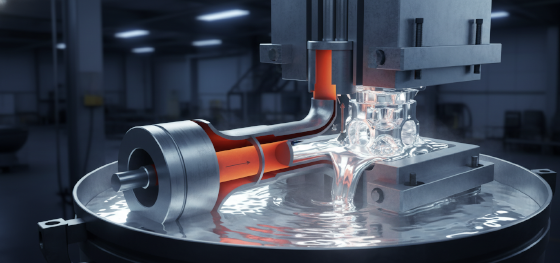
How do factories eliminate air exposure during metal injection?
By submerging the entire hydraulic gooseneck pump directly into the crucible of molten metal, allowing the system to suck up liquid and shoot it into the mold without ever breaking the surface.
Watching this closed-loop system operate is incredible. Because the plunger and the nozzle are already sitting inside the boiling metal, there is zero transfer time. The plunger retracts, the chamber floods with fresh liquid alloy instantly, and it fires immediately into the waiting steel die.
Eliminating the robotic pouring ladle literally cuts the cycle time in half. This speed means we can produce thousands of complex fiber-optic housings or camera chassis in a single factory shift. For procurement teams, this extreme output velocity translates directly into significantly lower per-unit manufacturing costs and much faster global shipping turnarounds.
Material Limits: Why Zinc and Magnesium Excel?

Why can't you run aggressive alloys like aluminum through a submerged hydraulic pump?
High-heat metals will chemically attack and dissolve the submerged steel gooseneck mechanism within hours, requiring factories to strictly limit this process to lower-melting-point alloys.
Trying to force the wrong metal into this specific machine architecture will destroy the factory equipment instantly. This is why the hot chamber die casting process is universally reserved for specialized, low-heat materials. Selecting the zinc die casting process allows engineers to design incredibly intricate, micro-precision parts because liquid zinc flows like water, filling microscopic mold details flawlessly.
When lightweighting is the absolute priority for portable electronics, deploying the magnesium die casting process through these submerged machines yields incredible results. Magnesium offers exceptional electromagnetic interference (EMI) shielding, making it the premier choice for protecting sensitive motherboards inside slim, rigid metal laptop chassis without melting the internal machine pumps.
Tooling Lifespan: Stopping Thermal Shock and Saving Budgets

How does running lower temperature alloys save your massive tooling budget?
Injecting metals at 800 degrees Fahrenheit instead of 1,200 degrees drastically reduces the brutal thermal shock on the steel mold, allowing a single tool to produce over a million parts before wearing out.
Replacing a worn-out hardened steel mold costs tens of thousands of dollars. Unlike the cold chamber die casting process, which constantly batters the steel die with extreme, aggressive heat, submerged systems operate in a much more relaxed thermal environment.
This massive extension in tooling lifespan changes the financial math for hardware scaling. You pay for the initial NRE tooling cost once, and that single block of H13 steel will confidently spit out flawless zinc gears, lock cylinders, and heat sinks for years without suffering from heat-checking or surface cracking.
Technical Data: Benchmarking Cycle Speeds

Procurement teams must align their supply chain demands with the physical speed limits of the factory equipment. The comparison matrix below clearly illustrates the overwhelming throughput advantage of closed-loop submerged pumping systems.
| Production Metric | JUCHENG Hot Chamber (Zinc/Mag) | Standard Cold Chamber (Aluminum) |
|---|---|---|
| Average Cycle Time | 15 to 20 Seconds (Extremely Fast) | 35 to 45 Seconds (Moderate) |
| Expected Tool Life | 1,000,000+ Shots | 100,000 Shots (Requires rebuilds) |
| Wall Thickness Limits | Ultra-thin capable (down to 0.5mm) | Standard thin walls (down to 1.5mm) |
| Secondary Machining Need | Very Low (Excellent net-shape) | High (Frequent CNC threading needed) |
Eliminating secondary CNC machining operations is the ultimate goal for B2B procurement. Because liquid zinc flows so perfectly inside these specialized machines, we can often cast functional internal threads directly into the part, allowing your assembly line to skip the tapping station entirely.
JUCHENG Hub: Shenzhen's Turnkey Hardware Arsenal
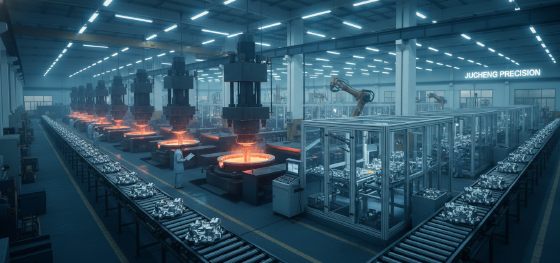
Why do global electronics brands trust Jucheng Precision's automated machines?
Because we maintain a massive fleet of high-speed submerged presses capable of running 24/7, backed by aggressive internal quality control that prevents dimensional drift during million-part production runs.
Relying on a supplier with only one or two machines is a massive supply chain risk. If their gooseneck fractures, your production stops for weeks. We operate our Shenzhen precision manufacturing hub with extreme redundancy, ensuring your high-volume orders are never delayed by single-point equipment failures.
Stop paying for slow machine cycles and constantly replacing worn-out steel molds. Send your complex, micro-precision CAD files to our engineering team today for a free DFM review. We will optimize your design for our high-speed submerged systems and deliver flawless hardware at unbeatable production velocities.
FAQ: Honest Answers About Maintenance and Alloy Purity

Can the submerged gooseneck pump be used for different types of metal?
No. To prevent cross-contamination of alloys, factories typically dedicate specific machines entirely to zinc or entirely to magnesium production runs.
Why does zinc hardware feel so heavy compared to aluminum?
Zinc is an incredibly dense metal. While it weighs significantly more than aluminum, that density provides excellent vibration dampening and a highly premium, solid feel.
Is it easy to apply chrome plating or paint to these parts?
Yes. Zinc alloys produced in these high-speed machines have incredibly smooth, non-porous surfaces that accept electroplating and automotive paints perfectly with minimal surface prep.
What happens if the internal submerged pump gets clogged?
The machine must be stopped and the heavy steel gooseneck must be physically hoisted out of the boiling crucible for maintenance, which is why we proactively rebuild our pumps before they fail.

