


Watching your CNC machining costs explode because you are trying to cut complex geometries out of solid metal blocks is a painful reality for scaling startups. Milling parts one by one is fine for a handful of prototypes, but the moment your purchase order hits five thousand units, you hit a massive financial wall. Engineering teams desperately need a way to produce thousands of identical, high-strength metal components without paying for hours of machine time on every single piece. Utilizing the die casting process remains the absolute gold standard for achieving near-net-shape metal hardware at commercial volumes.
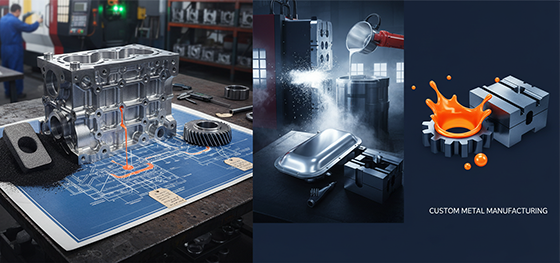
Throwing liquid metal into a steel cavity sounds simple until you actually try to manage the violent physics involved. Trapped air causes hidden porosity, and poor thermal management ruins your dimensional tolerances. I have seen procurement managers reject entire shipping containers of parts because hidden air bubbles destroyed their expensive CNC cutting tools during secondary threading operations. Operating from our Shenzhen precision manufacturing hub, Jucheng Precision tackles these metallurgical nightmares head-on.
Current [2026] hardware designs demand thinner walls, lighter weights, and zero failure rates in the field. Sourcing reliable metal components means deeply understanding how different injection speeds and crucible setups affect your specific alloy. This comprehensive guide breaks down the core machinery, the critical cooling phases, and the exact material strategies you need to master before investing in heavy steel production tooling.
content:
The Baseline: What Actually Happens Inside the Machine?
Process Flow: Dissecting the Injection and Cooling Cycle
Pressure Types: High, Low, and Squeeze Dynamics
Core Equipment: Beating the Melting Point Limitations
Alloy Selection: Aluminum, Zinc, and Magnesium Strategies
Manufacturing Alternatives: Why Ditch the Sand Molds?
JUCHENG Hub: Shenzhen's Advanced Metallurgical Center
FAQ: Honest Answers About Tooling Life and Porosity
The Baseline: What Actually Happens Inside the Machine?

How do you turn a block of raw aluminum into a complex automotive part in seconds?
By forcing molten non-ferrous metal into a custom-machined hardened steel mold cavity under extreme hydraulic pressure, freezing the liquid instantly into a highly precise solid shape.
Forging metal takes brutal force, and CNC milling wastes massive amounts of raw material. Injecting liquid metal offers a brilliant shortcut. You essentially pay the heavy engineering cost upfront to cut a perfect reverse-image of your part into a block of H13 tool steel. Once that die is loaded into the press, the machine churns out identical, highly durable parts every few seconds.
Medical device housings, heavy-duty automotive transmission cases, and complex heatsinks rely completely on this technology. You achieve incredibly tight tolerances and smooth surface finishes directly out of the mold, drastically reducing the amount of post-machining required before final assembly.
Process Flow: Dissecting the Injection and Cooling Cycle

What are the critical phases of a successful metal injection cycle?
The system relies on five distinct phases: die preparation, high-speed injection, intense thermal cooling, mechanical ejection, and finally, the automated trimming of excess flash.
Looking closely at a detailed die casting process diagram reveals exactly how complex the internal plumbing of these massive steel molds really is. The liquid metal must travel through a intricate network of runners and gates to fill every tiny corner of your design before it starts to freeze. If the metal freezes too early, you get defective parts with massive holes in them.
Executing the die casting process steps correctly requires absolute discipline on the factory floor. Our operators spray precise amounts of release agents onto the hot steel cavity before every single shot to prevent the liquid metal from welding itself to the tool.
Managing the thermodynamics is arguably the hardest part. Perfecting the die casting process cooling phase dictates your entire production speed. We drill complex water lines directly through the steel tool blocks. Pumping chilled water through these lines rapidly pulls the heat out of the molten metal, dropping your cycle time and preventing the part from warping as it solidifies.
Pressure Types: High, Low, and Squeeze Dynamics
Does all metal casting require massive hydraulic injection rams?
No. While high-pressure systems dominate thin-walled consumer parts, heavy structural components often utilize low-pressure or gravity-fed systems to eliminate internal air turbulence.
When you need a thin, lightweight drone chassis, the high pressure die casting process is the absolute king. The hydraulic ram slams the liquid metal into the mold at incredible speeds, forcing it to fill walls as thin as 1.5 millimeters before the metal cools. The downside is that this violent speed traps microscopic air bubbles inside the part.
Manufacturing heavy automotive wheels requires a completely different approach. Utilizing the low pressure die casting process pushes the molten metal upward into the mold very slowly. This gentle, anti-gravity fill completely prevents air from mixing with the liquid, resulting in a denser, structurally superior part that can withstand extreme road impacts.
Some applications require pure brute strength. The gravity die casting process relies simply on the weight of the metal itself to fill permanent iron molds, which is perfect for incredibly thick, heavy pipe fittings. For military-grade strength, the squeeze die casting process acts like a hybrid between casting and forging, applying massive hydraulic pressure as the metal freezes to crush any remaining microscopic voids.
Core Equipment: Beating the Melting Point Limitations
Why can't you run all metal alloys through the exact same injection machine?
Because metals with high melting points, like aluminum, will literally melt and dissolve the internal steel pumping mechanisms if they are kept constantly submerged in the liquid holding furnace.
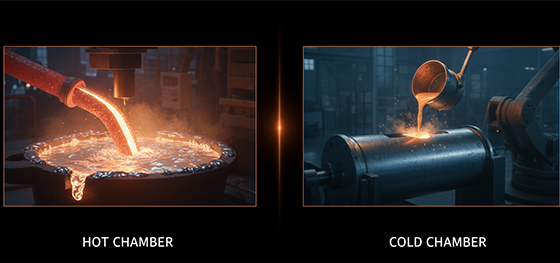
Running the cold chamber die casting process is mandatory for aggressive metals. A robotic ladle scoops the glowing liquid aluminum out of a separate holding furnace and pours it into a cold steel cylinder just seconds before the plunger fires. This protects the machine's internal parts from being destroyed by the extreme heat.
Softer metals like zinc melt at much lower temperatures. This allows factories to use the incredibly fast hot chamber die casting process. The machine's entire injection pump, called a gooseneck, sits permanently submerged in a pot of liquid metal. It sucks the metal in and shoots it into the mold automatically, doubling the production speed compared to cold chamber setups.
Porosity remains the universal enemy of all these machines. Air gets trapped inside the mold cavity when the metal rushes in. Jucheng Precision completely solves this by deploying the advanced vacuum die casting process. We suck all the oxygen out of the steel mold milliseconds before the metal injects, delivering ultra-dense, void-free parts suitable for critical aerospace applications.
Alloy Selection: Aluminum, Zinc, and Magnesium Strategies

Picking the right metal dictates your entire tooling budget and part lifespan. Jucheng Precision actively helps engineering teams select the perfect metallurgical profile. The table below breaks down the primary commercial options.
| Metal Alloy Family | Key Engineering Advantage | Required Machine Type | Tooling Lifespan |
|---|---|---|---|
| Aluminum (A380, ADC12) | Excellent strength-to-weight, high thermal conductivity. | Cold Chamber Only | 100,000 Shots (High heat wear) |
| Zinc (Zamak 3, 5) | Incredible precision, easiest to plate and paint. | Hot Chamber | 1,000,000+ Shots (Low heat wear) |
| Magnesium (AZ91D) | Lightest structural metal, excellent EMI shielding. | Hot or Cold Chamber | 500,000 Shots |
The aluminum die casting process dominates the automotive sector because it sheds heat beautifully, making it perfect for LED lighting housings and engine blocks. However, the high melting point slowly erodes the expensive steel molds over time.
If you are designing tiny, complex locking mechanisms or high-end cosmetic electronics covers, the zinc die casting process is vastly superior. The liquid zinc flows like water, capturing microscopic details and allowing the steel tool to last nearly forever without wearing out. For laptops and high-end camera bodies where every gram matters, the magnesium die casting process delivers the ultimate lightweight, dent-resistant armor.
Manufacturing Alternatives: Why Ditch the Sand Molds?
Is it ever cheaper to pour metal into a handmade sand mold instead of buying a steel tool?
Only for extreme low-volume prototyping or massive engine blocks; sand molds produce very rough surfaces and require heavy CNC machining to achieve functional tolerances.
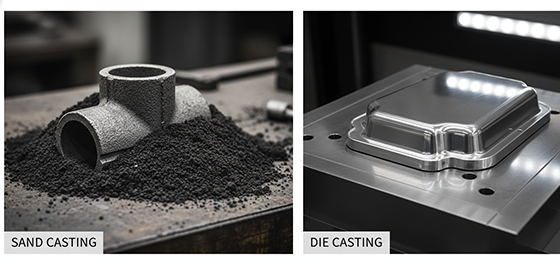
Startups often get confused by the different casting methodologies available. Debating sand casting vs die casting process always comes down to your production volume. Sand casting requires you to break and destroy the mold for every single part you make. It is a slow, messy, manual process that leaves your parts looking like they were buried in dirt.
Once your hardware moves past the Beta phase, you must transition to steel tooling. High-pressure injection delivers a beautiful, smooth finish right out of the machine. This drastically reduces the hours your supplier spends grinding and polishing the metal before painting, saving you a fortune in secondary labor costs.
JUCHENG Hub: Shenzhen's Advanced Metallurgical Center

Why partner with Jucheng Precision for your global metal production?
Because we control the entire lifecycle under one roof, utilizing advanced casting presses alongside 150+ CNC machines to deliver finished, fully threaded hardware straight to your assembly line.
Receiving raw cast parts that still need to be drilled, tapped, and powder-coated by three different vendors is a supply chain nightmare. If a threaded hole fails quality control, the machine shop blames the casting factory for hidden air bubbles. You get stuck paying for the scrap.
Operating out of our massive Shenzhen precision manufacturing hub, we crush this liability. We melt the metal, shoot it under a vacuum to eliminate porosity, and immediately load it into our 5-axis Mazak units for high-tolerance surface milling. Stop dealing with messy vendor handoffs. Send your 3D models to our engineering team today for a free DFM analysis and secure a flawless bridge to production.
FAQ: Honest Answers About Tooling Life and Porosity
What causes the ugly blister marks on painted die-cast parts?
Trapped microscopic air bubbles inside the metal expand when the part is baked in a paint curing oven, causing the surface to blister and pop. We prevent this using advanced vacuum extraction.
How long does it take to machine a hardened steel die casting mold?
Depending on part complexity, engineering and cutting a heavy H13 tool steel mold typically requires 3 to 6 weeks before first article inspection (FAI) samples are ready.
Can you cast metal parts with internal undercuts or hollow cavities?
Yes, but it requires designing the steel tool with complex hydraulic sliding cores and side-actions that pull out of the way before the part is ejected.
Why do thick metal casting walls constantly suffer from sink marks?
Because thick sections cool much slower than thin walls. As the liquid core freezes and shrinks, it pulls the outer skin inward. We fix this by coring out thick areas during the DFM phase.

