


Mechanical longevity depends entirely on the hidden pillars of your internal geometry. While exterior surfaces command the attention of industrial designers, the functional reality of an assembly is dictated by its fastening points. In the rigorous world of high-pressure manufacturing, a poorly conceived injection molding boss design is a ticking time bomb. A boss—the cylindrical protrusion intended to house a self-tapping screw or a threaded brass insert—is under constant mechanical siege from the moment a fastener is engaged. If the wall thickness is insufficient, the boss shatters under hoop stress. If the base is too thick, the aesthetic exterior of your part is marred by visible "Sink Marks" that suggest a lack of manufacturing maturity. Navigating this delicate balance between structural rigidity and thermodynamic cooling is the cornerstone of professional Injection molding design. At Jucheng Precision, we recognize that a boss is not just a hole; it is a structural anchor that must withstand the torque of a factory assembly line and the vibration of a product's lifecycle.
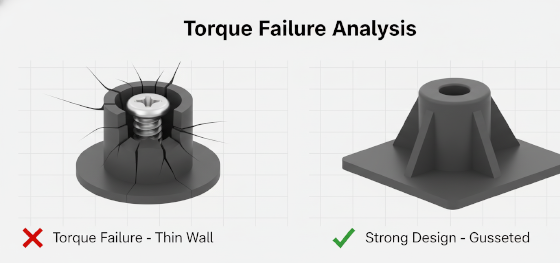
Manufacturing sovereignty requires an uncompromising approach to assembly physics. Engineers often overlook the "Hoop Stress" generated when a metal screw expands a plastic cylinder. Jucheng Precision eliminates these "Field Failures" by enforcing strict DFM (Design for Manufacturing) standards on every boss feature within your 3D CAD files. We interrogate the ratio of outer diameter to inner diameter, ensuring the polymer matrix has enough mass to resist splitting without triggering cooling bottlenecks. This guide deconstructs the geometry of sizing, the strategic placement of gussets, and the necessity of base isolation to ensure your parts are as rugged internally as they are beautiful externally. We provide the manufacturing insurance needed to ensure your screws stay tight and your cosmetic faces stay flat.
Sizing Physics: Mastering OD/ID Ratios for Strength
Sink Mark Pathology: Preventing Base-Level Deformation
Structural Support: The Logic of Gussets and Ribs
Fastening Methodology: Self-Tapping vs. Threaded Inserts
JUCHENG Protocol: Validating Assembly fitment
Sizing Physics: Mastering OD/ID Ratios for Strength
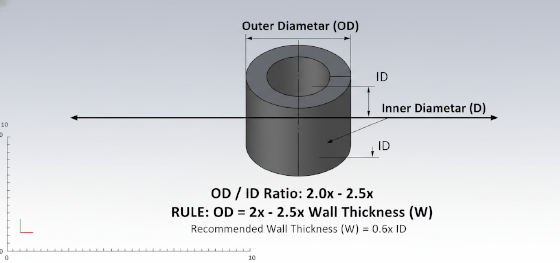
Geometric stability in injection molding boss design begins with the fundamental ratio of outer diameter (OD) to inner diameter (ID). The hole (ID) is dictated by your fastener choice, but the surrounding wall must be engineered to resist expansion. As a universal rule of thumb, the OD of a boss should be 2.0 to 2.5 times the ID. For instance, a hole for an M3 screw requiring a 2.5mm ID should possess an OD of at least 5.0mm. This 2:1 ratio provides the necessary bulk to prevent the plastic from "Hoop Splitting" when the screw threads bite into the material. However, if your design utilizes high-viscosity resins like Polycarbonate, Jucheng Precision often recommends a 2.5:1 ratio to accommodate the increased internal stresses. If the boss wall is too thin, the material will white-stress or fracture during the first assembly. If it is too thick, you create a "Thermal Hot Spot" that slows down the entire mold cycle and risks internal voids. We balance these dimensions to ensure maximum fastener engagement without sacrificing production speed.
Sink Mark Pathology: Preventing Base-Level Deformation
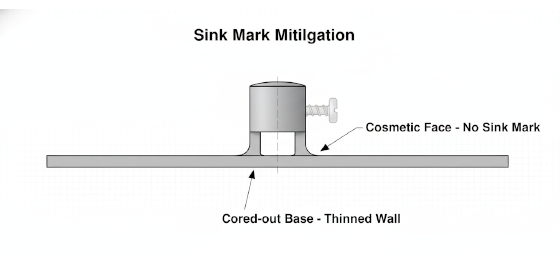
Thermal mass at the junction of a boss and a main wall is the primary catalyst for cosmetic rejection. Because a boss is inherently a vertical pillar attached to a horizontal plane, the intersection often becomes the thickest part of the entire component. This "Heavy Intersection" acts as a heat reservoir, cooling significantly slower than the surrounding thin walls. As the core contracts, it pulls the aesthetic "A-side" surface inward, resulting in a visible depression or "Sink Mark." To combat this, elite injection molding design utilizes "Cored-Out" or "Isolated" boss bases. Jucheng Precision engineers often propose a recessed groove around the base of the boss on the internal side. This maneuver ensures the wall thickness at the junction remains between 50% and 60% of the main wall thickness. By removing this excess material, we synchronize the cooling rates, ensuring your exterior surfaces remain perfectly flat and free of the visual shadows that signal a low-quality molding process.
Structural Support: The Logic of Gussets and Ribs
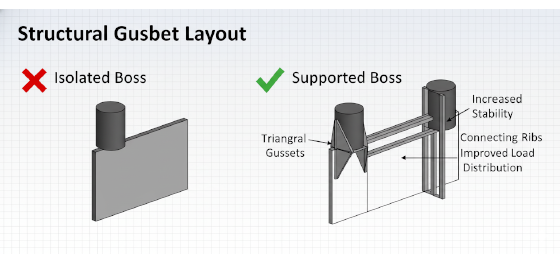
Cantilevered bosses are prone to mechanical leverage failure. If a tall, slender boss stands isolated in the center of a housing, it acts as a lever arm. During assembly or shipping, lateral forces can easily snap the boss off at its base. Professional injection molding boss design mandates the use of "Gussets"—small triangular reinforcement ribs that connect the boss to the main floor or an adjacent sidewall. These gussets distribute lateral loads over a wider area, preventing stress concentration at the root. We recommend at least two gussets per boss, ideally oriented 180 degrees apart. For bosses located near a sidewall, connecting the boss directly to the wall with a rib is the most effective way to ensure stability. However, caution must be used: the thickness of these supporting ribs must follow the 60% rule to prevent additional sink marks. Jucheng Precision designs support structures that breathe, allowing for rapid resin flow into the boss during injection while providing the structural spine needed for ruggedized use.
Fastening Methodology: Self-Tapping vs. Threaded Inserts
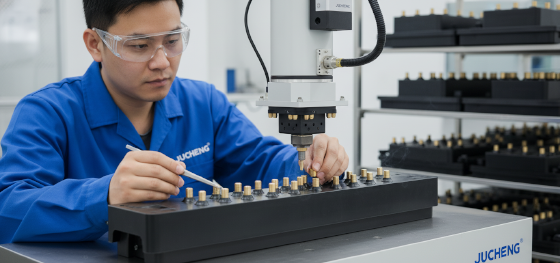
Material fatigue dictates the choice between direct-screw engagement and metal-threaded inserts. For products that will be assembled once and never opened, self-tapping screws are a cost-effective solution. However, self-tapping puts immense stress on the boss walls and can only survive one or two disassembly cycles before the plastic threads strip. If your project is a medical diagnostic device or an industrial controller that requires regular maintenance, injection molding boss design must incorporate brass threaded inserts. These inserts are heat-staked or ultrasonically welded into the boss after molding. This creates a metal-to-metal interface that can survive hundreds of assembly cycles. Jucheng Precision specializes in "Insert Molding" and secondary assembly services. We optimize the ID of your bosses to provide the exact interference fit required for your specific insert brand (e.g., Dodge or Spirol), ensuring the pull-out and torque-out resistance meets your engineering requirements. We turn fragile plastic holes into industrial-grade mounting points.
JUCHENG Protocol: Validating Assembly fitment
Manufacturing excellence at Jucheng Precision is built on the foundation of the integrated assembly audit. We don't just "mold and ship"; we verify that your assembly intent is physically achievable. When you upload a CAD file to our facility, our veteran engineers perform a comprehensive audit of every boss feature. We check for "Ejector Pin Interference" to ensure the boss can be safely removed from the tool, and we analyze "Gate Placement" to ensure the resin doesn't create weak knit-lines inside the boss wall. Our facility, housing over 150 CNC machines and specialized assembly bays, provides the one-stop-shop capability your project deserves. Stop worrying about stripped screws and sunken surfaces. Not sure if your wall thickness is uniform or your draft angles are correct? Upload your 3D CAD file to JUCHENG today for a Free DFM Review. Our experts will catch tooling issues before they cost you money, ensuring your assembly is robust, profitable, and ready for the field.

