


Structural rigidity without the penalty of thermal mass is the ultimate goal of advanced polymer engineering. Designers often mistakenly equate "strength" with "thickness," assuming that a solid, heavy plastic wall will withstand mechanical loads better than a delicate one. In the harsh environment of high-pressure manufacturing, this assumption leads to catastrophic cosmetic failures and excessive production costs. Thick walls act as thermal insulators that trap heat, extending cooling times and triggering massive "Sink Marks" that ruin Class-A surfaces. Achieving the necessary flexural modulus while maintaining a uniform, thin wall requires the strategic application of plastic ribs for injection molding design. Ribs are the mechanical "girders" of the plastic world. When engineered correctly, they provide a 10x increase in stiffness with virtually zero increase in cycle time. Jucheng Precision recognizes that ribbing is not just a structural addition; it is a thermal management strategy. Mastering the delicate ratios of rib geometry is the only way to deliver ruggedized housings that remain aesthetically flawless.
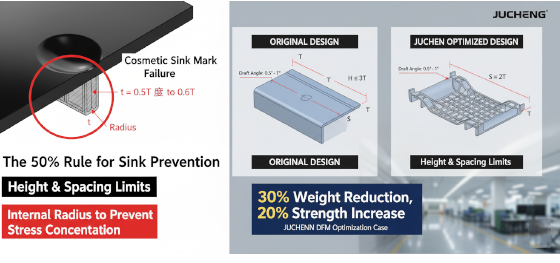
Eliminating the "Sink Mark Crisis" starts with a dispassionate look at volumetric shrinkage. As molten plastic cools inside a mold, it contracts. If the intersection where a rib meets a wall is too bulky, the cooling core pulls the surface inward, creating a visible depression on the exterior face. Jucheng Precision eliminates these "Manufacturing Scars" by enforcing strict DFM (Design for Manufacturing) standards on every client STEP file. We calculate the "Root Thickness" of every rib to ensure it never creates a thermal bottleneck. This guide deconstructs the 50% rule, the physics of height-to-spacing ratios, and the necessity of internal radii to ensure your Injection molding design survives the stress of real-world use.
The Golden Ratio: Mastering the 50-60% Thickness Rule
Geometric Limits: Managing Height and Spacing Ratios
Ejection Physics: Draft Angles and Stress-Relief Fillets
JUCHENG Protocol: Optimizing Rib Networks for Strength
The Golden Ratio: Mastering the 50-60% Thickness Rule
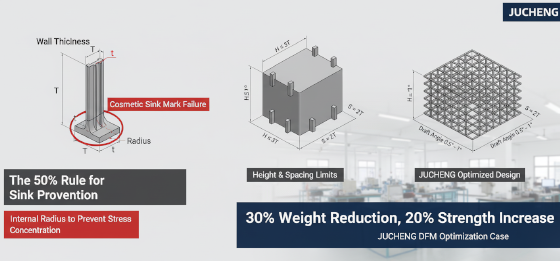
Material accumulation at the junction of a rib and a wall is the primary cause of cosmetic rejection. To prevent sink marks, the base of the rib must be significantly thinner than the main nominal wall. A professional plastic ribs for injection molding design mandates that the rib thickness at the root should be between 50% and 60% of the wall thickness. For instance, if your main housing wall is 2.5mm thick, the rib should ideally be no more than 1.5mm at its thickest point. If you exceed this 60% threshold, the thermal mass at the intersection takes significantly longer to cool than the surrounding areas. The resulting differential shrinkage pulls the aesthetic surface inward, creating a permanent visual defect that no amount of painting can hide. For high-gloss materials like Polycarbonate, Jucheng Precision often recommends dropping this ratio to 40% to ensure absolute surface perfection. Adhering to these strict ratios ensures that your structural enhancements remain invisible to the end user.
Geometric Limits: Managing Height and Spacing Ratios
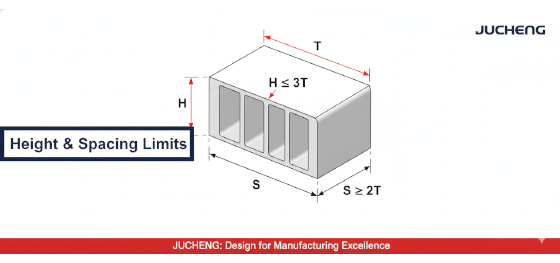
Stability is a byproduct of proportion, not sheer size. While it is tempting to design tall ribs to maximize rigidity, height brings its own set of manufacturing hazards. A tall rib is difficult to fill and even more difficult to eject from the mold. Standard engineering guidelines for plastic ribs for injection molding design suggest a maximum height of three times the nominal wall thickness (3T). A rib taller than this is prone to "bending" or "wobbling" during the injection process as the molten front hits it. Furthermore, the spacing between ribs is critical for thermal management. Placing ribs too close together creates a "Steel Bottleneck" in the mold—a thin blade of metal that cannot be adequately cooled. Jucheng Precision engineers enforce a minimum spacing of two times the wall thickness (2T) between parallel ribs. This ensures that the mold steel has enough mass to conduct heat away from the plastic, preventing localized hot spots that lead to warping and prolonged cycle times. We design rib networks that breathe, allowing for rapid cooling and high-yield production.
Ejection Physics: Draft Angles and Stress-Relief Fillets

Mechanical friction is the enemy of a clean demolding cycle. Because ribs are thin features that the plastic shrinks *onto* during cooling, they tend to grip the mold core with extreme tenacity. Without a proper taper, the part will stick, or the ejection pins will cause stress-whitening as they struggle to overcome the vacuum seal. Every plastic ribs for injection molding design must incorporate a minimum draft angle of 0.5 degrees per side, though 1.0 degree is preferred for deeper features. Additionally, sharp corners at the base of a rib are sites for "Stress Concentration," where mechanical failure typically begins. We mandate the inclusion of internal radii (fillets) at the root of the rib—typically 25% of the main wall thickness. These fillets serve a dual purpose: they smooth the flow of molten plastic into the rib during injection and distribute mechanical loads across a wider area during the part’s service life. By filleting the base, you transform a fragile junction into a robust structural arch.
JUCHENG Protocol: Optimizing Rib Networks for Strength

Engineering excellence at Jucheng Precision is defined by our ability to turn heavy, inefficient designs into high-performance structural masterpieces. We don't just execute your geometry; we optimize your "Strength-to-Weight" ratio. When you submit a CAD file to our facility, our veteran engineers perform a comprehensive structural audit. If we see a solid block that will sink and warp, we propose a "Cored-Out" alternative reinforced by an optimized rib network. Our facility operates over 150 CNC machines to ensure that these complex rib cavities are cut into the tool steel with sub-micron accuracy. We bridge the gap between "Digital Intent" and "Physical Reality," ensuring your parts are rigid enough for the laboratory but light enough for your budget. Stop over-designing with thick walls. Not sure if your wall thickness is uniform or your draft angles are correct? Upload your 3D CAD file to JUCHENG today for a Free DFM Review. Our experts will catch tooling issues before they cost you money, ensuring your mass production launch is stable, profitable, and structurally sound.

