


Manufacturing budgets evaporate at the mercy of lateral geometry. In the uncompromising physics of high-pressure manufacturing, the simplest design is one that can be pulled straight out of a two-piece steel block. However, modern functional requirements—snap-fits, side-ports, and internal threads—frequently introduce features that defy the primary axis of ejection. These obstructions are known as undercut injection molding challenges. An undercut is any geometric feature that prevents a part from being ejected via a simple "straight-pull" motion. Failing to identify and optimize these features during the initial Injection molding design phase is a strategic error that triggers a cascade of unnecessary expenses. Every undercut necessitates a "Side-Action" mechanism—precision-machined sliders, lifters, or unscrewing cores that add thousands of dollars to your tooling invoice and weeks to your lead time. Jucheng Precision recognizes that undercuts are the "Profit Killers" of hardware development. Our engineering mission is to identify these obstructions and deploy surgical DFM (Design for Manufacturing) hacks to eliminate them, ensuring your project remains agile and your capitalization remains lean.
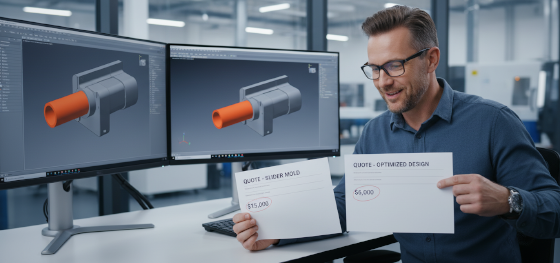
Mastering the "Great Escape" requires an engineer to visualize the mold not as a static object, but as a dynamic machine. When a molten polymer solidifies around a protrusion or within a cavity that sits perpendicular to the mold opening, that part is physically shackled to the steel. Jucheng Precision eliminates this "Tooling Debt" by providing a comprehensive audit of your 3D CAD files. We look for opportunities to transform complex side-actions into simple vertical shut-offs. This guide deconstructs the mechanical cost of undercuts, the physics of sliders and lifters, and the specific geometric maneuvers used by elite designers to keep their molds simple, fast, and profitable. We provide the manufacturing insurance needed to prevent your design from becoming a financial liability before the first shot is even fired.
Geometric Traps: Defining the Undercut Obstruction
Financial Friction: The True Cost of Sliders and Lifters
Design Hacks: Eliminating Undercuts with Pass-Through Cores
Parting Line Sovereignty: Shifting the Split to Save Capital
JUCHENG Strategy: Optimizing for Two-Plate Efficiency
Geometric Traps: Defining the Undercut Obstruction
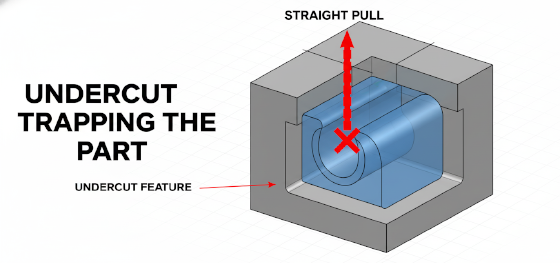
Visualizing the "Line of Draw" is the first step in identifying undercut injection molding risks. Imagine the mold as two hands coming together to clap. Anything that sits in the path of those hands opening or closing is a "straight-pull" feature. However, if you design a hole in the side of a plastic box for a USB port, or an internal snap-fit tab that hooks inward, those features are "trapped" by the mold steel. They exist at an angle—usually 90 degrees—to the direction of the mold's movement. During the ejection cycle, the part cannot move upward because the steel forming the hole is still inside the plastic. This geometric stalemate must be resolved by introducing a moving component that "clears the path" before the part is pushed out. These features are essentially mechanical anchors that refuse to let go, turning a simple manufacturing process into a high-precision mechanical puzzle. Every time you add a side-hole or a complex internal latch, you are implicitly requesting a more complex machine, which is why undercuts are the single largest variable in mold pricing.
Financial Friction: The True Cost of Sliders and Lifters
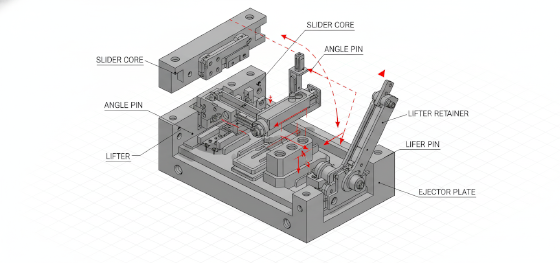
Precision mechanisms inside a mold are capital-intensive investments. To resolve an undercut injection molding feature, toolmakers typically deploy "Sliders" or "Lifters." A slider is a block of steel that moves laterally, driven by an angled "horn pin" as the mold opens. A lifter is an internal rod that moves at an angle during ejection to clear an internal undercut. These are not simple blocks of metal; they are high-tolerance assemblies that require lubrication, precise alignment, and regular maintenance. A single slider can add $2,000 to $5,000 to the cost of a tool. Furthermore, these mechanisms occupy physical space in the mold base, often forcing you to use a larger, more expensive mold frame. They also introduce "Flash Risks," as molten plastic under 15,000 psi of pressure will try to find the seams where the slider meets the cavity. At Jucheng Precision, we track the "Complexity Multiplier" of your design. We understand that a part with four sliders is not just four times more expensive; it is significantly more difficult to cool and slower to cycle, driving up your per-part price along with your tooling debt.
Design Hacks: Eliminating Undercuts with Pass-Through Cores

Engineering cleverness often trumps mechanical complexity. One of the most effective ways to handle undercut injection molding is through the "Pass-Through Core" or "Sliding Shut-off" hack. Imagine a snap-fit latch on the internal wall of a housing. Instead of using an expensive lifter to form the hook, a designer can create a small hole (a "window") in the floor of the part directly beneath the hook. This allows a stationary vertical "core" from the opposite side of the mold to reach through the part and form the underside of the snap. During ejection, the part simply pulls away from this stationary steel column. You have achieved the functional snap-fit without a single moving part in the mold. At Jucheng Precision, our DFM team looks for these opportunities in every medical and consumer electronics project. While this hack introduces a small visual opening in the part, it can save tens of thousands of dollars on a multi-cavity production run. We turn "undercuts" into "shut-offs," providing the same functional performance at a fraction of the tooling capitalization.
Parting Line Sovereignty: Shifting the Split to Save Capital

Strategic alignment of the parting line can "naturalize" an undercut. Many designers default to a flat parting line because it is easier to visualize in CAD. However, if a part features an angled protrusion or a side-hole, shifting the parting line to a non-planar path or tilting the entire part within the mold can often bring those features into the "straight-pull" direction. This is the domain of advanced Injection molding design. By orienting the part at a 15-degree tilt, a once-problematic side-action might become a simple feature that clears the mold halves naturally. Jucheng Precision engineers utilize 3D simulation to rotate your design in virtual space, searching for the "Zero-Slider Orientation." While this might make the mold halves slightly more complex to machine on our 5-axis CNC machines, the cost is far lower than maintaining a dynamic side-action mechanism. We prioritize "Static Complexity" over "Dynamic Complexity," ensuring your tool is robust, reliable, and significantly more affordable.
JUCHENG Strategy: Optimizing for Two-Plate Efficiency
Manufacturing excellence at Jucheng Precision is defined by our commitment to fiscal DFM. We don't just "accept" an expensive design; we challenge it for the benefit of your ROI. Our facility, housing over 150 CNC machines and specialized Rapid Tooling bays, is optimized for high-efficiency two-plate molds. When you upload a CAD file to our facility, our veteran mold designers perform a forensic audit of every undercut injection molding feature. We propose minor geometry modifications—such as adding a "Bypass" or "Rib-Swap"—that can keep your tool simple and your lead time short. Stop paying a "Complexity Tax" that you don't need. Not sure if your wall thickness is uniform or your draft angles are correct? Upload your 3D CAD file to JUCHENG today for a Free DFM Review. Our experts will catch tooling issues before they cost you money, helping you bridge the gap to production with the most profitable manufacturing strategy possible.

