


Thermodynamic balance dictates the structural and cosmetic success of every thermoplastic component. In the volatile environment of high-pressure manufacturing, the speed at which a polymer transitions from a molten state to a rigid solid is entirely dependent on its cross-sectional geometry. If a design features arbitrary fluctuations in thickness, the resulting "thermal chaos" triggers a cascade of failures: sink marks on cosmetic faces, internal voids in load-bearing sections, and catastrophic warpage that makes assembly impossible. Navigating these risks requires an uncompromising adherence to a professional injection molding wall thickness strategy. At Jucheng Precision, we recognize that thickness is not merely a dimension; it is a critical variable that governs cycle time, material cost, and part longevity. Every millimeter added beyond the engineering requirement is not just wasted material—it is a thermal insulator that traps heat, slows production, and invites mechanical instability. Mastering the golden rule of uniformity is the first step toward achieving Injection molding design sovereignty.
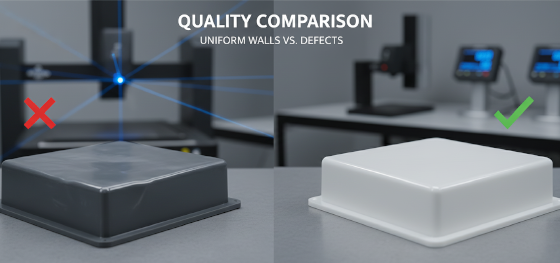
Consistency in wall geometry acts as the primary defense against the physics of shrinkage. As molten plastic hits the chilled steel walls of a mold, the outer skin freezes instantly while the core remains fluid. If one section of a part is twice as thick as an adjacent wall, the thick core continues to shrink long after the thinner sections have solidified, pulling the surface inward and creating the dreaded "sink mark." Jucheng Precision eliminates these "Biological Defects" by implementing a rigorous DFM audit on every client STEP file. We look for "Heavy Zones" that will cause cooling bottlenecks and suggest cored-out geometries that maintain strength without the thermal mass. This guide provides the material-specific data and geometric transition rules needed to ensure your parts emerge from the tool flat, functional, and flawless.
The Golden Rule: Why Uniformity Triumphs Volume
Material Matrix: Recommended Thickness by Resin Type
Transition Physics: Engineering Ramps and Radii
Defect Pathology: Voids, Sink, and Warpage
JUCHENG Protocol: Advanced Moldflow Validation
The Golden Rule: Why Uniformity Triumphs Volume
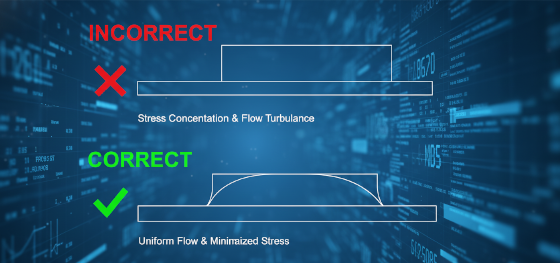
Designers often operate under the false assumption that "Thicker is Stronger." In the world of injection molding, this is a dangerous fallacy. A thick wall (exceeding 4mm) is an efficient thermal insulator; it prevents the core of the part from cooling, which significantly extends the cycle time and increases the part price. More critically, non-uniform walls create "Differential Shrinkage." When a part cools unevenly, internal residual stresses are "baked" into the polymer matrix. These stresses eventually resolve themselves by warping the part as it is ejected from the tool. injection molding wall thickness must remain consistent—ideally within a 10% variance across the entire geometry. By maintaining a uniform wall, you ensure that the plastic flows at a constant velocity and pressure, filling the cavity evenly and cooling at a synchronized rate. This consistency is the secret to producing high-precision enclosures that snap together perfectly every time, without the need for secondary heat-staking or manual straightening.
Material Matrix: Recommended Thickness by Resin Type
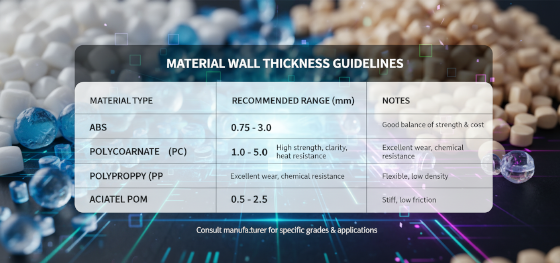
Polymer viscosity and flow characteristics dictate the "Minimum and Maximum" limits of your design. A high-flow material like Nylon can fill ultra-thin walls that would cause a "Short Shot" (incomplete fill) in a viscous material like Polycarbonate. Below is the technical reference matrix used by Jucheng Precision engineers to evaluate injection molding wall thickness during the RFQ phase:
| Material Type | Recommended Wall (mm) | Maximum Wall (mm) |
|---|---|---|
| ABS (General Purpose) | 1.2mm - 3.0mm | 3.5mm |
| PC (Polycarbonate) | 1.0mm - 4.0mm | 5.0mm |
| PA (Nylon / Polyamide) | 0.8mm - 3.0mm | 3.2mm |
| PP (Polypropylene) | 0.8mm - 3.5mm | 4.0mm |
| PEEK (High Performance) | 1.5mm - 3.0mm | 3.5mm |
Pushing these boundaries invites risk. Designing a part with 0.5mm walls in PC will likely lead to "Burning" (gas traps) as the machine is forced to use excessive pressure to fill the cavity. Conversely, designing a 6mm ABS wall will result in massive internal "Voids"—air pockets formed as the material shrinks away from itself in the center. Adhering to these ranges ensures a stable production process with minimal scrap rates.
Transition Physics: Engineering Ramps and Radii
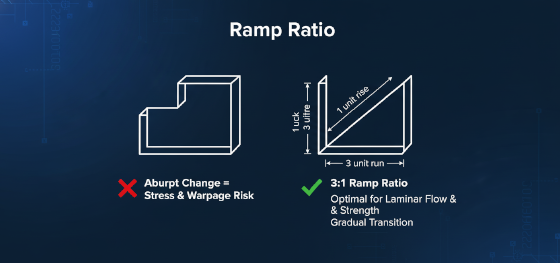
Abrupt geometric shifts are the catalysts for stress concentration failure. If your design must transition from a 2mm wall to a 3mm wall to accommodate a mounting feature, never use a "Step" or a sharp 90-degree corner. Molten plastic behaves like a fluid; it hates sharp turns and sudden volume changes. A sharp step creates a "Flow Hesitation," where the material momentarily slows down, leading to weak "Knit Lines" and localized stress points. A professional injection molding design mandates a "Ramp Transition" with a minimum 3:1 ratio. This means for every 1mm of thickness change, the ramp should span 3mm in length. This gradual taper maintains laminar flow, ensuring that the plastic remains under constant pressure and fills the cavity smoothly. Furthermore, always incorporate generous internal and external radii (fillets) at these transitions to distribute mechanical loads and prevent the part from cracking during use. We treat every transition as a highway for plastic flow, optimizing the path to eliminate turbulence.
Defect Pathology: Voids, Sink, and Warpage

Understanding the "Why" behind failure is essential for DFM mastery. The pathology of bad injection molding wall thickness is easy to diagnose. "Sink Marks" occur on the surface opposite a thick rib or boss because the heavy section takes longer to cool and pulls the surface inward. "Internal Voids" occur in thick sections because the outer skin solidifies first, trapping a shrinking core that literally pulls itself apart, creating a vacuum bubble. Most dangerously, "Warping" occurs when thin sections cool and shrink faster than thick ones, pulling the part into a "Potato Chip" shape once it is ejected from the tool. Jucheng Precision prevents these pathologies by advocating for "Cor-Out" designs. Instead of a thick, solid block, we recommend designing a thin-walled shell reinforced by strategic ribbing (which we will cover in the next guide). This approach provides the same structural rigidity with a fraction of the thermal mass, resulting in faster cycle times and better dimensional sovereignty.
JUCHENG Protocol: Advanced Moldflow Validation
Engineering excellence at Jucheng Precision is built on the foundation of predictive simulation. We do not rely on "Trial and Error" at the injection press; we solve thickness issues in the digital realm. When you upload a CAD file to our facility, our veteran engineers utilize advanced Moldflow technology to simulate the entire filling and cooling cycle. We identify "Gate Freeze" issues and "Thermal Hot Spots" before the first block of steel is machined. Our integrated facility, housing over 150 CNC machines and elite injection bays, ensures that the wall optimizations we propose are executed with sub-micron fidelity. Stop guessing about your part's structural future. Not sure if your wall thickness is uniform or your draft angles are correct? Upload your 3D CAD file to JUCHENG today for a Free DFM Review. Our experts will catch tooling issues before they cost you money, ensuring your mass production launch is stable, profitable, and retail-ready.

