


Flexural failure is a design verdict that usually arrives within the first three seconds of a user's experience. In the high-stakes world of consumer packaging and medical enclosures, the ability to integrate a permanent, flexible joint between two rigid components is a masterpiece of material science. This is the domain of living hinge injection molding. A living hinge—a micro-thin bridge of plastic—is expected to survive thousands, or even millions, of bending cycles without a single molecular tear. Designers often mistakenly view this as a simple exercise in thinning out a wall. However, in the uncompromising environment of high-pressure manufacturing, a living hinge is a high-precision fluid valve. If the geometry is too thick, it cracks under tensile stress. If the gating is incorrect, the molecular chains never align, leading to instant brittle fracture. Navigating this delicate balance is the pinnacle of Injection molding design. At Jucheng Precision, we recognize that a successful hinge is not just about shape; it is about managing the molecular orientation of the polymer as it screams through a 0.3mm gap at twenty thousand pounds of pressure.
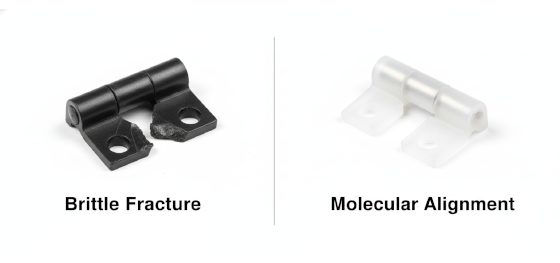
Manufacturing sovereignty in flexible joints requires an absolute rejection of brittle materials. Amateurs often attempt to design hinges in ABS or Polycarbonate, only to watch their prototypes shatter like glass upon the first opening. Jucheng Precision eliminates these "Product Recalls" by enforcing a strict material and geometric audit on every CAD file. We understand that the secret to flex life lies in the "Pre-Alignment" of the polymer matrix. This guide deconstructs the mandatory material choices, the physics of hourglass geometry, and the critical importance of gate placement to ensure your hinges don't just look functional—they survive the lifecycle of the product. We provide the manufacturing insurance needed to turn a fragile bridge into an indestructible mechanical link.
Material Logic: Why Polypropylene is the Only Contender
Geometric Precision: Mastering the Hourglass Profile
Fluid Logistics: Gating Strategy for Molecular Alignment
The First Bend Rule: Coining and Cold-Working the Resin
JUCHENG Protocol: Zero-Failure Hinge Production
Material Logic: Why Polypropylene is the Only Contender
Chemical compatibility dictates the "Life or Death" of a flexible joint. In living hinge injection molding, the material must possess extreme ductility and the ability to undergo significant strain without work-hardening into a brittle state. For ninety percent of all industrial applications, Polypropylene (PP) is the undisputed king. PP molecules are uniquely capable of realigning themselves under stress, creating a "Fibrous" structure that resists tearing. Polyethylene (PE) is a secondary choice, though it lacks the flexural modulus required for crisp lid closures. Materials like ABS, PC, and Nylon are strictly forbidden for living hinges; their crystalline or amorphous structures are too rigid, leading to immediate stress-whitening and snap-off. Jucheng Precision engineers partner with you to select the correct grade of "Random Copolymer" PP to ensure maximum clarity and flex life. We avoid filled resins (like talc-filled or glass-filled), as the fibers act as microscopic daggers that cut through the polymer chains during bending. By respecting the chemical limits of the resin, we ensure your hinge possesses the mechanical soul needed for a million cycles.
Geometric Precision: Mastering the Hourglass Profile
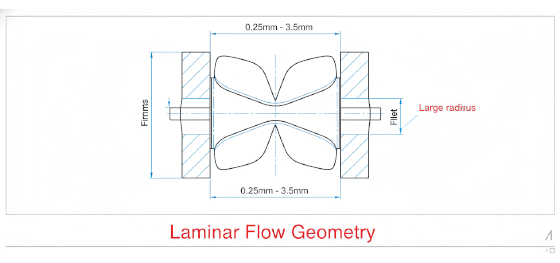
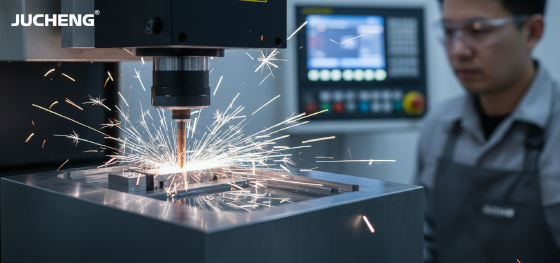
Thickness is the primary lever of flexural stress. If a hinge is too thick (exceeding 0.5mm), the outer fibers are stretched beyond their elastic limit when the hinge is closed, causing failure. If it is too thin (under 0.15mm), the plastic will "freeze-off" during injection, leading to a "Short Shot" where the mold never fully fills. Professional living hinge injection molding mandates a "Sweet Spot" between 0.2mm and 0.35mm. The most successful geometry is the "Hourglass" or "Tapered" profile. By thinning the hinge at its center and using large, generous radii (fillets) where it meets the main walls, you distribute the bending stress across a wider arc. This prevents localized "Stress Concentration" at the corners. Jucheng Precision technicians utilize sub-micron EDM (Electrical Discharge Machining) to cut these delicate hourglass cavities into the mold steel. We treat this 0.2mm gap as the most critical dimension in the entire tool, ensuring it is polished to a mirror finish to allow the molten PP to flow through without turbulence.
Fluid Logistics: Gating Strategy for Molecular Alignment
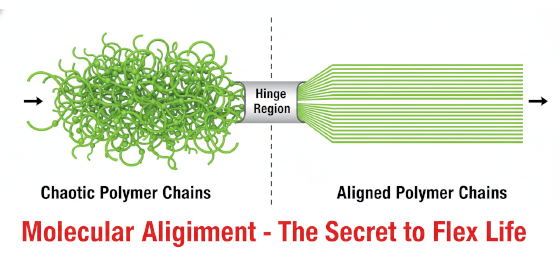
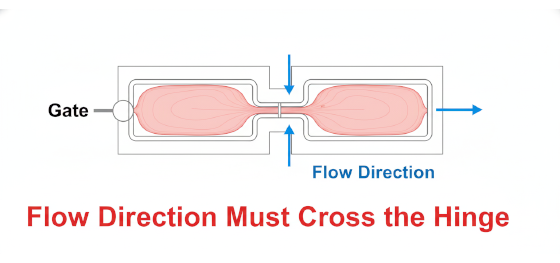
Molecular alignment is the secret to a "Living" hinge, and it is entirely dictated by gate placement. When molten plastic is squeezed through the narrow hinge cavity, the polymer chains are stretched out into long, straight lines—parallel to the direction of flow. This orientation is what gives the hinge its incredible tensile strength and flexibility. If the gate is placed poorly, two separate flow fronts might meet *at* the hinge, creating a "Knit Line" or "Weld Line." A weld line in a hinge is a death sentence; the part will fail instantly because the molecular chains are not continuous across the bridge. A professional Injection molding design mandates that the molten front must flow perpendicularly *across* the hinge from one side of the part to the other. At Jucheng Precision, we use Moldflow simulation to verify that the resin passes through the hinge area as a single, unified wave. This ensures the "Molecular Grain" is oriented in the direction of the bend, armoring the part against fatigue.
The First Bend Rule: Coining and Cold-Working the Resin
Performance is "Locked In" within the first sixty seconds of ejection. Even a perfectly designed hinge is vulnerable when it first leaves the tool. Professional operators follow the "Warm Bend" rule: the hinge should be folded while the part is still warm from the mold. This initial flex acts as a "Cold-Working" process, permanently orienting the molecules and significantly increasing the flex life. Some high-end applications utilize "Coining"—a process where the mold itself squeezes the hinge area while it's still molten to further reduce thickness and align the chains. Jucheng Precision implements these "Post-Molding" protocols on our assembly floor, ensuring every part is "Seasoned" before it reaches the client. If a hinge is allowed to cool completely in a flat position and then bent for the first time days later, the risk of stress-whitening increases by forty percent. We provide the manufacturing discipline needed to ensure your prototypes survive the most aggressive lifecycle testing in the consumer electronics and medical industries.
JUCHENG Protocol: Zero-Failure Hinge Production
Manufacturing excellence at Jucheng Precision is built on the foundation of high-precision tooling and material expertise. We don't just "cut hinges"; we engineer mechanical interfaces. Our facility, housing over 150 CNC machines and specialized micro-EDM bays, is optimized for the tight tolerances of living hinge injection molding. When you submit a CAD file to our facility, our veteran engineers perform a forensic audit of your hinge thickness and gating strategy. We propose minor geometry modifications—such as adding a "V-Groove" or shifting a gate—that can extend your product's flex life from hundreds to millions of cycles. Stop compromising with snap-off failures and poor material choices. Not sure if your wall thickness is uniform or your draft angles are correct? Upload your 3D CAD file to JUCHENG today for a Free DFM Review. Our experts will catch tooling issues before they cost you money, ensuring your hardware is robust, profitable, and ready for a lifetime of movement.

