


Dimensional rebellion occurs the moment a part escapes the rigid confinement of its steel tool. In the hyper-competitive world of high-precision hardware, there is no failure more frustrating than a part that fits the digital CAD borders perfectly but emerges from the mold in a "Potato Chip" shape. Injection molding warpage is essentially a physical manifestation of internal residual stresses resolving themselves after ejection. This bowing, twisting, or bending is not a random defect; it is a calculated reaction to thermodynamic imbalance. When one section of a part shrinks more than another, the resulting tension pulls the entire geometry out of alignment. Navigating the pathology of Injection molding defects requires moving beyond simple machine tweaks and entering the realm of "Stress Management." Jucheng Precision operates as a strategic engineering partner, utilizing advanced simulation and innovative cooling technologies to ensure your housings, chassis, and frames remain as flat and functional as the digital intent dictates.

Mastering part flatness requires a forensic interrogation of "Differential Shrinkage." Plastic is an insulator that undergoes significant volumetric change as it cools from a molten liquid to a solid polymer. If this contraction is not synchronized across the entire geometry, the part will literally fight its own structure until it finds a distorted equilibrium. warpage in injection molding is the price paid for failing to respect the laws of heat transfer and molecular orientation. Jucheng Precision eliminates these "Invisible Failures" by performing a surgical DFM audit and utilizing scientific cooling protocols before the first shot is ever fired. We interrogate wall transitions, gate placements, and cooling channel layouts to lock in dimensional sovereignty. This guide deconstructs the physics of cooling rates, the dangers of non-uniform walls, and the mechanical impact of fiber alignment to ensure your high-volume production remains profitable and precise.
Thermodynamic Chaos: Uneven Cooling and Thermal Gradients
Geometric Tension: Wall Thickness and Differential Shrinkage
Anisotropic Combat: Material Selection and Fiber Orientation
Tooling Innovation: The Power of Conformal Cooling
JUCHENG Protocol: Scientific Simulation for Zero Warp
Thermodynamic Chaos: Uneven Cooling and Thermal Gradients
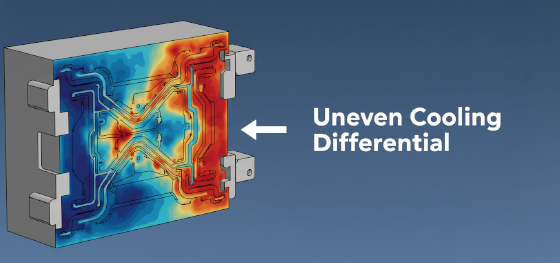
Heat management is the primary lever of dimensional control in the injection room. Injection molding warpage is most frequently a symptom of "Differential Cooling." If the core side of the mold is ten degrees hotter than the cavity side, the plastic touching the core will shrink more slowly than the plastic touching the cavity. This creates a thermal gradient across the thickness of the wall. As the part is ejected and the two sides reach ambient temperature, the side that stayed hotter longer will continue to contract, physically pulling the part toward it. This results in a bowed or "cupped" geometry. Amateurs often attempt to "fix" this by increasing the overall cooling time, but this only increases the part price without solving the fundamental delta in temperature. Jucheng Precision engineers utilize Moldflow analysis to visualize these "Thermal Hot Spots" during the tool design phase. We balance cooling circuits to ensure that every millimeter of the part hits the "Solidification Point" at the exact same moment. By synchronizing the thermal exit strategy, we neutralize the internal tensions before they can distort your design.
Geometric Tension: Wall Thickness and Differential Shrinkage
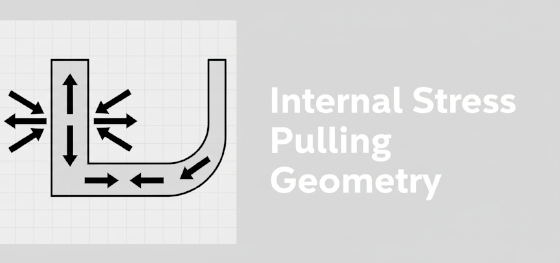
Structural instability is often a self-inflicted design wound. Non-uniform wall thickness is the silent architect of warpage in injection molding. When a part transitions from a 2mm wall to a 4mm wall, the thicker section acts as a thermal reservoir. It retains heat significantly longer than its adjacent thinner sections. Because shrinkage is a function of time and temperature, the thick section continues to pull on the already solidified thin walls. This internal "tug-of-war" is never won; it always results in the thin wall bending toward the heavy mass. Jucheng Precision enforces a strict "Uniformity Policy" during our DFM reviews. We suggest "Coring Out" heavy features and replacing them with a network of thin ribs to maintain rigidity without the thermal mass. By equalizing the "Cross-Sectional Area," we ensure that the entire part shrinks as a unified whole. This eliminates the "Asymmetrical Pull" that ruins the flatness of high-performance enclosures and industrial frames. We don't just mold your CAD; we optimize the physics of the geometry to ensure it remains dimensionally sovereign.
Anisotropic Combat: Material Selection and Fiber Orientation
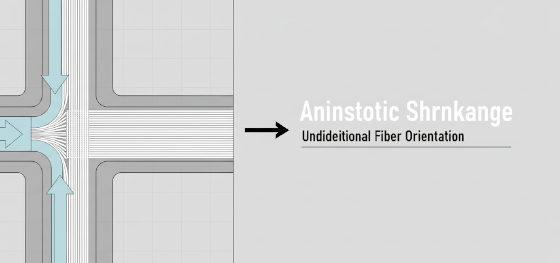
Molecular grain dictates the direction of structural failure in glass-filled polymers. When an engineer selects a 30% Glass-Filled Nylon for its high modulus, they inadvertently introduce the risk of "Anisotropic Shrinkage." As the molten plastic rushes through the cavity, the microscopic glass fibers align themselves like logs in a river—following the direction of flow. These fibers act as rigid reinforcement, preventing shrinkage in the "Flow Direction." However, in the "Cross-Flow Direction," there is no reinforcement, allowing the polymer to shrink significantly more. This radical difference in contraction rates across the X and Y axes is a primary catalyst for Injection molding warpage. Jucheng Precision manages this "Grain Effect" through strategic gate placement. We don't just "fill the part"; we engineer the flow path to ensure that fiber orientation is either randomized or aligned in a way that minimizes distortion. We utilize advanced simulation to predict "Fiber Trajectories," allowing us to reposition gates or add flow leaders to combat the warping effects of reinforced materials. We turn material science into a manufacturing advantage.
Tooling Innovation: The Power of Conformal Cooling
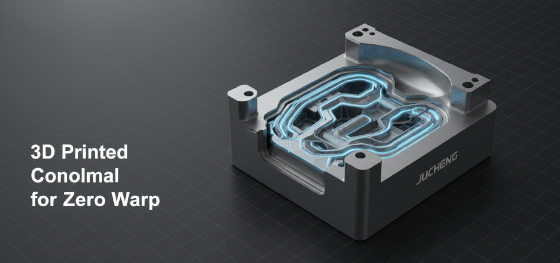
Breaking the limits of traditional machining allows for unprecedented flatness control. Traditional cooling channels are drilled in straight lines, often leaving "Thermal Blind Spots" in deep pockets or around complex bosses. These uncooled zones are breeding grounds for warpage in injection molding. Jucheng Precision remains at the forefront of tooling innovation by utilizing 3D-printed "Conformal Cooling" inserts. By employing Direct Metal Laser Sintering (DMLS), we can "grow" cooling channels that curve and wind within millimeters of the part's surface, perfectly following its geometry. This "Precision Quenching" allows us to pull heat from the most difficult-to-reach areas of a tool, ensuring that even a complex automotive air vent or a deep-walled medical housing remains perfectly flat and stable. While this advanced tooling carries an upfront premium, it pays for itself by slashing cycle times by 30% and virtually eliminating the scrap costs associated with warped components. We bridge the gap between "standard" and "superior," providing the thermal armor your project deserves.
JUCHENG Protocol: Scientific Simulation for Zero Warp
Engineering excellence at Jucheng Precision is built on the foundation of predictive manufacturing. We do not accept warpage as an occupational hazard; we treat it as a design problem to be solved in the digital space. When you submit a project to our facility, our veteran engineers perform a comprehensive "Warp Analysis" on your CAD file. We provide specific feedback—recommending a wall change here or a material switch there—to guarantee that your hardware arrives retail-ready. Our facility, housing over 150 CNC machines and elite injection bays, ensures that the complex thermal and geometric optimizations we propose are executed with absolute fidelity. Stop gambling your R&D budget on parts that arrive twisted and unusable. Not sure if your wall thickness is uniform or your material choice is optimal? Upload your 3D CAD file to JUCHENG today for a Free DFM Review. Our experts will identify Injection molding defects before they cost you money, ensuring your product launch is stable, profitable, and dimensionally perfect.

