


Cosmetic rejection in high-stakes hardware often centers on a single, subtle surface depression. Industrial designers spend months perfecting the specular reflection of a luxury consumer device or a medical monitor housing, only to find the final molded parts marred by rhythmic shadows located directly opposite internal ribs and bosses. These sink marks injection molding failures are not mere accidents of the machine; they are the physical manifestations of thermodynamic imbalance. In the uncompromising world of high-pressure manufacturing, plastic is an insulator that hates to cool evenly. When the core of a thick section remains molten long after the outer skin has solidified, the resulting volumetric contraction pulls the surface inward, creating a permanent visual scar. Navigating the pathology of Injection molding defects requires moving beyond simple machine adjustments and entering the domain of "Forensic DFM." Jucheng Precision operates as a strategic manufacturing clinic, identifying geometric "Hot Spots" in the digital phase to ensure your Class-A surfaces remain flat, crisp, and retail-ready.
Establishing a sink-free production run requires a dispassionate audit of the design-to-process relationship. Amateurs often attempt to "fix" sink by cranking up injection pressure, only to trigger secondary failures like flash or part-sticking. Real solutions exist in the geometry of the part and the scientific timing of the gate freeze. Jucheng Precision eliminates these manufacturing headaches by providing a complimentary, high-depth DFM review before a single block of P20 steel is cut. We interrogate the ratio of every rib, boss, and mounting feature to ensure they don't act as thermal reservoirs. This guide deconstructs the physics of contraction, the mandatory 50% rib rule, and the processing variables needed to keep your prototypes and mass-production batches dimensionally sovereign.
Physics of Contraction: Defining the Sink Path
Design Forensics: Mastering the 50% Rib Rule
Scientific Molding: Gate Freeze and Packing Dynamics
Polymer Pathology: Crystalline vs Amorphous Shrinkage
JUCHENG Protocol: Eliminating Geometric Hot Spots
Physics of Contraction: Defining the Sink Path
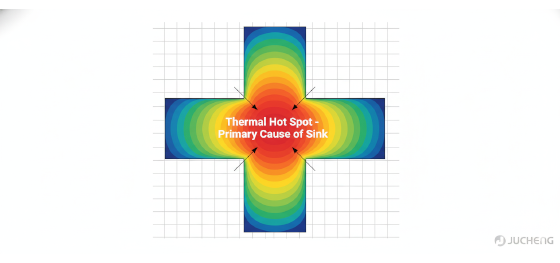
Volumetric change is an inescapable law of polymer thermodynamics. As molten plastic is injected into a chilled tool, it begins to lose energy and contract. If the part features a uniform wall thickness, this contraction happens globally and predictably. However, most functional designs require internal reinforcements like ribs or screw bosses. These features create "Heavy Intersections" where the volume of plastic is significantly greater than the nominal wall. This extra mass acts as a thermal insulator; the outer skin freezes against the mold steel almost instantly, but the internal "Hot Spot" remains fluid and expanded. As this hidden core finally cools and shrinks, it pulls on the solidified skin. Because the skin is still warm and ductile, it yields to this internal vacuum, sinking inward. The result is a visible dimple on the "A-side" cosmetic face. Understanding that sink marks injection molding is a symptom of "Differential Cooling" allows engineers to stop fighting the machine and start optimizing the geometry. We treat every intersection as a thermodynamic challenge, ensuring that no section of your part holds heat significantly longer than its neighbors.
Design Forensics: Mastering the 50% Rib Rule
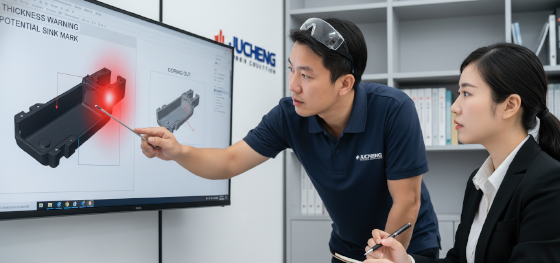
Geometric ratios remain the primary defense against cosmetic surface collapse. The industry standard for preventing sink marks injection molding is the "50-60% Rule." This mandate dictates that the thickness of an internal rib at its root must not exceed 60% of the main wall thickness—and for high-gloss parts, Jucheng Precision recommends a more conservative 50%. If you design a 3mm nominal wall with a 3mm thick rib, you have created a massive thermal junction that will inevitably sink. By thinning the rib base, you reduce the localized thermal mass, allowing the intersection to cool at nearly the same rate as the main wall. For screw bosses, we deploy "Base Isolation" or "Coring-out" strategies. Instead of attaching a thick, solid cylinder directly to the wall, we suggest a recessed groove or "moat" around the boss base to maintain thin wall sections. These design maneuvers are "Zero-Cost" optimizations that save thousands of dollars in scrapped parts and mold rework later in the production cycle. We prioritize "Laminar Cooling" over brute strength, ensuring your parts are rigid yet beautiful.
Scientific Molding: Gate Freeze and Packing Dynamics

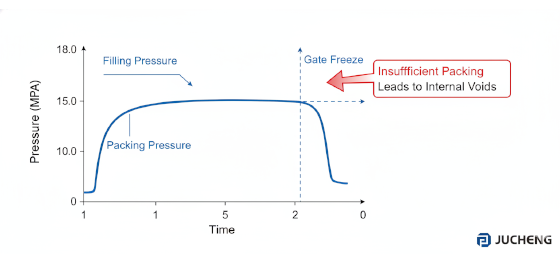
Process control serves as the final "Safety Net" for designs that hover on the edge of the sink threshold. Once the design is frozen, Injection molding defects must be managed through the physics of the injection cycle. The critical phase is "Packing and Holding." After the cavity is filled, the machine continues to push molten plastic into the tool to compensate for the shrinkage occurring during cooling. If the "Packing Pressure" is too low or the "Hold Time" is too short, the center of the part will shrink without receiving extra material to fill the void. A professional molding operation performs a "Gate Freeze Study" to determine exactly when the plastic in the gate solidifies. If the machine stops pushing before the gate freezes, the pressurized plastic inside the cavity can actually flow *backwards* into the runner, worsening the sink marks. Jucheng Precision utilizes scientific molding protocols to find the "Molding Window" where pressure is maximized without causing flash. We ensure that the cavity remains pressurized until the structural spine of the part is stable, effectively "forcing" the plastic to stay flat against the steel.
Polymer Pathology: Crystalline vs Amorphous Shrinkage
Material chemistry dictates the severity of the sink reaction. Not all plastics are created equal when it comes to volumetric change. Crystalline and semi-crystalline polymers—such as Polypropylene (PP), Nylon (PA), and Polyethylene (PE)—exhibit aggressive shrinkage because their molecules fold into tightly packed, ordered structures as they cool. This transition causes a dramatic reduction in volume, often resulting in severe sink marks if design ratios are ignored. Conversely, amorphous plastics like ABS and Polycarbonate (PC) have random, tangled molecular chains that take up more space even when solid, resulting in lower shrinkage rates and better surface fidelity. Jucheng Precision engineers act as your "Material Navigators." If your project requires the chemical resistance of Nylon but your design features heavy sections, we may recommend a glass-filled grade to reduce the global shrinkage. Understanding the "Biological Clock" of your chosen polymer allows us to predict sink behavior before the first shot is fired, ensuring your material choice doesn't sabotage your aesthetic goals.
JUCHENG Protocol: Eliminating Geometric Hot Spots
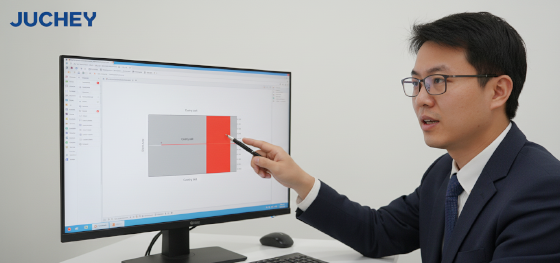
Engineering success at Jucheng Precision is built on the foundation of the proactive DFM audit. We don't just "mold and ship"; we verify that your design is physically ready for high-yield mass production. When you upload a 3D CAD file to our facility, our veteran engineers utilize advanced Moldflow technology to identify every potential sink-prone "Hot Spot." We provide specific design feedback—recommending a cored-out boss here or a thinner rib there—to guarantee that your Class-A surfaces remain flawless. Our integrated facility, housing over 150 CNC machines and specialized Rapid Tooling bays, ensures that these optimizations are executed with surgical fidelity in the tool steel. Stop gambling your R&D budget on designs that will inevitably fail the visual audit. Not sure if your wall thickness is uniform or your rib ratios are correct? Upload your 3D CAD file to JUCHENG today for a Free DFM Review. Our experts will catch Injection molding defects before they cost you money, ensuring your product launch is stable, profitable, and retail-ready.

