


Mechanical longevity in modern hardware often rests on the volatile interface between metal and polymer. When an engineer designs a high-torque automotive bracket or a durable medical diagnostic housing, the primary adversary is not the plastic itself, but the failure of the fastening points. Relying on secondary assembly methods—such as pressing in cold inserts after molding—introduces uncontrolled residual stresses and weak mechanical bonds that inevitably lead to "Pull-out" or "Torque-out" failures. Navigating this structural hurdle requires the uncompromising application of an insert molding design guideline framework. This technology involves placing a metal component—typically a threaded brass insert, a stamped contact, or a precision-machined pin—directly into the mold cavity before the injection cycle begins. At Jucheng Precision, we recognize that insert molding is essentially an act of "Encapsulated Sovereignty." If the geometry surrounding the metal doesn't account for the thermal contraction of the cooling plastic, the part will arrive at the assembly line already compromised by microscopic stress fractures. This guide deconstructs the physics of hoop stress, the necessity of aggressive knurling, and why our integrated Swiss CNC and molding facilities provide the mandatory foundation for the overmolding vs insert molding decision matrix.
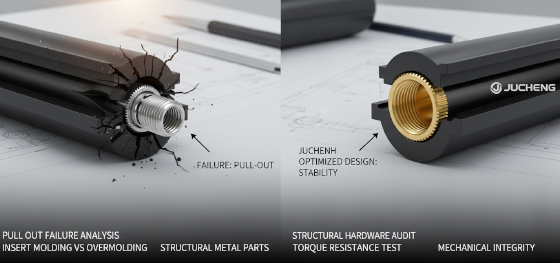
Establishing a failure-proof assembly requires moving beyond simple "threaded holes" and entering the domain of thermodynamic management. Every metal insert acts as a thermal heat sink during the injection process, chilling the surrounding plastic melt and potentially creating weak weld lines. Furthermore, the different Coefficients of Thermal Expansion (CTE) between metal and plastic mean that as the part cools, the polymer will shrink onto the metal with immense force. Jucheng Precision eliminates these "Biological Failures" by performing a surgical DFM audit on every insert-molding project, ensuring that your boss diameters and knurling patterns are mathematically synchronized with the resin's shrinkage coefficient. This analysis provides the technical data needed to turn a fragile plastic shell into an industrial-grade mounting platform.
Anatomy of the Anchor: Knurling and Undercut Mechanics
Managing Hoop Stress: The 2x Boss Diameter Mandate
Thermodynamic Combat: CTE and Thermal Expansion Deltas
Locating Sovereignty: Securing Hardware in a 15,000 PSI Flow
JUCHENG Protocol: In-House Swiss CNC and Molding Control
Anatomy of the Anchor: Knurling and Undercut Mechanics
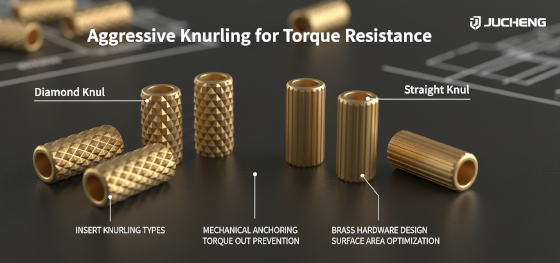
Mechanical resistance in insert molding is not achieved through adhesion; it is achieved through entrapment. A professional insert molding design guideline mandates the use of "Aggressive Anchoring Features" on the metal surface. Threaded inserts must possess a high-depth diamond or straight knurling pattern. As the molten polymer flows around the insert, it fills these microscopic valleys. Once solidified, the plastic becomes a rigid negative of the knurl, providing the "Torque-out" resistance needed to withstand power-tool assembly. For high-stress applications, Jucheng Precision advocates for "Under-cut Grooves" or "Hexagonal Flanges" at the base of the insert. These features provide "Pull-out" resistance, ensuring that the fastener will strip its own threads before the metal insert can be physically extracted from the plastic housing. We don't just "drop in hardware"; we engineer a mechanical interlock that transforms the insert into a structural spine of the polymer matrix.
Managing Hoop Stress: The 2x Boss Diameter Mandate
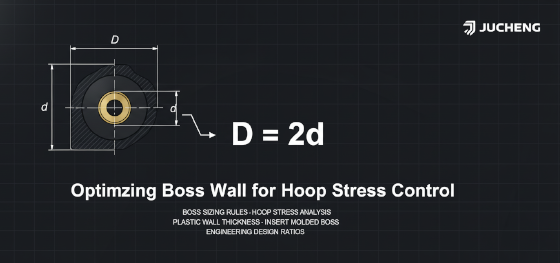
Structural integrity around a metal insert is dictated by the "Hoop Stress" of the cooling plastic. As the resin solidifies, it shrinks inward. Because the metal insert is essentially non-compressible, it acts as a rigid expander, forcing the plastic to stretch around it. If the surrounding plastic wall—the "Boss"—is too thin, the tensile stress exceeds the material's yield point, resulting in "Cracked Bosses" or stress whitening. An elite insert molding design guideline approach mandates a minimum Boss Outer Diameter (OD) of twice the insert diameter (2.0d). For instance, if you utilize a 4mm brass insert, the surrounding plastic boss must be at least 8mm in total diameter. This 2:1 ratio provides the necessary bulk to absorb the shrinkage energy without fracturing. Jucheng Precision engineers utilize Moldflow simulation to identify "Weld Line" risks around the boss; if the melt front meets behind the insert, it creates a structural weak point that will snap the first time a screw is torqued. We optimize gate locations to ensure a unified flow around the metal, armoring your design against assembly failure.
Thermodynamic Combat: CTE and Thermal Expansion Deltas
Coefficient of Thermal Expansion (CTE) mismatch is the invisible predator of insert stability. Metal expands and contracts at a significantly slower rate than Injection molding materials like Nylon or ABS. If your product is intended for outdoor use or medical sterilization cycles, the part will undergo extreme temperature swings. During a heat cycle, the plastic expands away from the metal knurls, potentially weakening the mechanical grip. During a cold cycle, the plastic squeezes the insert with even more intensity. Professional designs mitigate this through " CTE Balancing." Jucheng Precision recommends selecting resins with glass-fiber reinforcement for insert-heavy designs, as the fibers reduce the global shrinkage of the plastic and align its thermal behavior more closely with the metal. We also suggest "Pre-heating" the metal inserts to 100°C before they enter the tool. This reduces the thermal shock on the polymer melt and ensures a more uniform "Molecular Wrap" at the interface, preventing the microscopic air gaps that lead to eventual failure.
Locating Sovereignty: Securing Hardware in a 15,000 PSI Flow
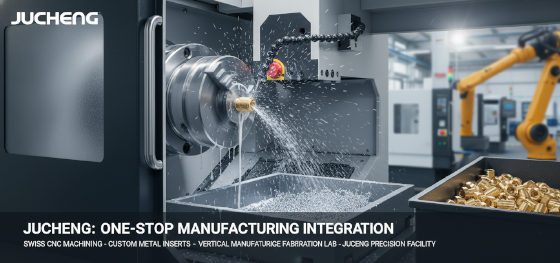
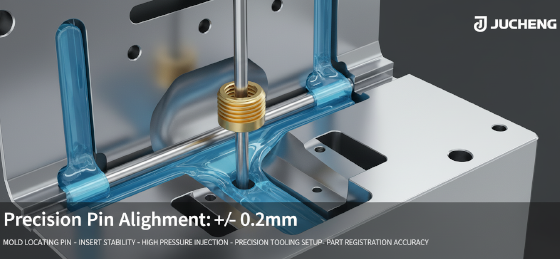
Manufacturing "Drift" occurs when a loose metal part encounters the violent force of molten plastic. During the injection phase, resin enters the cavity at pressures exceeding 15,000 psi. If a metal insert is not physically restrained within the mold, it will be "washed away"—pushed off-center or tilted by the incoming melt front. Successful insert molding design guideline execution requires "Positive Location." Jucheng Precision toolmakers design precision "Locating Pins" that fit inside the insert’s threaded hole with a tolerance of +/- 0.02mm. These pins act as anchors, holding the metal in digital alignment while the plastic surges around it. For stamped metal contacts or busbars, we utilize "Magnetized Pockets" or "Secondary Shut-offs" to pinch the metal in place. This surgical management of the tool's interior ensures that your internal hardware is located with the same sub-micron precision as your external cosmetic faces. We turn a high-risk manual process into a repeatable industrial science.
JUCHENG Protocol: In-House Swiss CNC and Molding Control
Manufacturing excellence at Jucheng Precision is built on the foundation of single-source accountability. Most injection molders outsource their metal inserts, leading to tolerance stack-ups and "Material Finger-Pointing" when an insert doesn't fit the mold. Jucheng Precision eliminates this supply chain friction by housing a world-class fleet of Swiss-style CNC lathes alongside our elite injection bays. We don't just "buy inserts"; we manufacture custom-engineered hardware in-house. This vertical integration allows us to optimize the "Knurl Depth" and "CTE Profile" of the metal part to perfectly match the specific Injection molding materials we are injecting. Our quality control lab audits every batch using CMM and non-contact profilometry to ensure your inserts are centered and your bosses are stress-free. Stop gambling with fragmented suppliers who don't understand the physical interaction between steel and resin. Leverage our decade of integrated mastery to secure prototypes that dominate the lab and survive the market. Contact our technical team today for a free DFM review and see how we can anchor your design's physical future with the certainty of professional insert molding.

