


Electronic failure in high-stakes hardware is rarely a software glitch; it is almost always a victim of environmental hostility. When a hardware engineer designs an automotive sensor, a smart wearable, or an industrial IoT hub, the primary adversary is the ingress of moisture, the vibration of transport, and the violent shock of a drop test. Traditional protection methods—such as messy epoxy potting or thin conformal coatings—are "Old World" solutions that add uncontrolled weight and fail to provide structural support. Navigating this integrity gap requires the strategic deployment of pcb insert molding. This specialized branch of overmolding vs insert molding technology focuses on the surgical encapsulation of delicate circuit boards within a high-performance polymer shell. Unlike standard high-pressure manufacturing, which would instantly crush ceramic capacitors and melt solder joints, Jucheng Precision operates a dedicated Low-Pressure Molding (LPM) facility. We utilize specific thermodynamics to create a monolithic, watertight armor that protects your IP and your hardware from the most unforgiving field conditions.

Establishing a "Zero-Failure" electronics lifecycle requires moving beyond the assumed limits of thermoplastic heat. Standard injection molding operates at pressures exceeding 15,000 psi and temperatures above 250°C—conditions that represent engineering suicide for a multi-layered PCB. Jucheng Precision eliminates these "Component Killers" by utilizing specialized polyamide and hot-melt resins injected at a fraction of that force (often below 500 psi). This gentle integration ensures that your electronics are physically supported without being mechanically compromised. Whether you are validating a waterproof medical pump or a ruggedized military communication unit, our technical advisory ensures your physical test data is 100% predictive of long-term field survival. This guide deconstructs the physics of pressure thresholds, the necessity of material compatibility, and why our integrated cleanroom facility is the mandatory foundation for your next smart hardware launch.
The Pressure Crisis: Why Standard Injection Kills Electronics
Molecular Armor: The Chemistry of Low-Pressure Resins
Hermetic Sovereignty: Achieving IP67 Without Adhesives
Strategic Consolidation: Reducing the BOM and Weight
JUCHENG Protocol: Surgical Electronics Encapsulation
The Pressure Crisis: Why Standard Injection Kills Electronics

Mechanical violence in the mold cavity is the silent predator of delicate circuitry. Standard injection molding is designed for high-velocity throughput, where molten plastic is slammed into a tool with enough force to fill complex geometries in seconds. If a PCB is placed inside such a tool for pcb insert molding, the results are catastrophic. The hydraulic surge of the plastic melt front will physically shear components off the board, while the high clamping force can crush microscopic ceramic traces. Jucheng Precision manages this through the mastery of Low-Pressure Molding (LPM). Our machines utilize gear-pump technology to deliver resin at a controlled, "Laminar" velocity. This allows the polymer to flow gently around surface-mount devices (SMD), filling every air gap without inducing shear stress on the solder fillets. By reducing the pressure from the 15,000 psi of standard molding to less than 200-500 psi, we transform a destructive process into a protective embrace, ensuring your hardware survives the molding cycle without a single latent defect.
Molecular Armor: The Chemistry of Low-Pressure Resins

Chemical compatibility dictates the success of a "Living" circuit. Standard Injection molding materials like ABS or PC require high temperatures that risk "Re-flow"—melting the solder on your PCB and causing internal shorts. pcb insert molding utilizes a unique class of hot-melt polyamides and polyolefins. These resins have a significantly lower melting point and a low "Viscosity Plateau," allowing them to flow around dense assemblies at lower temperatures. Below is the technical reference matrix utilized by Jucheng Precision to guide material selection for electronic encapsulation:
| Property | LPM Polyamide (JUCHENG) | Standard ABS |
|---|---|---|
| Injection Pressure | 2 - 40 bar (Low) | 500 - 1500 bar (High) |
| Processing Temp | 180°C - 210°C | 230°C - 270°C |
| Flame Retardancy | UL94 V-0 (Available) | Standard Grade |
| Moisture Absorption | < 0.5% (Excellent) | Moderate |
This "Soft Thermal Profile" is mandatory for medical devices and aerospace sensors. By utilizing these specialized resins, Jucheng Precision ensures your hardware maintains its "Dielectric Sovereignty," providing a permanent insulating layer that resists high-voltage arcing and environmental degradation.
Hermetic Sovereignty: Achieving IP67 Without Adhesives
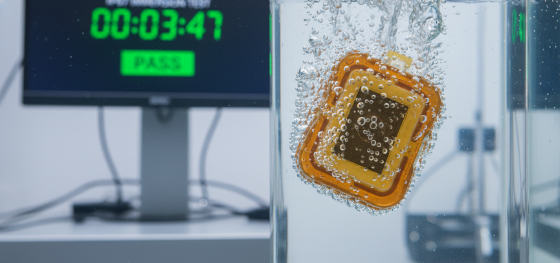
Watertight integrity is the primary byproduct of professional pcb insert molding. In traditional assembly, achieving an IP67 rating requires complex gaskets, messy silicone adhesives, and mechanical fasteners that can fail over time. LPM eliminates these failure points by creating a monolithic chemical barrier. As the resin flows over the PCB, it forms a "Primary Seal" around the entry points of cables and connectors. Because the material is injected in its molten state, it wets the surface of the components and the copper traces, leaving zero air gaps for moisture to migrate. Jucheng Precision subjects all encapsulated batches to rigorous "Bubble Leak" and "Hydrostatic Pressure" audits in our QC lab. We turn a vulnerable circuit into a hermetically sealed industrial asset, allowing your sensors to operate indefinitely in underwater or high-humidity environments. We don't just "cover" the electronics; we integrate them into an impenetrable physical shell.
Strategic Consolidation: Reducing the BOM and Weight

Manufacturing efficiency is earned through the elimination of unnecessary parts. The most strategic advantage of pcb insert molding is the radical simplification of your Bill of Materials (BOM). In many cases, the LPM resin acts as *both* the protective potting and the final external housing. This eliminates the need for separate plastic enclosures, screws, and assembly labor. For wearables and portable medical devices, this "Consolidated Architecture" results in a 40% reduction in total assembly weight and a significantly smaller physical footprint. Jucheng Precision engineers work with your team during the DFM phase to identify these "BOM-reduction" opportunities. We can mold mounting tabs, belt clips, and custom logos directly into the LPM shell, delivering an assembly-ready hardware solution straight from the mold. We turn "Complex Assemblies" into "Monolithic Components," directly improving your supply chain agility and your product's competitive edge.
JUCHENG Protocol: Surgical Electronics Encapsulation
Manufacturing excellence at Jucheng Precision is built on the foundation of the "Total IP Shield." We don't just "inject plastic"; we protect your innovation. Our facility, housing over 150 CNC machines and specialized low-pressure injection bays, is optimized for the high-requirement standards of the automotive and med-tech industries. We provide full material lot traceability and X-ray inspection reports (on request) to verify that internal components have shifted zero microns during the molding cycle. Stop gambling with "Epoxy Pours" that introduce moisture and weight. Leverage our decade of chemical replication and low-pressure mastery to secure electronics that survive the laboratory and dominate the market. Contact our technical team today for a free DFM review and see how we can anchor your design's physical future with the certainty of professional pcb insert molding.

