


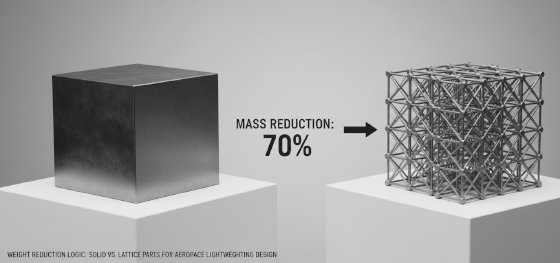
Nature never builds with solid, uniform blocks. If you look at the cross-section of a human femur or the internal geometry of a bird's wing, you see a complex, porous web designed to maximize strength while minimizing mass. For centuries, manufacturing was incapable of replicating this biological efficiency; we were forced to carve or cast solid shapes because our tools were too crude to see the void. This limitation has been permanently erased by lattice structure design. In the sophisticated arena of 3D printing design, the void is no longer a vacuum—it is an engineered sub-system. We are moving into the era of "Digital Bone," where the internal architecture of a part is mathematically optimized to handle specific stress paths, allowing for components that are 70% lighter than their solid predecessors without sacrificing a single Newton of structural stiffness.
Jucheng Precision operates at the forefront of this structural revolution. We understand that a lattice is not merely an "infill" pattern borrowed from hobbyist slicers; it is a mechanical meta-material. By manipulating the unit cell geometry, the strut diameter, and the nodal connectivity, we can engineer a part’s response to impact, vibration, and thermal expansion. Whether you are developing a titanium orthopedic implant that must encourage bone ingrowth or a high-performance heat exchanger with maximized surface area, the logic of the lattice is your primary competitive edge. This guide moves past the basic definitions to explore the physics of Triply Periodic Minimal Surfaces (TPMS), the technical struggle of powder evacuation, and why JUCHENG’s integrated approach to generative engineering ensures your skeletal designs survive the move from the screen to the real world.
Consistency in high-performance hardware is found in the removal of unnecessary mass. You aren't just printing a shape; you are coordinating millions of microscopic intersections to act as a single, unified structural shield. Let us break down the technical pillars of digital space and see how algorithmic foresight can lock the integrity of your most ambitious designs into physical reality.
Geometric Architectures: Truss vs. TPMS Logic
Mechanical Tailoring: Engineering the Stress-Strain Curve
Lightweighting Sovereignty: Shaving Mass from High-Value Alloys
The Post-Processing Paradox: Designing for Powder Evacuation
JUCHENG’s Technical Standard: From Algorithm to Assembly
Geometric Architectures: Truss vs. TPMS Logic

The first technical crossroad in lattice structure design is the selection of the unit cell architecture. Traditional engineering relies on "Truss-based" lattices—structures composed of interconnected straight beams or struts. These are the digital equivalents of the I-beams and girders found in skyscrapers. Common geometries like the Octet-Truss are favored for their high stiffness-to-weight ratio and predictable linear behavior. For parts like aerospace brackets or industrial mounting frames, truss-based designs provide a robust, crystalline rigidity that ensures the component doesn't deflect under static loads. However, they possess a significant flaw: stress concentration. Every point where two struts meet is a sharp intersection that acts as a localized stress riser, potentially leading to fatigue failure over time.
The modern evolution of the void is found in "TPMS" (Triply Periodic Minimal Surfaces). These are organic, mathematically derived shapes like the Gyroid or the Schwarz-P surface. Unlike the sharp angles of a truss, TPMS structures are entirely composed of smooth, continuous curves. This "Curvilinear Sovereignty" eliminates the stress concentration points found in standard lattices, making them far superior for dynamic applications involving high vibration or cyclic loading. Furthermore, TPMS geometries are "Self-Supporting," meaning they can often be printed in metal without the need for internal support scaffolding. At Jucheng Precision, we advocate for TPMS in medical implants and high-efficiency heat exchangers because the flowing channels facilitate easy cleaning and provide a massive surface-area-to-volume ratio. By choosing between a "Stiff Truss" and a "Durable Curve," you are dictating how your part interacts with the laws of mechanical stress.
Mechanical Tailoring: Engineering the Stress-Strain Curve

The primary superpower of additive manufacturing is the ability to create "Variable Density" components. In the traditional world, a material has a fixed set of mechanical properties. If you use aluminum, you get aluminum’s stiffness. With lattice structure design, the machinist becomes a material architect. By strategically varying the thickness of the struts or the size of the cells across the part's geometry, JUCHENG can create "Tailored Stiffness." We can make the mounting points of a bracket rock-solid while keeping the center section soft enough to absorb vibrations. This is the ultimate tool for impact management.
This capability is particularly vital in the development of "Digital Foam" using TPU. We can replace traditional uniform-density foam liners in helmets or robotic grippers with a lattice that offers a "Non-Linear" response to force. Imagine a cushion that feels soft to a light touch but becomes exponentially stiffer during a high-impact collision—this progressive resistance is achieved entirely through geometric orchestration. We utilize advanced FEA (Finite Element Analysis) to map the expected stress loads of your design, then we populate the CAD model with a graded lattice that matches that stress map perfectly. This ensures that every gram of material is working at its maximum efficiency, providing a safety margin that solid blocks simply cannot replicate. We don't just fill space; we engineer the part's tactile and mechanical personality.
Lightweighting Sovereignty: Shaving Mass from High-Value Alloys

In industries where every milligram is a tax on performance—like aerospace and motorsports—lightweighting is the only metric of success. Using 3D printing design to replace solid metal with a skeletal lattice is the most aggressive move an engineer can make. Consider a titanium structural node for a satellite. By utilizing a Diamond lattice infill, JUCHENG can reduce the part's weight by 60% while maintaining 90% of its original rigidity. When you are using expensive superalloys like Titanium or Inconel, this weight reduction isn't just about speed; it's about raw economic survival. The less metal we print, the lower the part cost.
| Structure Type | Stiffness Retention | Mass Reduction | Ideal Industry |
|---|---|---|---|
| Solid Billet | 100% | 0% | Tooling / Heavy Ind. |
| Honeycomb | ~85% | ~40% | Structural Panels |
| Truss Lattice | ~70% | ~65% | Aerospace Brackets |
| Gyroid TPMS | ~75% | ~55% | Medical / Thermal |
This "Mass Sovereignty" allows for the creation of monolithic designs that combine multiple functions into a single part. We can print an aluminum housing that serves as its own shock-absorber and heat-sink through the use of internal lattice zones. This eliminates the weight of assembly hardware and reduces the risk of vibration-induced loosening in high-speed machinery. By removing the burden of unnecessary material, JUCHENG enables your hardware to operate closer to the theoretical limits of performance. We help you transition from the "Carving" mindset of the 20th century to the "Growing" mindset of the 21st, where every milligram of metal must justify its existence.
The Post-Processing Paradox: Designing for Powder Evacuation

Complexity is a liability if it cannot be cleaned. This is the most painful lesson for engineers exploring lattice structure design. In the metal DMLS or nylon MJF processes, the part is born in a bed of loose powder. If your design features a dense, closed-off internal lattice, that powder becomes trapped inside. It cannot be removed. Instead of a lightweight structural part, you end up with a heavy, expensive container full of unsintered dust. This is the "Post-Processing Paradox": the more complex you make the void, the harder it is to reclaim it.
Successful implementation requires a "Cleaning-First" design strategy. At Jucheng Precision, our DFM team audits every lattice model for "Drainability." We ensure that the lattice "unit cell" is large enough to allow powder to flow freely during the breakout phase. We often suggest adding large, strategic "Clean-out Ports"—holes in the exterior skin that allow us to use high-pressure air or ultrasonic fluid to flush out every remaining particle. For resin-based SLA lattices, these ports are even more critical; if liquid resin is trapped inside and then post-cured, it will expand and explode the part from the inside out. We treat the exit path of the waste material with the same technical reverence as the load path of the metal. By engineering the evacuation route during the CAD phase, we ensure your "Lattice" dream doesn't become a "Residual" nightmare, guaranteeing a part that is 100% clean and functionally pure.
JUCHENG’s Technical Standard: From Algorithm to Assembly
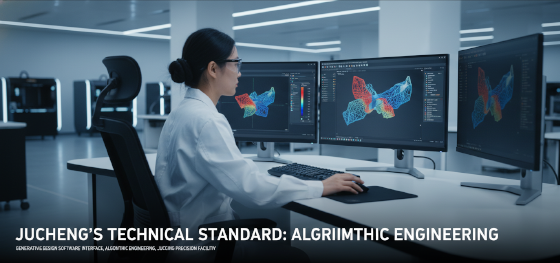
The final hallmark of a world-class manufacturing partner is the integration of software and hardware. Lattice structure design is too complex for standard CAD tools. At Jucheng Precision, we utilize advanced generative design and implicit modeling software to orchestrate the internal geometry of your parts. We don't just "infill" a volume; we weave a structure that aligns with the fluid dynamics and mechanical loads of your mission. Our facility is equipped with high-resolution DMLS and MJF systems that can resolve strut diameters as small as 0.2mm, allowing for the creation of microscopic dot-matrix textures.
Our quality assurance protocol includes CT scanning and high-resolution X-ray analysis for critical skeletal parts. We verify that the lattice is fully fused and that no internal struts have failed during the build or the post-process stress-relief cycles. This level of technical oversight is why JUCHENG is the preferred partner for the aerospace, medical, and high-end consumer sectors. When you receive a shipment from our facility, you aren't just getting 3D prints; you are getting verified engineering masterpieces that have been audited for survival. We bridge the gap between abstract mathematical beauty and the brutal reality of industrial service. Whether you are building an innovative orthopedic implant or a high-performance EV battery cooling plate, our lattice protocols clarify and elevate your most ambitious projects. Contact Jucheng Precision today for a technical DFM review and see how our digital space protocols can armor your next manufacturing breakthrough.

