


Scaling the hardware for an autonomous delivery fleet or a high-end medical diagnostic console in [2026] often hits a financial wall: the cost of massive steel molds. When a single enclosure part exceeds 1,000mm in length, the clamping forces required for traditional high-pressure injection can reach thousands of tons, driving tooling budgets into the six-figure range. The reaction injection molding process offers a sophisticated physical escape from this economic trap. By utilizing Low pressure reaction injection molding, engineers can manufacture oversized, structural components with high-fidelity surface finishes while utilizing significantly more affordable aluminum tooling.

Low pressure in the world of thermoset polymers is not a compromise in quality; it is an optimization of fluid dynamics. Because the A and B liquid components flow with the viscosity of water before they cross-link, they do not exert the violent hydraulic forces found in molten thermoplastic cycles. Jucheng Precision addresses these large-format manufacturing challenges by providing high-tier Polyurethane Molding Services that prioritize dimensional stability and low NRE costs. 我们 deliver parts that move beyond prototype fragility to provide the "Production-Ready" rigidity that medical, automotive, and robotic sectors demand from their Shenzhen supply chain.
Operating within the Shenzhen precision manufacturing hub, JUCHENG serves as the technical advisor for global OEMs navigating the transition from Alpha prototypes to Beta pilot runs. We transform complex engineering files into validated, large-scale shells in as fast as 15 business days. This guide explores the essential pressure standards, the financial logic of aluminum tooling, and the elimination of internal stresses required for mastering Low pressure reaction injection molding to ensure your innovation scales without the crushing financial penalties of conventional high-pressure molding.
Defining Low Pressure: Why 100 PSI is the Magic Number?
Technical Data: Comparing Tooling Costs and Clamping Forces
Tooling Freedom: Why Low Pressure Allows for Aluminum Molds?
Quality Standards: Eliminating Internal Stress in Giant Parts
JUCHENG: The Shenzhen Hub for Oversized Low-Pressure RIM
FAQ: Logistics and Economics of Low-Pressure Molding
Defining Low Pressure: Why 100 PSI is the Magic Number?
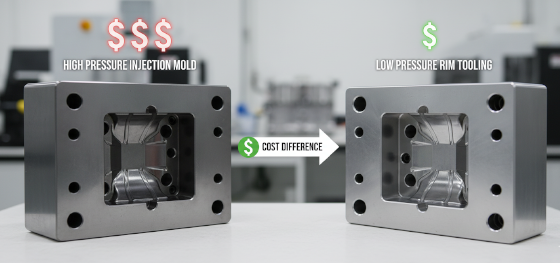
Mechanical integrity in large plastic parts is often ruined by the very pressure used to create them. In Low pressure reaction injection molding, the internal cavity pressure typically remains below 100 psi (7 bar). For context, traditional high-pressure injection molding can reach 15,000 to 20,000 psi. This 99% reduction in pressure fundamentally changes the engineering of the mold and the part itself. Because the liquid polymer does not "hammer" the mold walls, the risk of part distortion and tool wear is virtually eliminated, allowing for the consistent production of parts that are 2 meters long but only 3mm thick.
How does low pressure improve part quality?
It enables laminar flow, which prevents the turbulent air entrapment and "knit lines" that weaken high-pressure molded parts over large spans.
Fluidity is the primary driver of this low-pressure capability. The A and B polyurethane components are injected as low-viscosity liquids that react chemically inside the mold. JUCHENG utilizes specialized gating systems that allow the material to fill complex internal ribs and bosses before the "exothermic kick" begins to solidify the part. This ensures that every corner of a diagnostic scanner shell or a tractor hood is filled with 100% solid polymer, providing the "Bionic Density" required for long-term field use in the [2026] market.
Clamping force requirements are the secondary benefit of the 100-psi standard. In traditional molding, a part with 500 square inches of surface area would require a 2,500-ton press to stay closed. With Low pressure reaction injection molding, the same part only requires a fraction of that force. JUCHENG’s Shenzhen facility utilizes high-efficiency RIM presses that can handle oversized molds without the massive energy consumption or overhead of heavy industrial presses. This efficiency is directly passed to our clients through lower piece-part prices and faster setup times for low-to-medium volume runs.
Technical Data: Comparing Tooling Costs and Clamping Forces
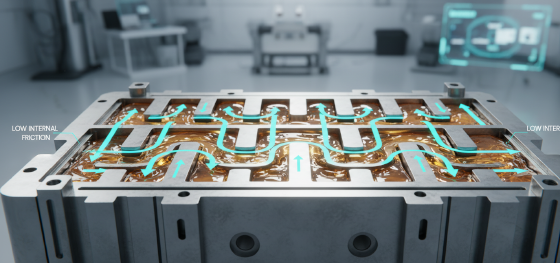
Selecting the right manufacturing path for your Beta trials depends on the financial break-even point between tooling and unit cost. While 3D printing has no tooling cost, its unit cost is astronomical at scale. Jucheng Precision provides technical consultations to help you identify when to switch to Polyurethane Molding Services. The following table compares the essential operational and financial variables of the reaction injection molding process against conventional high-pressure molding for a 1-meter enclosure.
| Variable | Low Pressure RIM | Conventional Injection | Budget Impact |
|---|---|---|---|
| Mold Material | Machined Aluminum | Hardened P20 Steel | 70% Reduction in NRE |
| Clamping Force | 50 - 150 Tons | 2,000 - 3,500 Tons | Enables Massive Parts |
| Wall Flexibility | Variable (3 - 25mm) | Uniform (2 - 4mm) | Integrated Structural Ribs |
| Tooling Lead Time | 2 - 3 Weeks | 8 - 12 Weeks | Faster Time-to-Market |
The ability to use aluminum molds is the "Game Changer" for startups. Because aluminum is three times faster to CNC machine than hardened steel, JUCHENG can deliver T1 samples of a large robot chassis enclosure in a fraction of the time. Furthermore, aluminum’s superior thermal conductivity ensures more uniform cooling during the exothermic reaction, which is the secret to achieving the mirror-flat surfaces required for high-gloss medical finishes. By choosing Polyurethane Molding Services early in the development cycle, you preserve your R&D budget for critical software and sensor integration.
Tooling Freedom: Why Low Pressure Allows for Aluminum Molds?

Engineering freedom in [2026] hardware is often restricted by the rigidity of steel. In Low pressure reaction injection molding, the lack of abrasive high-pressure melt-flow means the tool faces very little physical stress. JUCHENG utilizes aerospace-grade 7075-T6 aluminum for our RIM molds. This alloy provides the surface hardness needed for VDI texturing while remaining easy to modify if the part design changes between Beta 1 and Beta 2 trials. If your engineering team realizes a sensor mounting hole needs to move by 10mm, JUCHENG can weld and re-machine the aluminum mold in 48 hours, a process that would be impossible with hardened steel.
Can aluminum molds produce 5,000 parts?
Yes. Under the low-stress conditions of the RIM cycle, aluminum tools can maintain sub-millimeter tolerances for up to 10,000 shots before requiring refurbishment.
Complex side-actions and cam-slides are more affordable in aluminum. For robot enclosures with undercut features or integrated cable exits, the mold must move in multiple directions. JUCHENG’s 5-axis CNC machining centers allow us to create these complex moving parts within the mold base with micron-level precision. This means you don't have to "Design for Molding" by removing all your complex internal features; you can "Design for Function" and let JUCHENG’s advanced tooling department handle the geometry. This capability is essential for industrial robot parts where internal space is at a premium.
Thermal regulation of the tool is the final advantage. Because aluminum dissipates heat quickly, JUCHENG can run shorter cycle times for large parts. We integrate complex water-cooling circuits directly into the mold cavity and core. This active temperature management ensures that the exothermic reaction is controlled, preventing the localized "Hot Spots" that cause sink marks or brittle zones in inferior molding setups. Our Shenzhen hub manages these variables via automated PLC controllers, ensuring that part #1 is identical to part #5,000 in both dimension and chemical properties.
Quality Standards: Eliminating Internal Stress in Giant Parts

Residual internal stress is the silent killer of large plastic assemblies. When molten plastic is forced into a mold under high pressure, the polymer chains are "stretched" and frozen in place. Over weeks or months, these chains want to relax, leading to the "potato-chipping" warpage that ruins door fits and gasket seals. Low pressure reaction injection molding eliminates this failure mode. Because the liquid polymer cross-links chemically at low pressure, the parts are essentially "Stress-Free" from the moment they are demolded. This makes RIM the only viable choice for 1.5-meter long diagnostic console panels that must remain perfectly flat for their 10-year service life.
How to ensure zero-warpage on large panels?
Utilize low-pressure liquid chemistry to ensure isotropic shrinkage and uniform cooling across the entire part surface.
Isotropic strength is a secondary byproduct of stress-free molding. In industrial robot parts, components are often subjected to multi-directional loads. Injection-molded parts are often weaker along the "flow line" because of molecular orientation. RIM parts have equal strength in all directions because the chemical reaction happens uniformly throughout the liquid mass. JUCHENG utilizes this property to produce structural robot skeletons and heavy-duty agricultural fenders that can absorb hammer-like impacts without cracking, even in the freezing temperatures of a winter harvest.
Precision at the parting line is the third benefit. Because the cavity pressure is so low, there is very little "Mold Blow" (the mold plates pushing apart). JUCHENG machines our mold parting lines to +/- 0.02mm, ensuring that the "Flash" is kept to a microscopic film. This reduces the labor-intensive post-processing and hand-trimming required for large parts, ensuring that the critical gasket surfaces for IP67 sealing are as-molded and dimensionally perfect. By delivering hardware with "Locked-In" geometry, JUCHENG allows your assembly team to focus on the high-value AI integration rather than manual hardware adjustments.
JUCHENG: The Shenzhen Hub for Oversized Low-Pressure RIM

Dominating the [2026] large-format hardware market requires a partner that can scale from a single hand-finished prototype to a commercial deployment of 5,000 units without losing a micron of momentum. Jucheng Precision operates with a 24/7 manufacturing mindset in our Shenzhen precision manufacturing hub, delivering high-tolerance Low pressure reaction injection molding enclosures and structural prototype robot components with industry-leading speed. We provide a "Bridge to Production" that ensures your innovations move from concept to pilot run with 100% chemical and dimensional confidence.
Integrating your structural design with JUCHENG’s expertise ensures that your hardware survives the "First-Field Contact" and moves into mass adoption. We offer comprehensive DFM reviews within 24 hours, identifying potential thermal-expansion risks or machining bottlenecks in your design before they become field failures. Whether you are building an autonomous vineyard scout or a multi-part MRI housing, Jucheng Precision provides the rigid, precise, and *chemically optimized* foundations that keep your innovation moving through the high-stakes cycles and the years of hard labor.
Our facility is equipped with 150+ CNC machines and dedicated oversized RIM presses, allowing us to manage the entire hardware lifecycle in one location. We manage the complexity of multi-component chemistry and robotic post-trimming so your engineering team can focus on the system integration and the software. By combining Shenzhen's speed with industrial-grade material verification and global ISO 13485 standards, JUCHENG remains the preferred partner for the world's most aggressive Polyurethane Molding Services challenges. Contact us today to start your next project.
FAQ: Logistics and Economics of Low-Pressure Molding

Why is low pressure better for 500 robot shells?
It allows for aluminum molds that are 70% cheaper and 3x faster to build than steel injection tools.
What is the typical cavity pressure for a large RIM part?
Cavity pressures are typically between 40 and 80 psi, preventing the internal stress found in high-pressure molding.
Can Low-Pressure RIM achieve Class-A automotive finishes?
Yes. The lack of internal stress ensures perfectly flat surfaces that are ideal for high-gloss painting and branding.
How do you handle sensor mounting in large shells?
We integrate precision CNC-machined metal inserts directly into the low-pressure mold for +/- 0.1mm registration.
What is the lead time for a 1-meter aluminum RIM tool?
Custom aluminum RIM molds are typically completed and delivering parts in 15 to 20 business days.
Tooling debt and warped enclosures are absolute innovation killers for large-scale robotics. Partnering with Jucheng Precision ensures that your functional iterations are built with the stress-free reaction injection molding process and specialized Low pressure reaction injection molding techniques the industry demands. Reach out to our Shenzhen manufacturing hub today for a complete DFM review and build the unyielding foundation your autonomous fleet requires.

