


Precision sealing in life-critical environments demands a radical departure from traditional thermoplastic logic. When engineering a wearable medical pump or an underwater sensor housing, standard elastomers like TPE often fail due to compression set or chemical degradation. These high-stakes requirements necessitate the deployment of lsr injection molding. Liquid Silicone Rubber (LSR) is a two-part, platinum-cured thermoset elastomer that operates on the principle of "Reverse Thermodynamics." Unlike standard Injection molding materials where a hot melt is injected into a cold tool, LSR involves injecting a chilled liquid mixture into a scorching hot mold (170°C to 200°C) to trigger a permanent chemical cross-linking reaction. Jucheng Precision operates as an elite silicone manufacturing hub, utilizing specialized liquid injection units and high-precision tooling to deliver parts that remain flexible from -50°C to 250°C. Mastering LSR is an exercise in managing fluid viscosity and thermal expansion to ensure your hardware maintains its hermetic integrity in the most unforgiving conditions on earth.
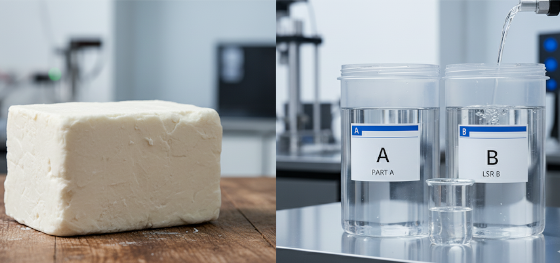
Molecular purity and high-velocity automation define the strategic superiority of LSR over traditional compression molding. LSR arrives as a dual-component system (Part A and Part B) that is pumped through a static mixer into the injection barrel. This closed-loop system eliminates atmospheric contamination, making it the gold standard for ISO 13485 medical applications. Jucheng Precision eliminates the "Flash Crisis" common in silicone production by utilizing 5-axis CNC machining to create mold shut-offs with sub-micron accuracy. Because LSR is as thin as water during injection, even a 0.01mm gap in the tool will lead to catastrophic overflow. This guide deconstructs the chemistry of platinum vulcanization, the economics of cold runner systems, and the mandatory cleanroom protocols required for high-fidelity silicone execution.
Reverse Thermal Logic: The Liquid Injection Process
Mechanical Sovereignty: LSR Property Performance Matrix
Waterproof Integration: LSR Overmolding and Sealing
Tooling Rigor: Eradicating Flash via 0.005mm Tolerances
Vertical Compliance: ISO 13485 and Cleanroom Protocols
Reverse Thermal Logic: The Liquid Injection Process
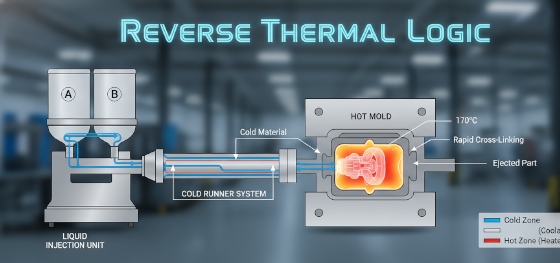
Fluid dynamics in lsr injection molding represent a high-stakes engineering paradox. Unlike thermoplastics that harden as they lose heat, LSR remains a stable liquid as long as it stays chilled. The manufacturing cycle utilizes a "Cold Runner Block"—a water-cooled manifold that keeps the silicone at roughly 20°C to 25°C. The moment the liquid enters the heated mold cavity (which we maintain at 180°C), the platinum catalyst triggers a violent, rapid cross-linking reaction. The material transforms from a viscous liquid to a solid elastomer in seconds. This speed allows for significantly faster cycle times than traditional rubber molding, but it leaves zero room for error. Jucheng Precision engineers utilize specialized nozzle seals and precision-timed injection profiles to prevent "Scorching" (premature curing) in the gates. By managing this thermal delta, we deliver parts with uniform density and zero internal voids, providing the structural spine needed for high-pressure industrial valves and complex medical diaphragms.
Mechanical Sovereignty: LSR Property Performance Matrix

Selecting the correct silicone grade requires an interrogation of "Compression Set" and "Tear Strength." LSR is prized by engineers because it does not become "brittle" in extreme cold or "mushy" in extreme heat. Unlike TPE, which melts if exposed to high temperatures, LSR remains stable until it reaches its decomposition point near 300°C. To assist in early-stage material selection, Jucheng Precision provides the following technical matrix:
| Property | Typical LSR Value | Comparison (Standard TPE) |
|---|---|---|
| Temperature Range | -50°C to 200°C+ | -20°C to 80°C |
| Compression Set (22h/175°C) | 10% - 20% (Excellent) | 40% - 60% (Poor) |
| Tensile Strength | 8 - 11 MPa | 5 - 15 MPa |
| Shore A Hardness | 10A to 80A | 20A to 90A |
The "Compression Set" data is the most critical metric for sealing applications. It proves that LSR will return to its original shape after being compressed for years, ensuring your IP68-rated enclosures never leak due to material fatigue. We provide the material science required to ensure your prototypes survive the most aggressive lifecycle tests in the aerospace and medical industries.
Waterproof Integration: LSR Overmolding and Sealing
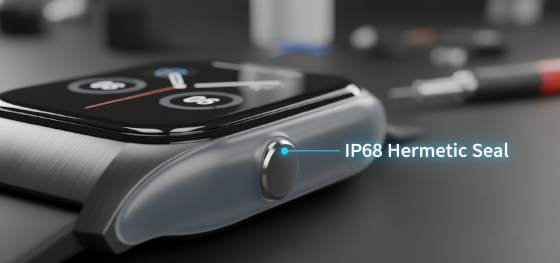
Tactile sophistication meets structural waterproofing through advanced overmolding casting. Jucheng Precision excels in bonding liquid silicone directly onto rigid substrates like Polycarbonate (PC) or Stainless Steel. This "Multi-Material" approach is vital for the latest generation of smartwatches and surgical tools. Unlike standard overmolding, LSR requires a substrate that can withstand the 180°C mold temperatures needed for vulcanization. We utilize high-heat engineering resins and specialized chemical primers to induce a covalent bond at the interface. This ensures that the soft silicone grip or seal will never peel away, even under the stress of high-pressure cleaning or chemical sterilization. We turn complex multi-part assemblies into monolithic, leak-proof hardware, eliminating the need for unreliable O-rings and messy adhesives.
Tooling Rigor: Eradicating Flash via 0.005mm Tolerances
Manufacturing "Seam Discipline" is the primary barrier to entry for lsr injection molding. Because liquid silicone has an extremely low viscosity, it can penetrate gaps as small as 5 microns (0.005mm). In an injection mold, this results in "Flash"—ugly, hair-thin excess material that requires expensive manual trimming. Jucheng Precision eliminates this artisanal failure through our elite CNC mold shop. We utilize high-speed Mazak and Haas 5-axis centers to finish mold parting lines and shut-off surfaces to mirror-like tolerances. When the mold halves meet under 50 tons of clamping force, the seal is so tight that the silicone has no choice but to stay within the cavity. This "Flash-Free" production keeps your unit costs low and ensures your parts arrive retail-ready, without the geometric variance introduced by manual knives.
Vertical Compliance: ISO 13485 and Cleanroom Protocols
Manufacturing sovereignty in the healthcare sector is built on the foundation of the cleanroom audit trail. Jucheng Precision recognizes that an LSR medical component—such as a heart valve or a catheter tip—must be 100% free of dust and contaminants. We operate dedicated LSR machines inside Class 100,000 cleanroom environments, utilizing platinum-cured medical-grade resins that are fully biocompatible and USP Class VI compliant. Our ISO 13485 quality management system provides the material lot traceability and dimensional inspection reports required for regulatory submission. We don't just "mold silicone"; we manufacture safe, clinically validated solutions. Stop compromising your medical hardware goals with inaccurate mockups or dirty production environments. Leverage our decade of LSR mastery to validate safely and launch profitably. Contact our engineering team today for a free DFM review and see how we can turn your digital intent into a sterile, indestructible reality.

