


Tactile disappointment remains the silent killer of premium hardware perceived value. When a surgeon grips a high-precision diagnostic instrument or a consumer interacts with a high-end smartphone case, the "handshake" between the user and the device dictates the emotional verdict of quality. If the soft-touch surface feels sticky, displays unsightly flash lines, or—most catastrophically—begins to delaminate from the rigid core, the engineering credibility of the entire brand evaporates. Relying on manually glued rubber grips is an archaic practice reserved for landfill-bound commodities. Achieving a monolithic, retail-ready multi-material part requires the strategic deployment of tpe injection molding. Thermoplastic Elastomers (TPE) represent a unique class of Injection molding materials that combine the processability of plastics with the performance of vulcanized rubber. Jucheng Precision operates as a high-fidelity manufacturing partner, navigating the complex molecular physics required to bond disparate durometers into a single, indestructible mechanical unit.
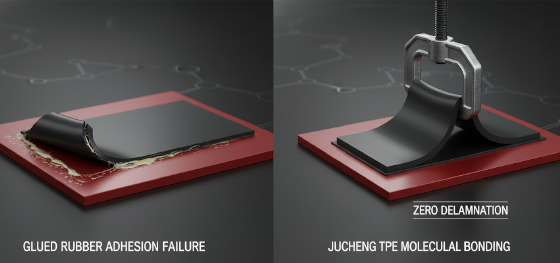
Interface sovereignty is earned through the management of chemical polarity and thermodynamic synchronization. TPE is not a singular material; it is a vast chemistry of alloys, including Styrenic block copolymers (TPS), Polyolefin blends (TPO), and Thermoplastic polyurethanes (TPU). Selecting the incorrect variant for your rigid substrate leads to a "bonding crisis" where the soft skin peels away like an orange. Jucheng Precision eliminates these "Field Failures" by performing a surgical DFM audit on every overmolding project, ensuring that the melt temperature of the TPE is synchronized with the surface energy of the base material. This guide deconstructs the Shore A spectrum, the physics of molecular cross-linking at the interface, and the mandatory mechanical interlocks needed to ensure your hardware survives years of intense human contact.
Durometer Dynamics: Navigating the Shore A Spectrum
Interface Physics: Chemical Bonding and Polarity Matching
Structural Security: The Necessity of Mechanical Interlocks
Processing Warfare: Managing Gating, Venting, and Flash
JUCHENG Protocol: ISO 13485 and Multi-Material Mastery
Durometer Dynamics: Navigating the Shore A Spectrum
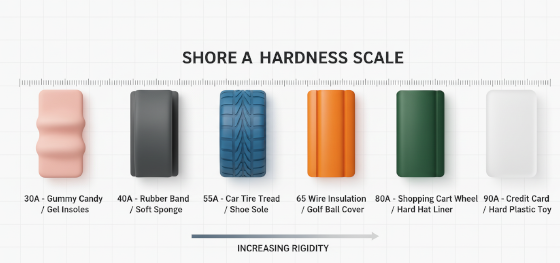
Hardness in the elastomeric world is not a binary choice; it is a nuanced sliding scale that dictates the ergonomic success of your hardware. Designers often specify a generic "Shore 60A" without realizing how a 5-point deviation can alter the assembly's tactile feel. tpe injection molding at Jucheng Precision allows for hyper-specific durometer control. To assist engineers in early-stage material selection, we utilize the following technical reference matrix:
| Shore A Hardness | Tactile Reference | Common Application |
|---|---|---|
| 20A - 30A | Gummy / Soft Gel | Vibration Dampeners / Ear Tips |
| 40A - 50A | Pencil Eraser | Medical Device Grips / Seal Gaskets |
| 60A - 70A | Tire Tread | Power Tool Handles / Rugged Bumpers |
| 80A - 90A | Shopping Cart Wheel | Heavy Industrial Seals / Foot Pads |
Selecting the "Sweet Spot" requires balancing compliance with durability. A Shore 30A TPE offers spectacular comfort but lacks the abrasion resistance needed for long-term use. Jucheng Precision engineers partner with your ID (Industrial Design) team to select the exact resin grade that supports your specific tactile intent while maintaining the structural modulus needed for high-yield manufacturing.
Interface Physics: Chemical Bonding and Polarity Matching
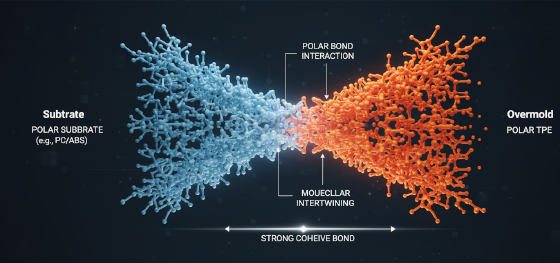
Adhesion in tpe injection molding is not a physical grip; it is a molecular fusion. To achieve a "Cohesive Bond"—where the TPE itself tears before the interface gives way—the chemistry of the elastomer must match the "Surface Energy" of the substrate. Polar TPEs (such as those based on TPU or copolyamides) are engineered to bond with polar rigid plastics like ABS, Polycarbonate, and Nylon. Attempting to bond a generic, non-polar TPO (Thermoplastic Olefin) to a PC shell will fail every time without the use of expensive primers. Jucheng Precision eliminates this "Adhesion Trap" by mapping your production BOM to our material library. We ensure the TPE melt temperature is set 20°C above the substrate's glass transition temperature, allowing for a localized "Re-melt" at the interface. This micro-fusion creates a permanent covalent bond that withstands repetitive flexing and chemical cleaning cycles, providing the manufacturing sovereignty your high-end wearables and medical tools deserve.
Structural Security: The Necessity of Mechanical Interlocks

Relying purely on chemical adhesion is a risky engineering strategy for ruggedized environments. Professional Injection molding design for TPE components mandates the use of "Mechanical Insurance." During our complimentary DFM review, Jucheng Precision engineers look for opportunities to integrate physical anchors into your rigid chassis. By designing "Through-Holes," "Dovetail Grooves," or "Edge Wraps," you allow the molten TPE to flow *through* or *around* the rigid part. Once cured, the soft elastomer is physically trapped within the rigid matrix. This "Belt and Suspenders" approach is mandatory for power tools and handheld medical monitors that undergo intense lateral stress or torque. We transform a simple soft-cover into a structural reinforcement, ensuring your prototypes survive the most aggressive lifecycle tests in the industry.
Processing Warfare: Managing Gating, Venting, and Flash
Manufacturing "Seam Discipline" is the hallmark of an elite molding facility. Because TPE has high viscosity and rapid cooling rates, managing the "Melt Front" is a high-stakes challenge. If the gate is too small, the TPE will "Jet" or create unsightly "Flow Marks" on cosmetic faces. Jucheng Precision toolmakers utilize oversized "Fan Gates" to ensure laminar flow into the overmold cavity. Furthermore, TPE is notorious for "Flash"—excess plastic leaking onto the "clean" areas of the rigid core. This is prevented through "Surgical Shut-offs." We utilize high-precision 5-axis CNC machines to cut the mold mating surfaces to a tolerance of +/- 0.005mm. When the mold closes around your pre-molded part, the steel "pinches" the plastic with enough force to create a hermetic seal against the pressurized TPE melt. We don't just "overmold"; we engineer a leak-proof enclosure.
JUCHENG Protocol: ISO 13485 and Multi-Material Mastery
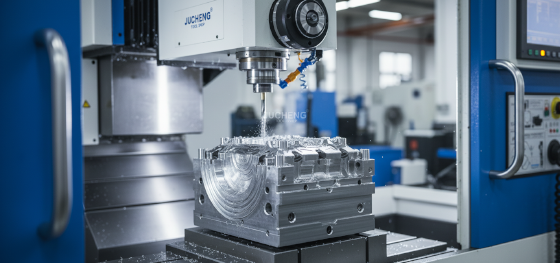
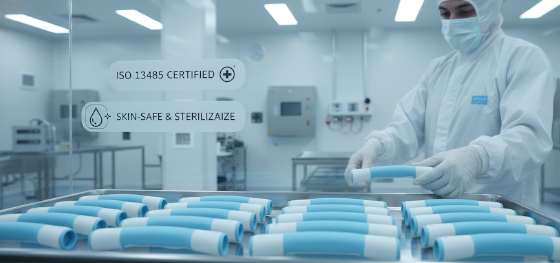
Manufacturing excellence at Jucheng Precision is built on the foundation of the integrated supply chain. We eliminate the friction of vendor-hopping by housing our elite CNC mold shop, 3D printing bay, and multi-shot injection bays under a single roof. Our IATF 16949 and ISO 13485 certified workflows provide the material traceability needed for medical and automotive validation. When you upload a CAD file to our facility, our veteran engineers perform a comprehensive "Interface Audit." We suggest Shore A optimizations to prevent "Squish Fatigue" and propose gating locations that minimize cosmetic weld-lines. Stop compromising your hardware vision with "sticky" mockups or delaminating rubber. Leverage our decade of chemical replication mastery to validate rapidly and launch profitably. Contact our engineering team today for a free DFM review and see how we can turn your digital intent into a soft-touch, indestructible reality.

