


Your part will spend its life on the deck of a ship, constantly sprayed with saltwater. Or it will be implanted inside the human body, exposed to corrosive body fluids for decades.
For these applications, "good" corrosion resistance is not good enough. It is a recipe for disaster. You need the best. You need a material that is designed from its very atoms to survive in the most aggressive chloride environments.
This is the world of 316L. The process of machining 316l stainless steel is about shaping this ultimate protector. It is a material for when failure is simply not an option.
content:
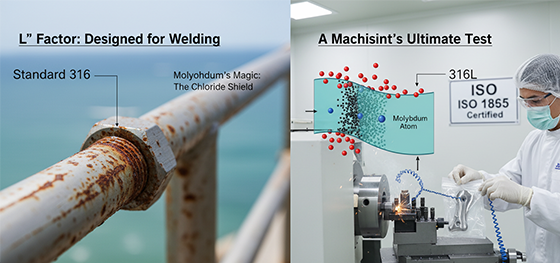
The "L" Factor: Designed for Welding
Molybdenum's Magic: The Chloride Shield
A Machinist's Ultimate Test
JUCHENG's Commitment to Critical Applications
The "L" Factor: Designed for Welding

First, what does the "L" in 316L mean? It stands for "Low Carbon."
This is a critical detail for any part that needs to be welded. When you weld standard stainless steel, the high heat can cause the carbon in the steel to react with the chromium. This forms chromium carbides along the grain boundaries in the "heat-affected zone" next to the weld. This is a bad thing. It depletes the chromium from that area, destroying its protective passive layer. This makes the weld area highly susceptible to corrosion.
The "L" grade has a much lower carbon content. This prevents the formation of those harmful carbides during welding. It ensures that the weld and the area around it maintain their full corrosion resistance. For any welded stainless steel structure in a corrosive environment, an "L" grade is essential.
Molybdenum's Magic: The Chloride Shield
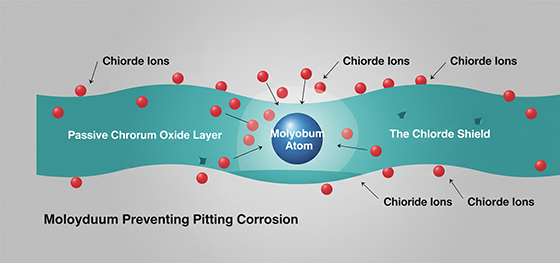
Now for the real superpower of the 316 family. Its secret weapon is a special ingredient that 304 does not have: Molybdenum (Mo).
While the chromium in all stainless steels provides good general corrosion resistance, it has a weakness. It is vulnerable to attack from chlorides. Chlorides are found in saltwater, de-icing salts, and even in the human body. They can break down the passive layer in very specific spots, causing a nasty type of corrosion called "pitting."
The addition of 2-3% Molybdenum to the 316L recipe dramatically enhances the strength and stability of the passive layer. It acts like a shield, specifically repelling the chloride attack. This is what gives 316L its "marine grade" and "medical grade" status. It is the material you choose when you absolutely cannot have pitting corrosion.
A Machinist's Ultimate Test

This superior performance comes at a price. The process of machining 316l stainless steel is even more challenging than machining 304.
The added molybdenum, combined with a higher nickel content, makes the material tougher and gummier. It also work-hardens more severely than 304.
For a machinist, this means the battle is even tougher. Cutting speeds must be even slower. Feed rates must be carefully controlled. The cutting tools must be of the highest quality, with a very tough coating to survive the extreme heat and pressure. The chips produced are often very hot, tough, and difficult to break.
This difficulty increases the machine time and the cost per part. It is a premium process for a premium material. This is one of the most demanding of all common stainless steel cnc machining operations.
JUCHENG's Commitment to Critical Applications
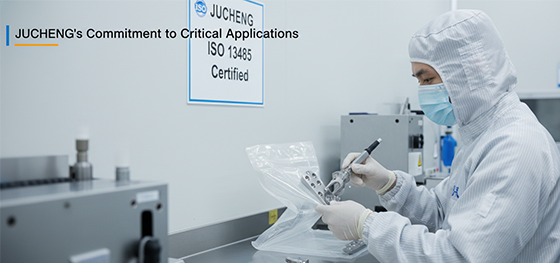
The industries that demand 316L are industries where there is zero room for error. This requires a manufacturer with a quality system to match.
At JUCHENG, our ISO 13485 certification is our commitment to the medical device industry. It is a rigorous quality system that governs every aspect of our process, from material sourcing to final inspection.
When we machine a medical implant from certified 316L, we provide full material traceability. We can trace the specific batch of raw material back to the mill it came from. We maintain detailed records of every step of the manufacturing and inspection process.
This level of discipline and documentation is not just good practice. It is a requirement. It is our guarantee to you that the critical components we deliver are made to the highest possible standard of safety and quality. It is how we earn the trust of our partners in the most demanding industries.

