


In manufacturing, time is money. This is a simple truth. For a machinist, the time spent fighting a difficult material is time that is not making parts. It is a direct hit to efficiency and cost.
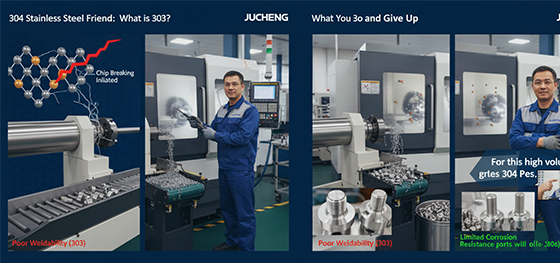
We know that standard stainless steel is a tough opponent. It work-hardens. It generates a lot of heat. It is slow to machine. But what if there was a version of stainless steel that was... friendly?
There is. It is a special grade designed with one purpose in mind: ultimate machinability. This is the world of 303 stainless steel. And the process of 303 stainless steel machining is a masterclass in manufacturing efficiency.
The Machinist's Friend: What is 303?
The Payoff: Speed and Cost
The Double-Edged Sword: What You Give Up
Making the Smart Call
The Machinist's Friend: What is 303?
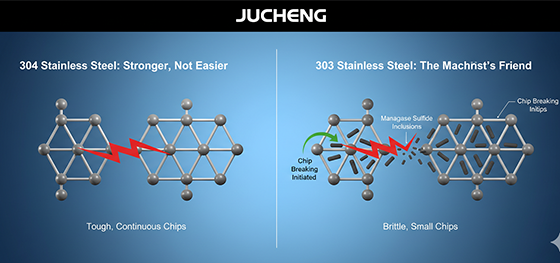
303 stainless steel is the "free-machining" version of its famous cousin, 304. It has a very similar base chemistry of chromium and nickel. This gives it good, general-purpose corrosion resistance.
But it has a secret ingredient. A small amount of sulfur (or sometimes selenium) is intentionally added to the recipe. This is its superpower.
The sulfur forms tiny, soft inclusions of manganese sulfide within the steel's microstructure. You cannot see them. But when a cutting tool hits one of these inclusions, it acts as a microscopic "chip breaker."
Instead of forming long, stringy, difficult chips like 304, the chips from 303 break off into small, clean, manageable pieces. This simple change in chip formation completely transforms the machining experience.
The Payoff: Speed and Cost
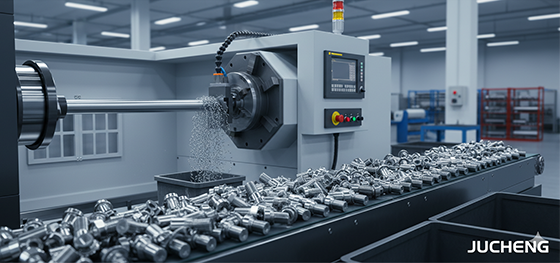
Because the chips are so well-behaved, the entire stainless steel cnc machining process can be supercharged.
A machinist can dramatically increase the cutting speeds and feed rates without the risk of chips tangling around the tool. This means the time it takes to make a single part is significantly reduced. In some cases, machining speeds can be increased by 25% or more compared to 304.
This is a massive advantage for high-volume production. When you are making thousands of parts, this time saving translates into a huge reduction in the final cost per part.
The cleaner cutting action also leads to less tool wear. The cutting tools last longer, which further reduces operating costs. This is why 303 stainless steel machining is the secret weapon for any high-volume, automated CNC turning project.
The Double-Edged Sword: What You Give Up
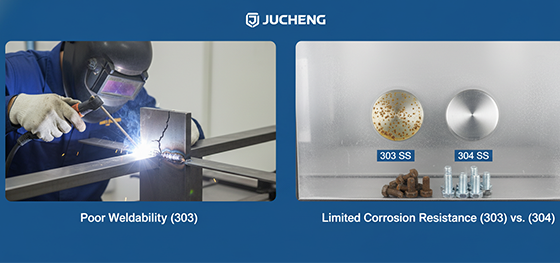
But that magical sulfur ingredient is a double-edged sword. The incredible machinability it provides comes at a price. There are two major trade-offs.
First, you lose some corrosion resistance. Those same sulfide inclusions that break the chips can also act as initiation points for corrosion. While 303 is still "stainless," it is not as resistant to rust and pitting as its 304 counterpart, especially in marine or chemical environments.
Second, and more critically, you cannot weld it. The sulfur in the alloy causes severe cracking (hot cracking) in and around the weld zone. For this reason, 303 should never be used for any part that requires welding. It is a material for monolithic, machined-only components.
It is also slightly less tough and ductile than 304, meaning it is not as good for parts that require significant cold forming or bending.
Making the Smart Call
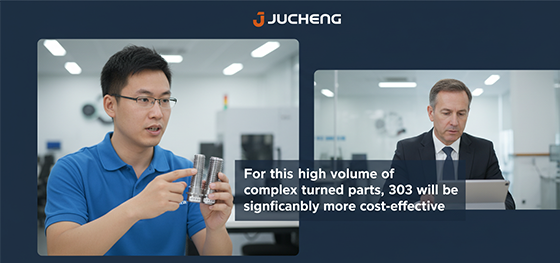
So, when is 303 the smart call? It is a strategic choice based on your part's geometry and production volume.
You choose 303 when you are producing a high volume of small, complex, machined parts where the cost per part is a major driver. It is the perfect material for nuts, bolts, screws, shafts, fittings, and valve bodies that are made on an automated CNC lathe.
You do NOT choose 303 if your part needs to be welded. You do NOT choose 303 if your part will be used in a harsh marine or chemical environment. In those cases, the slightly higher machining cost of 304 or 316 is a necessary and wise investment.
A good manufacturing partner understands this trade-off. At JUCHENG, we can look at your design, your volume, and your application. We can provide the expert DFM feedback to help you decide if the incredible efficiency of 303 stainless steel machining is the right choice to make your project a cost-effective success.

