


Water molecules are persistent assassins of autonomous subsea electronics. In the hyper-hostile environment of the deep ocean, where an underwater robot must survive hydrostatic pressures exceeding six thousand psi, the primary point of failure is rarely the pressure hull; it is the cable entry point. If the electrical interface between a thruster or sensor and the primary logic bay exhibits even a microscopic gap, capillary action will draw saltwater into the system, causing an immediate short circuit and catastrophic program loss. Navigating this requirement for zero-leak, high-pressure connectivity requires the strategic deployment of Waterproof overmolding for marine connectors. Jucheng Precision operates as a high-fidelity manufacturing sanctuary in the Shenzhen precision manufacturing hub, providing the multi-material injection depth needed to transform vulnerable wire harnesses into hermetically sealed structural assets. Within the broader framework of Robotics Automation Manufacturing, we bridge the gap between "standard cabling" and "abyssal sovereignty," ensuring your autonomous maritime fleet remains operational through years of saltwater immersion.

Establishing a resilient deep-sea supply chain in 2026 demands the absolute rejection of "potting-only" methodologies. Amateurs often rely on epoxy potting compounds to seal their connectors, unaware that the differing coefficients of thermal expansion (CTE) between the rigid epoxy and the flexible cable jacket will trigger delamination during the first thermal cycle. Jucheng Precision eliminates these "Interfacial Failures" by enforcing a strict "Molecular Fusion" protocol. We utilize Waterproof overmolding for marine connectors to chemically bond specialized elastomers directly onto the wire insulation and the metal bulkhead. Whether you are developing a micro-AUV for acoustic mapping or a heavy-duty ROV for subsea welding, our integrated facility provides the material science and metrological rigor required for global market entry. This guide deconstructs the necessity of covalent bonding, the physics of high-pressure seal consolidation, and why JUCHENG’s "Turnkey Protocol" is the mandatory foundation for anyone developing Waterproof overmolding for marine connectors for the abyss.
Why overmolding beats potting for deep-sea hardware?
Molecular Fusion: Bonding elastomers to metal and wire
Ingress Defense: Managing pressure-induced water wicking
Turnkey Integration: Machining bulkheads and molding seals
FAQ
Why overmolding beats potting for deep-sea hardware?
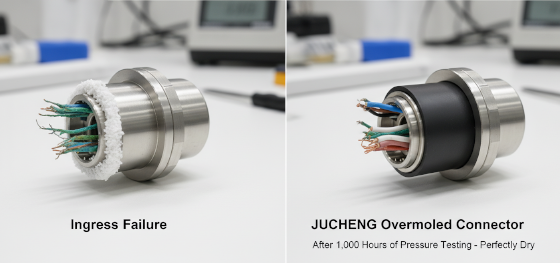
Mechanical durability in a liquid vacuum is a hostage to material adhesion. Traditional potting involves pouring a liquid resin into a shell and allowing it to cure at atmospheric pressure. This process often traps microscopic air bubbles that act as "implosion sites" at depth. Furthermore, potting resins rarely form a true chemical bond with the cable jacket; they merely "wrap" around it. Waterproof overmolding for marine connectors utilizes high-pressure injection (exceeding 10,000 psi) to force the molten polymer into every microscopic crevice of the wire and bulkhead. Jucheng Precision engineers utilize specialized TPU (Thermoplastic Polyurethane) and Silicone resins that possess high surface energy. The intense pressure of the molding cycle eliminates internal air voids, resulting in a 100% dense monolithic seal. We turn "vulnerable joints" into "solid-state assets," ensuring your subsea connectors maintain their hermetic integrity through thousands of pressure cycles where potting compounds would inevitably crack or leak.
Molecular Fusion: Bonding elastomers to metal and wire
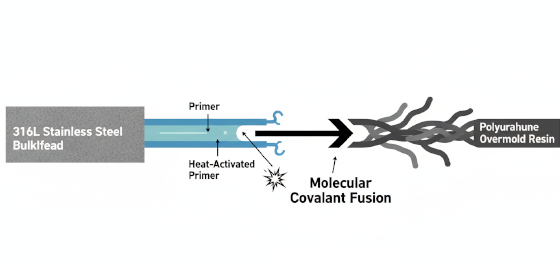
Interfacial sovereignty dictates the success of a maritime electrical assembly. The primary challenge is bonding a non-polar elastomer to a high-density metal bulkhead. Jucheng Precision eliminates the "Delamination Crisis" through advanced chemical priming and mechanical interlocks. We utilize specialized heat-activated primers that induce a "Covalent Handshake" between the polymer and the 316L stainless steel or titanium shell. When the molten resin hits the primed metal surface inside the mold, it triggers a chemical cross-linking reaction that effectively "welds" the plastic to the metal. We augment this with "Mechanical Insurance"—designing the metal bulkhead with Dovetail Grooves and Through-Holes so the elastomer physically anchors itself to the hardware. This dual-layered defense ensures that even if the robot is subjected to extreme vibration or temperature swings, the seal remains permanent. We provide the material science required to survive the most abusive oceanic environments.
Ingress Defense: Managing pressure-induced water wicking
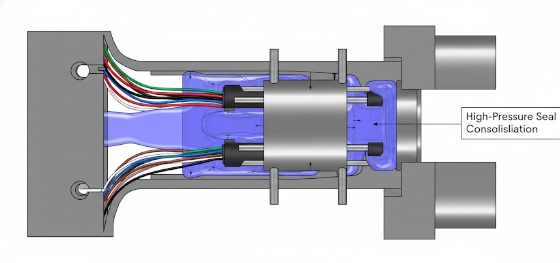
Water ingress often targets the "Wicking Path"—the microscopic air gaps between individual strands of copper wire inside a cable. If the overmolding process doesn't achieve a hermetic seal against the inner conductor, water will migrate down the wire like a high-pressure straw, bypassing the external seals entirely. Jucheng Precision manages this atmospheric sabotage through "Pressure-Decay Integration." We design our overmolding tools to exert specific "Shut-off" force on the cable jacket, compressing the polymer and forcing it to bite into the wire insulation. By utilizing high-flow resins with low melt viscosity, we ensure the material penetrates the outer jacket and encapsulates the internal strain reliefs. We turn "leak-highways" into "hermetic dead-ends," providing the manufacturing insurance needed to secure an IP68+ rating for your most sensitive sensor arrays and power distribution hubs.
Turnkey Integration: Machining bulkheads and molding seals

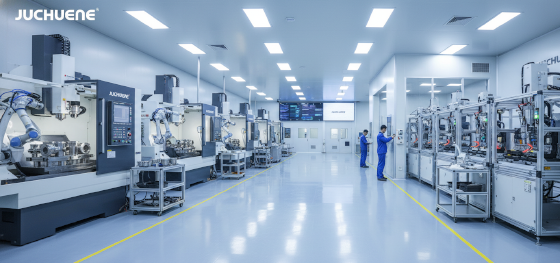
Manufacturing excellence at Jucheng Precision is built on the foundation of single-source accountability for subsea hardware. We don't believe you should manage one vendor for your CNC-machined bulkheads and another for your overmolded seals. JUCHENG houses elite 5-axis CNC centers and specialized vertical injection bays under one ISO 9001 certified roof. When you upload a marine CAD assembly to our facility, our veteran engineers perform a comprehensive "Hermetic DFM Audit." We machine the sub-micron O-ring grooves in the metal shell and then move the part directly to our molding cleanroom for the overmolding phase. This vertical integration ensures that the surface energy of the metal is maintained and that the alignment is perfect. We provide full material lot traceability and helium-leak inspection reports for every batch, providing the "Paper Trail of Quality" required for naval and offshore contracts. Leverage our decade of Waterproof overmolding for marine connectors mastery to validate rapidly and launch profitably.
FAQ
Q: Why choose overmolding?
A: Overmolding creates a molecular bond and high-pressure seal that potting or standard connectors cannot match, effectively eliminating leak paths in underwater robot hardware.
Q: How deep can JUCHENG seals go?
A: Our Waterproof overmolding for marine connectors protocols are designed to survive pressures up to 10,000 psi, making them suitable for missions at 6,000 meters or deeper.
Q: Which materials bond best?
A: TPU (Thermoplastic Polyurethane) offers spectacular adhesion to 316L stainless steel and titanium when combined with JUCHENG’s specialized heat-activated primers.
Q: What is the lead time for a custom bulkhead connector?
A: Utilizing our integrated facility, we can machine the metal shell and overmold the seal in as fast as 10 to 14 business days from CAD approval.

