


Precision replication is a struggle against the physics of the seam. In the high-fidelity landscape of the vacuum casting process, the quality of every finished component is decided by the geometry of the void it was born in. While many focus on the chemical properties of the resin, the true technical differentiator is the craftsmanship involved in making a mold for silicone casting. It is an exercise in "Reverse Engineering" the final part's surface integrity. If the mold's parting line is misplaced by a fraction of a millimeter, or if the venting logic fails to account for air traps, the resulting part is a visual failure. At Jucheng Precision, we treat the silicone mold as a high-precision technical tool, utilizing 5-axis CNC-machined masters to ensure that the "Flexible Cavity" we build possesses the same dimensional lock as a steel die.
Efficiency in low-volume production is found in the removal of manual rework. A part that requires hours of hand-sanding to remove a thick parting-line "flash" is a part that has been poorly tooled. We have moved past the era of simple "rubber pouring" to provide our clients with an engineered tooling roadmap. By strategically placing gates and vents and utilizing high-durometer silicones, we deliver parts that are assembly-ready directly from the mold. This guide moves beyond the hobbyist tutorials to explore the actual mechanics of parting-line architecture, the thermodynamic rigor of the curing cycle, and why JUCHENG’s commitment to master pattern perfection is the only way to ensure your prototypes survive the scrutiny of a high-end marketing launch.
Profitability in the casting lab is won by maximizing the mold’s duty cycle. You aren't just building a temporary container; you are engineering a structural negative that must withstand the exothermic heat of polyurethane dozens of times. Whether you are building an intricate medical manifold or a textured automotive interior trim, the logic of the tool is your primary manufacturing governor. Let us break down the physical laws of silicone tooling and see how technical foresight can lock the integrity of your next design into reality.
Master Pattern Preparation: Establishing the Surface DNA
Parting Line Architecture: Mastering the Invisible Seam
Gate and Vent Logic: Orchestrating the Fluid Path
Encapsulation Physics: Managing the Two-Stage Pour
Thermal Curing: Locking in Molecular Stability
Mold Longevity: Predicting the 25-Shot Degradation
Master Pattern Preparation: Establishing the Surface DNA
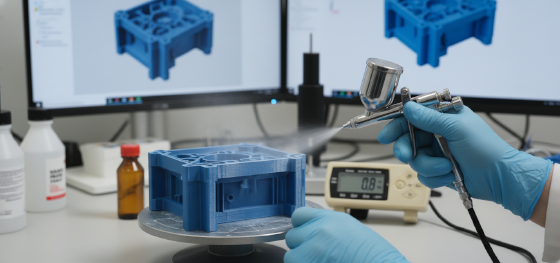
The quality of a silicone mold is a perfect reflection—literally—of the master pattern. In the process of making a mold for silicone casting, the first milestone is the technical audit of the master's surface. If the master features 3D printing layer lines, the silicone will record them with such fidelity that the final cast parts will appear unfinished. At Jucheng Precision, we advocate for CNC-machined masters whenever possible. A 5-axis milled pattern provides the dimensional "lock" and surface smoothness (Ra 0.8 or better) that allows the subsequent copies to mimic high-pressure injection molded parts.
Preparation involves more than just sanding. We must account for the chemical "handshake" between the master and the silicone. We apply specialized release agents in microscopic, uniform layers to ensure that the silicone does not bond to the master's surface. We also identify any "Mechanical Interlocks"—geometry that would physically prevent the master from being extracted from a rigid mold. The flexible nature of silicone handles many undercuts, but extreme geometries still require a multi-part tool strategy. By establishing the "Surface DNA" during this phase, JUCHENG ensures that the vacuum casting process starts with an objective baseline of excellence, preventing the surface defects that ruin cosmetic prototypes for the consumer electronics and medical sectors.
Parting Line Architecture: Mastering the Invisible Seam

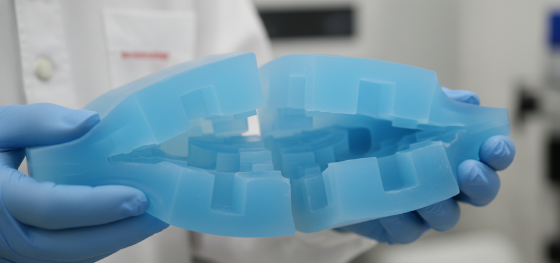
The "Parting Line" is where the two halves of the silicone mold meet. In professional making a mold for silicone casting, the design of this line is an engineered decision, not a visual accident. If a parting line is placed across a visible aesthetic face or a precision assembly datum, the part is compromised. Our engineers utilize a "Functional Concealment" strategy. we identify the natural edges and transitions of your CAD model where a tiny seam would be naturally disguised by the geometry.
For complex 3D shapes, we often utilize "Stepped" or "Irregular" parting lines to ensure the mold provides the necessary structural support during the resin pour. We use specialized tapes and clay-up techniques to define this boundary with surgical precision. The goal is to minimize "Flash"—the unwanted thin layer of plastic that escapes between mold halves. By engineering the seam into the non-functional zones of the component, JUCHENG delivers parts that feel monolithic and professional directly from the mold. This attention to tooling architecture is why our cast parts require 70% less manual post-processing than parts from standard bureaus, preserving the sharp industrial lines of your original vision.
Gate and Vent Logic: Orchestrating the Fluid Path
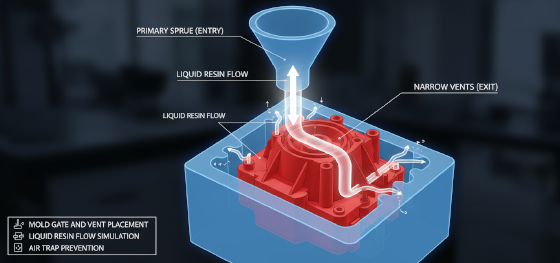
Inside the vacuum casting process, the resin behaves like a fluid looking for the path of least resistance. If you simply pour resin into a cavity, you will trap air in the "high points," resulting in voids and missing features. Making a mold for silicone casting requires a sophisticated understanding of fluid dynamics. We design a "Gating System"—the primary channel where the resin enters—to ensure the liquid fills the mold from the bottom up, pushing the air ahead of it.
Complementing the gates are the "Vents" or "Risers." These are tiny escape chimneys placed at every isolated peak of the part's geometry. In the vacuum chamber, as the pressure drops, the air is sucked out through these vents, allowing the resin to claim 100% of the volumetric space. JUCHENG’s technicians calibrate the diameter of these vents to be as small as possible—often less than 1mm—to prevent excessive material waste while still ensuring complete air evacuation. This orchestration of the fluid path is vital for parts with thin walls or complex internal ribs. We don't just "pour and hope"; we engineer a vacuum-assisted flow that guarantees every microscopic detail—from a knurled grip to a 0.5mm logo—is captured with crisp, bubble-free accuracy.
Encapsulation Physics: Managing the Two-Stage Pour

The creation of a two-part silicone tool is a literal act of encapsulation. The process begins by suspending the master pattern in an acrylic casting box. We then pour the first "Half" of the silicone. The technical challenge here is managing the "Silicone Gel-Time." If the silicone begins to set before all the air is removed, you will have bubbles on the face of your mold. At Jucheng Precision, we use high-flow, low-viscosity industrial silicones that allow for a deep degassing phase in our vacuum chambers.
Once the first half is cured, we apply a "Barrier Coat" and pour the second half. This creates a perfectly interlocking two-piece tool. The "Registration" between these two halves is what determines the dimensional accuracy of your final parts. If the mold halves shift by even 0.1mm, the part is out of spec. We utilize high-accuracy "Locating Keys" or "Registration Hubs" integrated into the mold frame to lock the two halves into a single, unmovable unit. This mechanical rigor in making a mold for silicone casting is the only way to hold the tight tolerances required for interlocking medical housings or automotive electronic enclosures. We treat the encapsulation not as a liquid pour, but as the manufacturing of a soft-tooling engine.
Thermal Curing: Locking in Molecular Stability
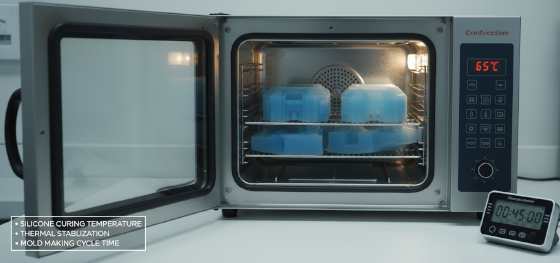
Thermodynamics dictate the final mechanical modulus of your parts. Silicone rubber and polyurethane resins are both temperature-sensitive materials. If a mold is allowed to cure at room temperature, the polymer chains often fail to reach their full cross-linking potential. Jucheng Precision utilizes programmable industrial ovens to manage the "Cure Profile" of every mold we make. We maintain a constant, stabilized temperature—typically between 60°C and 70°C—to ensure the silicone reaches its maximum Shore hardness.
This thermal discipline is essential for preventing "Mold Flex." A soft, under-cured mold will expand when it is filled with warm polyurethane resin, leading to parts that are larger than the master pattern. By "Baking" our tools, we lock in the dimensions. We also account for the shrinkage of both the silicone and the final casting resin. For a part that is 200mm long, a 0.5% shrinkage rate represents a full millimeter of drift. JUCHENG’s engineers utilize "Compensated Master Patterns"—machining the master slightly oversized to ensure that after the mold shrinks and the resin shrinks, the final part landed in your hand is exactly the size specified in your STEP file. We move past the trial-and-error of basic shops to provide a data-driven path to stability.
Mold Longevity: Predicting the 25-Shot Degradation

The final hallmark of a professional manufacturing partner is the management of the tool’s lifecycle. A common misconception in the vacuum casting process is that a mold lasts forever. In reality, a silicone mold is a consumable asset. The chemical reaction of polyurethane is exothermic; it generates heat. This heat, combined with the chemical attack of the resins, slowly eats away at the silicone’s surface integrity. After roughly 15 to 25 "Shots," the mold begins to lose its ability to replicate fine textures and hold tight tolerances.
At Jucheng Precision, we don't wait for a part to fail before we replace a tool. We implement a "Batch Ceiling" protocol. If you order 100 parts, we build 4 to 5 identical silicone molds simultaneously. This ensures that part number 99 has the exact same surface finish and dimensional fidelity as part number 1. We also analyze the chemistry of the specialized resins you select—some aggressive PC-simulants will degrade a mold faster than soft elastomers. We provide our clients with a "Tooling Life Audit," giving you the transparency needed to budget for high-volume prototype runs. By respecting the biological-like aging of the silicone tool, we deliver a consistent quality level that makes JUCHENG the premier choice for pre-series automotive and medical hardware. Contact our engineering team today for a technical DFM review and see how our mold-making protocols can clarify and secure your next manufacturing breakthrough.

