


Losing operational battery hours due to the parasitic weight of oversized enclosures is the primary engineering headache for Rapid Prototyping for Robotics. In the high-stakes world of autonomous delivery fleets and flying scouts, every kilogram of dead weight on the chassis is a kilogram removed from the payload or sensor array. While standard polyurethane reaction injection molding is famous for creating large parts, pure solid resins can still be too heavy for agile mobile platforms. Achieving the ultimate strength-to-weight ratio requires a move toward microcellular polyurethane RIM, a process that creates a bionic "sandwich structure" with a dense, unyielding skin and a micro-porous, shock-absorbing core.

Lightweighting through foaming is not just about making a part less dense; it is about managing the skin-to-core ratio to ensure structural stiffness remains high. In traditional high-pressure molding, foaming often leads to surface "silver streaks" or a rough, porous finish that requires heavy sanding. Jucheng Precision addresses these aesthetic and mechanical hurdles by utilizing gas-charged polyols and low-pressure liquid dynamics. Jucheng delivers components that feel as solid as bone but weigh 30% to 50% less, providing the "Aero-Industrial" reliability that next-generation robotics and medical consoles demand in our Shenzhen factory hub.
Operating under a dual mandate of ISO 13485 and ISO 14001, Jucheng Precision acts as the high-tier material scientist for global OEMs. We transform raw concepts into validated, lightweight hardware in as fast as 15 business days, leveraging our 150+ CNC machines to build the high-tolerance aluminum tools required for gas-assisted RIM. This guide explores the essential sandwich-structure standards, density reduction data, and the internal damping coefficients required for manufacturing microcellular polyurethane RIM hardware that secures the future of your autonomous fleet.
content:
The Sandwich Structure: How to Balance Stiffness and Mass?
Technical Data: Comparing Density and Structural Performance
Hidden Benefits: Mastering Acoustic Damping and Insulation
JUCHENG Strategy: Bridging Prototyping to Lightweight Production
FAQ: Logistics and Performance of Foamed Polyurethane Parts
The Sandwich Structure: How to Balance Stiffness and Mass?
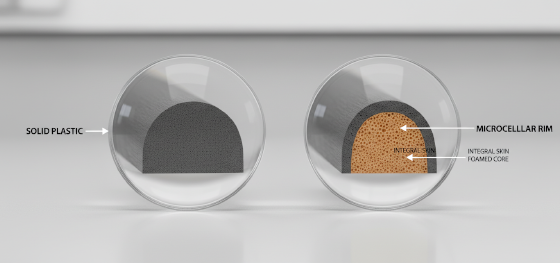
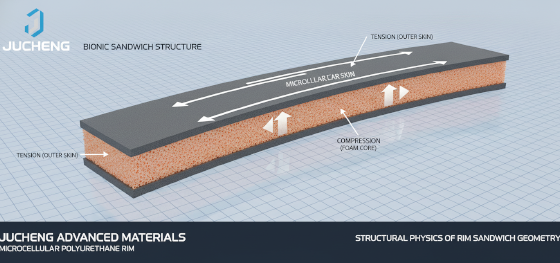
Structural performance in microcellular polyurethane RIM is governed by the laws of bionic geometry. Unlike a solid plastic part that has uniform density, a microcellular part consists of three layers: two high-density solid exterior skins and one low-density micro-porous core. This is essentially an "I-Beam" in every direction. When a robot fender is hit, the outer skin handles the tensile and compressive loads, while the foam core acts as a shear-resistant spacer. Jucheng Precision performs free DFM analysis in 24 hours to optimize the thickness of these skins, ensuring that your prototype robot remains rigid even when the total material volume is reduced.
Can a foamed part hold metallic threads?
Yes. Jucheng utilizes localized densification or overmolds metal inserts into the solid skin areas, providing unyielding torque resistance even in lightweight panels.
Laminar flow control is the secret to achieving a perfect "Integral Skin." During the injection phase, the liquid polyurethane hits the cold walls of the aluminum mold and solidifies instantly, forming a non-porous exterior. The blowing agent then triggers the foaming reaction in the warmer center of the part. Jucheng’s engineering team utilize 25 5-axis Haas/Mazak units to machine intricate venting channels into the mold parting lines. These vents allow the air to escape ahead of the expanding foam, preventing the "Surface Pockmarks" that ruin the aesthetics of low-tier foamed parts.
Internal rib design must be adapted for the microcellular process. In solid molding, thick ribs cause sink marks; in foamed RIM, the expansion of the bubbles actually pushes the material into the ribs, eliminating sinks entirely. This allows Jucheng Precision to mold complex internal reinforcement structures that are impossible to achieve with injection molding. By delivering high-stiffness structural plastic with zero surface defects, we allow your industrial designers to maintain a clean "Apple-style" exterior while the mechanical engineers get the structural backbone they need for high-torque robotic joints.
Technical Data: Comparing Density and Structural Performance
Success in hardware optimization depends on the numbers. If your design assumes the density of water but you receive the weight of a brick, your autonomous platform will be underpowered. Jucheng Precision provides full material characterization reports for every custom formulation. The following table compares the essential mechanical properties of microcellular polyurethane RIM against standard solid polymers for the current MedTech and robotic markets.
| Metric | Solid Polyurethane RIM | Microcellular RIM (Foamed) | Engineering Advantage |
|---|---|---|---|
| Specific Gravity (g/cm³) | 1.05 - 1.15 | 0.60 - 0.85 | 30-40% Mass Reduction |
| Flexural Modulus (psi) | 300,000 | 220,000 (Sandwich) | High Rigidity per Gram |
| Acoustic Damping (dB) | Low | Exceptional | Silences Motor Noise |
| Tooling Pressure (psi) | 50 - 100 | 40 - 60 | Enables Massive Parts |
The "Specific Gravity" data highlights why this process is a "Game Changer" for flying drones and handheld medical devices. By reducing the density below 1.0, Jucheng creates parts that are literally lighter than water but have the surface hardness of a car bumper. This mass reduction is the primary driver of energy efficiency in electric autonomous fleets, as it reduces the power required for every start-stop cycle. Our Shenzhen hub manages these density targets with +/- 2% precision, ensuring that part #1 and part #500 have identical centers of gravity for your flight control software.
Hidden Benefits: Mastering Acoustic Damping and Insulation
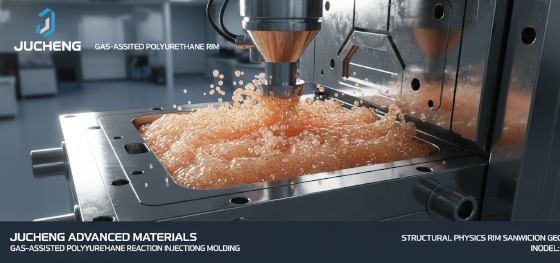
Beyond weight reduction, microcellular polyurethane RIM provides mechanical advantages that solid plastics cannot match. The micro-bubbles within the core act as millions of tiny shock absorbers, dissipating kinetic energy before it can travel through the frame. This results in high internal damping coefficients that are essential for robots operating in quiet clinical or office environments. If your robot's gearboxes or cooling fans are too noisy, a microcellular enclosure acts as a natural "Muffler," soaking up high-frequency vibrations and delivering the mechanical silence that defines a premium product.
Does it dampen motor noise?
Yes. The porous core breaks up sound waves, reducing the "Rattle" of internal robotic components by up to 15 decibels compared to thin-walled injection molded shells.
Thermal insulation is the second hidden superpower. In medical diagnostic equipment containing high-power lasers or MRI coils, localized heat can be dangerous for patients and technicians. Standard plastic enclosures conduct this heat directly to the surface. Jucheng’s microcellular RIM parts act as a thermal insulation barrier, keeping the exterior skin cool to the touch even when internal components are running hot. This removes the need for expensive internal insulation blankets and simplifies your thermal management strategy, reducing the total footprint of your machine.
Environmental resilience in [2026] hardware is further enhanced by the "Gas-Shield" effect. Because the core is micro-porous, the part handles thermal expansion differently than solid plastic. It exhibits a lower "Coefficient of Linear Thermal Expansion" (CLTE), meaning your large-scale robot fenders won't sag or "buckle" when moving from a cold warehouse into the hot sun. Jucheng Precision provides production-grade Polyurethane Molding Services that incorporate UV-blocking additives into the skin, ensuring your lightweight hardware survives years of outdoor exposure without color fading or brittle failure.
JUCHENG Strategy: Bridging Prototyping to Lightweight Production
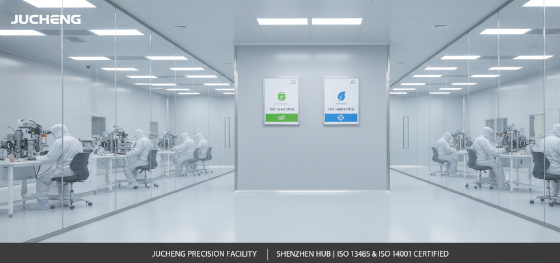
Dominating the robotics market requires a partner that can scale from a single functional Alpha unit to a commercial deployment of 5,000 Beta machines without losing a gram of efficiency. Jucheng Precision operates with a 24/7 manufacturing mindset in our Shenzhen precision manufacturing hub, delivering high-tolerance microcellular components with industry-leading speed. we provide a "Bridge to Production" that ensures your innovations move from concept to pilot run with 100% metallurgical and chemical confidence.
Integrating your structural design with Jucheng’s expertise ensures that your microcellular polyurethane RIM decision is based on performance data, not guesswork. we offer comprehensive DFM reviews within 24 hours, identifying potential gas-trap zones or wall-thickness bottlenecks in your design before they become field failures. Whether you are building an autonomous vineyard scout or a heavy-duty industrial mobile base, Jucheng Precision provides the rigid, precise, and lightweight foundations that keep your innovation moving through the high-speed cycles and the years of hard labor.
Our facility is equipped with dedicated high-pressure RIM assembly cells and ISO-standard quality labs, allowing us to manage the entire hardware lifecycle in one location. we manage the complexity of multi-material bonding and gas-injection chemistry so your engineering team can focus on the motion control and the AI. By combining Shenzhen's speed with industrial-grade material verification and global quality standards, Jucheng Precision remains the preferred partner for the world's most aggressive high strength plastic machining challenges. Contact us today to start your next project.
FAQ: Logistics and Performance of Foamed Polyurethane Parts
Is the surface of a foamed part smooth enough for painting?
Yes. The integral skin formed against the mold is 100% solid and smooth, making it ideal for automotive-grade high-gloss painting.
What is the maximum part length Jucheng can foam?
We regularly produce microcellular structural panels up to 2,500mm in length with consistent density across the entire span.
Does foaming reduce the impact strength?
Actually, the sandwich structure often handles impact energy better than solid plastic because the foam core deforms to absorb the shock.
Can I get 50 units with custom EMI shielding?
Yes. we specialize in applying conductive coatings to the internal skin of microcellular shells for regulatory compliance.
What is the lead time for a foamed Alpha prototype?
Functional foamed parts from aluminum rapid tooling are typically delivered in 15 to 18 business days.
Inertial mass and vibration noise are absolute innovation killers for high-end mobile robotics. Partnering with Jucheng Precision ensures that your functional iterations are built with the energy-saving polyurethane reaction injection molding and specialized microcellular polyurethane RIM techniques the industry demands. Reach out to our Shenzhen manufacturing hub today for a complete DFM review and build the high-fidelity foundation your autonomous fleet requires.

