


Slashing open a freshly cured block of silicone with a surgical scalpel requires both brute force and paranoid precision. Last week, I watched a junior technician attempt a perfectly straight cut down the center of a complex drone housing mold. When we locked the halves together and pulled the vacuum, the liquid polyurethane instantly squeezed through the flat seam. Opening the chamber revealed a useless plastic blob encased in razor-sharp, paper-thin flash. Mastering the dark art of parting line design in Silicone Molds dictates the absolute cosmetic survival of your vacuum casting production run.
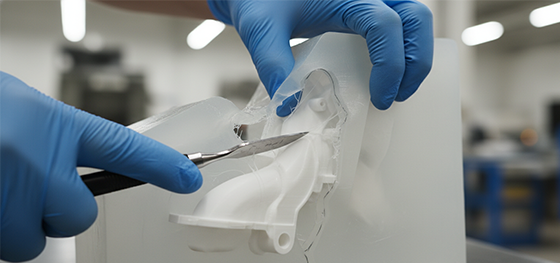
Choosing between manual scalpel separation and rigid taped boundaries represents the ultimate quality crossroads for low-volume urethane casting. Unlike multi-ton steel injection dies that utilize CNC-milled, crush-proof steel parting lines, flexible tooling relies entirely on the operator's steady hand to create microscopic mechanical interlocks. A poorly designed split line allows negative atmospheric pressure to violently suck the liquid resin outward, destroying critical geometric tolerances and inciting massive manual rework.
Evaluating this specific polymer matrix aggressively prevents catastrophic non-recurring engineering (NRE) losses. Procurement engineers must brutally evaluate thermal degradation limits, severe undercut extraction capabilities, and the hidden costs of manual deflashing. Surviving [2026] agile hardware scaling demands treating soft tooling with the exact same mathematical paranoia as hardened steel.
content:
Why Do Straight Parting Lines Ruin Soft Tooling Cavities?
How Does Tape and Clay Dictate the Physical Boundary?
Can Soft Cavities Handle Deep Negative Undercuts?
Why Does Thermal Degradation Kill Molds After Twenty Shots?
What Are the True Cost Breakdowns Against Injection Tooling?
How Does Jucheng Optimize Vacuum Casting in Shenzhen?
What Are the Most Critical Soft Tooling Defect FAQs?
Why Do Straight Parting Lines Ruin Soft Tooling Cavities?
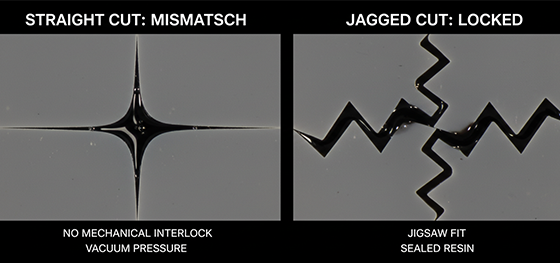
Does a perfectly flat cut prevent resin leakage? Absolutely not. A flat, straight slice through the rubber provides zero mechanical interlocking, allowing the two flexible halves to slide and mismatch microscopically under intense vacuum pressure.
When a toolmaker extracts the SLA master pattern by cutting the cured block open, they must intentionally execute an erratic, zig-zagging wavy motion with the scalpel. This chaotic path creates thousands of highly specific peaks and valleys along the entire perimeter. When the operator reassembles the empty mold, these jagged edges act like a complex 3D jigsaw puzzle, physically locking the two halves together in space.
If an amateur slices straight down the middle, clamping the mold shut applies asymmetrical pressure. The rubber faces shear against each other, displacing the internal cavity by a fraction of a millimeter. The resulting cast part emerges with a horrific "step" defect running down its center, permanently ruining any chance of achieving a Class-A cosmetic surface finish or a tight assembly tolerance.
How Does Tape and Clay Dictate the Physical Boundary?
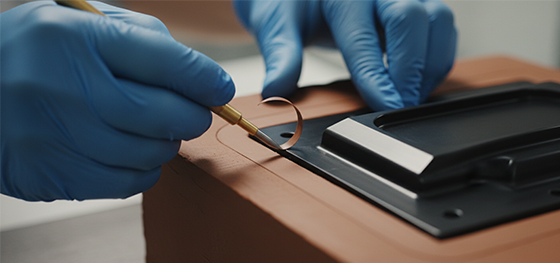
Is the scalpel the only way to establish a parting seam? No. For ultra-complex geometries, engineers bury the master pattern halfway in industrial modeling clay to mathematically dictate the exact parting plane before pouring the first liquid batch.
The two-part pour technique completely bypasses the brutal manual cutting process. Technicians construct a bounding box, lay down a bed of sulfur-free clay, and painstakingly press the master part into it. Using custom dental tools, they scrape the clay perfectly flush against the desired equator of the prototype. The team pours the first half of the rubber and lets it cure.
After removing the clay, they apply a chemical release agent and pour the second half directly over the cured first half. This method guarantees a flawless, gap-free parting line that follows bizarre organic contours perfectly. However, this intensive manual labor doubles the initial setup time, forcing procurement teams to balance upfront labor hours against the risk of catastrophic flash generation.
Can Soft Cavities Handle Deep Negative Undercuts?
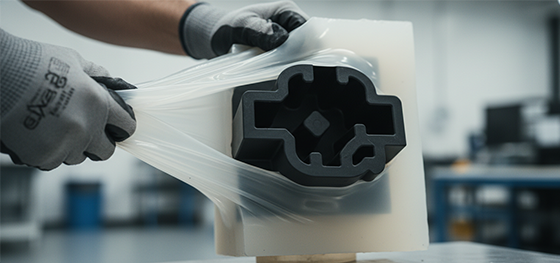
Do you need complex hydraulic sliders to release trapped plastic features? Never. The intrinsic flexibility of the rubber completely eliminates the need for expensive mechanical side-actions required by traditional rigid steel dies.
When an injection molding press encounters a deep, negative undercut (like a hollow side port), it requires heavy steel lifters that mechanically slide out of the way before ejection. This adds tens of thousands of dollars to the NRE tooling budget. Soft tooling ignores this constraint entirely. The operator literally bends, twists, and violently peels the rubber cavity away from the rigid polyurethane replica.
This physical elasticity empowers hardware designers to execute incredibly aggressive geometries—such as reverse-tapered snap hooks or enclosed helical threads—that would otherwise be financially impossible to prototype. Engineers must deliberately select a lower Shore A hardness (typically 30A to 40A) for the base material to ensure maximum stretchability without prematurely ripping the tool during brutal extraction cycles.
Why Does Thermal Degradation Kill Molds After Twenty Shots?
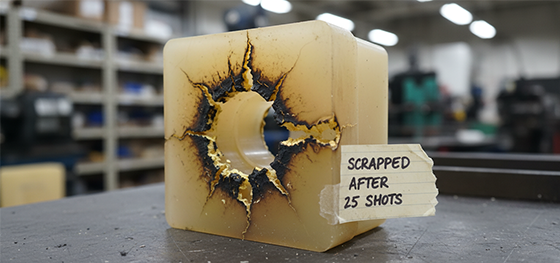
Can a rubber mold produce thousands of parts like an aluminum die? Absolutely not. The intense exothermic chemical reaction generated by curing polyurethane physically bakes the surrounding cavity walls until they turn brittle and fracture.
Liquid urethane resins generate massive internal heat as their molecular chains cross-link and solidify inside the vacuum chamber. The surrounding rubber absorbs this thermal blast repeatedly. By the fifteenth or twentieth casting cycle, the extreme temperature fluctuations extract all the natural plasticizers out of the cavity face. The once-flexible surface scorches yellow, turns microscopic ally rigid, and begins to crack.
Once the cavity surface degrades, the liquid resin seeps into those micro-fissures and mechanically locks onto the mold. Attempting to demold the next part aggressively rips chunks of the rubber wall right out of the block. Procurement planners must strictly budget for a complete tool replacement every 20 to 25 shots when scaling bridge production into the hundreds.
| Manufacturing Metric | Vacuum Casting (Soft Tooling) | Injection Molding (Hard Tooling) | Financial & Engineering Impact |
|---|---|---|---|
| Upfront NRE Tooling Cost | $300 - $1,500 | $10,000 - $80,000+ | Soft molds protect early-stage cash flow |
| Expected Lifespan | 15 - 25 Parts Max | 500,000 to 1 Million+ Shots | Thermal degradation destroys rubber rapidly |
| Geometric Flexibility | Infinite (Mold stretches over undercuts) | Restricted (Requires sliders & draft) | Soft tooling ignores traditional DFM rules |
| Per-Unit Part Cost | High ($15 - $50+) | Extremely Low ($0.10 - $2.00) | Steel dominates ultimate mass-production margins |
What Are the True Cost Breakdowns Against Injection Tooling?
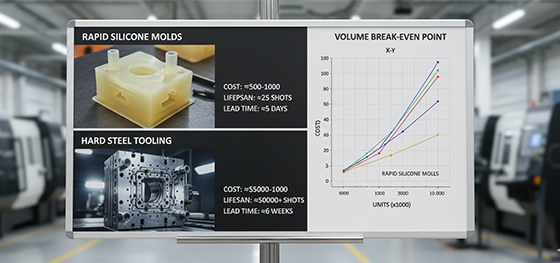
Where is the exact financial intersection where soft tooling becomes too expensive? Calculating the amortization curve against part replacement volume dictates the absolute limit of bridge manufacturing operations.
Assume an ABS medical enclosure costs $800 to master and mold via vacuum casting, plus $25 per poured urethane replica. Executing a 20-piece clinical trial run totals a mere $1,300. Commissioning a hard steel injection die for that exact same enclosure costs $20,000 in upfront NRE, but drops the unit price to $1.00. Making those same 20 parts via injection molding incinerates $20,020. The soft process dominates prototype economics.
However, scaling aggressively to 2,000 units violently punishes the soft strategy. Pouring 2,000 urethane parts requires purchasing 100 separate replacement cavities (due to thermal burnout), dragging the total invoice past $60,000. The injection molding route handles 2,000 units effortlessly for a combined total of only $22,000. Data-driven executives never push vacuum casting past its mathematical breaking point.
How Does Jucheng Optimize Vacuum Casting in Shenzhen?
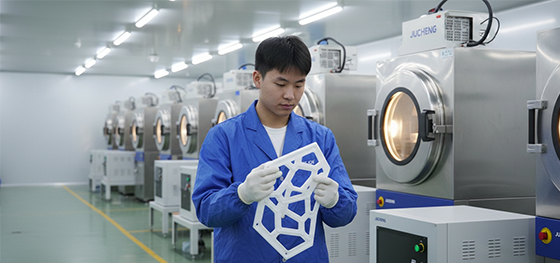
Can a facility mathematically prevent severe flash before the first pour? Yes. Operating within the [2026] Shenzhen precision manufacturing hub, Jucheng deploys elite SLA master pattern generation and master-level scalpel technicians to guarantee zero-mismatch seams.
Navigating global hardware procurement demands an absolute elimination of disconnected vendor handoffs. We do not rely on outsourced 3D printing bureaus to supply master patterns with sloppy layer lines. Our 8000-square-meter facility executes optical-grade SLA printing internally, heavily polishing the master to an SPI A-2 mirror finish before it ever touches the liquid rubber.
Our engineering teams intervene aggressively during the CAD transition phase. Backed by strict ISO9001:2015 protocols, our Free DFM reviews identify deep internal cores that require pre-planned air venting channels to prevent trapped bubbles under negative pressure. We engineer absolute survivability without MOQ restrictions.
What Are the Most Critical Soft Tooling Defect FAQs?
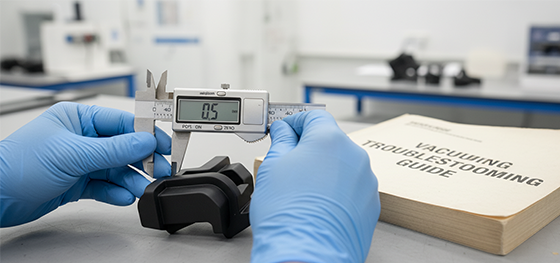
Resolving hardcore chemical and vacuum variables prevents devastating cosmetic rejections when deploying cast polyurethanes into consumer-facing environments.
What causes massive voids or air bubbles inside the cast urethane?
Voids occur when the vacuum chamber fails to extract trapped oxygen before the resin's "pot life" expires and it gels. Complex geometries with blind pockets require technicians to surgically cut tiny air-escape vents directly into the rubber block, allowing the negative pressure to physically pull the liquid resin upward into the dead zones.
Can you cast multiple different materials in the same cavity?
Yes, this is known as overmolding. Operators can pour a rigid ABS-like core, let it partially cure, suspend it inside a slightly larger secondary mold, and pour a soft TPR-like rubber directly over it. The chemical heat fuses the two polyurethanes together permanently, perfectly simulating complex multi-shot injection molded consumer electronics handles.
Does the color of the silicone indicate its quality?
No, the color is typically an artificial dye added by the manufacturer to indicate the Shore A hardness rating or to ensure proper mixing of the two-part platinum catalyst. However, translucent silicone is highly favored by elite shops because it allows technicians to visually see the scalpel blade and the master pattern during the highly dangerous manual cutting phase.

