


Constructing the structural backbone of a prototype robot in [2026] requires a departure from the "aesthetic-first" mindset of consumer electronics. On the factory floor or in the muddy terrain of an agricultural trial, the chassis is the primary shield against mechanical chaos. If the frame flexes under the weight of heavy lithium batteries or high-torque actuators, the entire kinematic model of the robot collapses. Achieving the necessary rigidity without bloating the machine’s mass demands a sophisticated approach to Prototyping robot chassis and frames that leverages hybrid fabrication techniques to ensure field-ready durability.
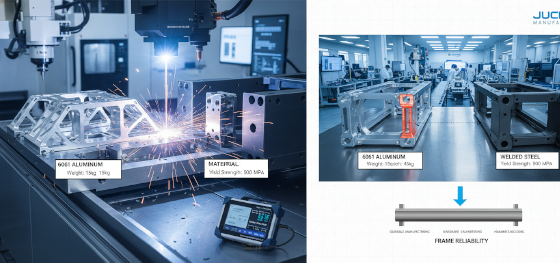
Robotic skeletons are the most difficult components to iterate because they dictate the mounting points for every other system. A mistake in the chassis parallelism can cause a multi-thousand dollar LiDAR sensor to be misaligned by several degrees, rendering the autonomy software useless. Jucheng Precision addresses these foundational risks by providing an integrated service that combines the speed of laser-cut sheet metal with the micron-level precision of 5-axis CNC machining. We manufacture the "bones" that allow your robot to stand tall, move fast, and survive the first 1,000 hours of stress testing.
Operating within the Shenzhen precision manufacturing hub, JUCHENG serves as the high-strength fabrication partner for global robotics OEMs. We transform oversized CAD files into stabilized chassis units that serve as the rigid anchor for the robot’s drive-train and sensor stack. This guide explores the essential hybrid fabrication standards, material selection trade-offs, and alignment strategies required for manufacturing Prototyping robot chassis and frames hardware that survives the scrutiny of real-world physics and extreme environmental loads.
Hybrid Fabrication: Merging Sheet Metal and CNC Precision
Technical Data: Comparing Alloys for Robot Skeletons
Material Selection: 6061 Aluminum vs. High-Strength Steel
Alignment Accuracy: Squaring Motor Mounts and Gearbox Seats
JUCHENG: The Shenzhen Hub for Large-Scale Robot Frames
FAQ: Engineering Skeletons for High-Performance Robotics
Hybrid Fabrication: Merging Sheet Metal and CNC Precision
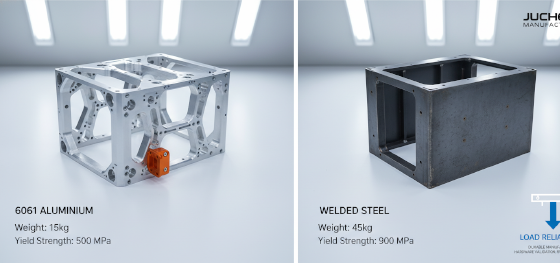
Efficiency in Prototyping robot chassis and frames is often found in the synergy between subtractive and additive fabrication. For a large mobile robot, machining the entire chassis from a single aluminum billet is a financial suicide due to the massive waste and machine time. JUCHENG utilizes a hybrid approach: we laser-cut and bend the primary structural panels from high-strength steel or aluminum sheet, then weld precision CNC-machined "hard-points" directly into the frame. This ensures that the bulk of the chassis is cost-effective to produce, while the critical motor mounts and sensor interfaces maintain aerospace tolerances.
Weld-distortion management is the primary technical challenge of this hybrid method. Heating the metal during welding causes internal stresses that can pull a prototype robot frame out of square by several millimeters. JUCHENG utilizes specialized water-cooled welding jigs and staggered weld sequences to minimize thermal movement. For high-precision Beta units, we perform "Post-Weld CNC Machining." We fabricate the frame slightly oversized, then mount the entire welded assembly onto our large-scale CNC gantry mills to finish-machine the mounting surfaces, ensuring they are perfectly coplanar and parallel regardless of weld pull.
Internal reinforcement via internal webbing or honeycombs is integrated during the sheet-metal phase. JUCHENG utilizes tab-and-slot design logic, where internal ribs interlock with the external skin before welding. This creates a "monocoque" structure that is incredibly rigid under torsional loads—essential for robots navigating uneven agricultural fields or warehouse stairs. By holding +/- 0.1mm on the laser-cut tabs, we ensure that the frame "self-squares" during assembly, reducing the manual labor required for alignment and shortening the overall lead time.
Consolidation of parts is the final goal of JUCHENG’s hybrid strategy. During the DFM review, we often suggest replacing several bolted brackets with a single multi-axis CNC component that also acts as a structural heat sink for the robot’s AI computer. This reduces the number of fasteners that can vibrate loose in the field and simplifies the assembly BOM. By treating the chassis as an integrated functional component rather than just a "box," JUCHENG delivers a prototype robot foundation that is lighter, stiffer, and faster to assemble.
Technical Data: Comparing Alloys for Robot Skeletons

Selecting the right substrate for a chassis determines the robot's "Structural Duty Cycle." For high-speed drones, weight is the only metric; for autonomous tractors, yield strength and fatigue resistance rule the day. Jucheng Precision provides technical consultations to help you balance stiffness-to-weight ratios. The following table compares the physical performance of materials used in high-end Prototyping robot chassis and frames for the [2026] market.
| Material Grade | Yield Strength (MPa) | Fatigue Life | Primary Application |
|---|---|---|---|
| 6061-T6 Aluminum | 240 - 270 | Moderate | Mobile AMR / Humanoid Frames |
| 7075-T6 Aluminum | 500 - 540 | High | High-Impact Legs / Joints |
| A36 Carbon Steel | 250 - 300 | Very High | Heavy Payload Tractors |
| 4130 Chromoly | 430 - 460 | Exceptional | Off-Road Scout Skeletons |
A36 Steel remains the workhorse for industrial robot parts that must operate in remote, rugged environments. While heavier than aluminum, steel offers a predictable "Ductile-to-Brittle" transition, making it safer for heavy-payload machines where sudden brittle failure could lead to catastrophic property damage. JUCHENG utilizes 12kW fiber lasers to cut these steel components with absolute edge-clarity, minimizing the heat-affected zone (HAZ) and ensuring that the structural integrity of the alloy is maintained throughout the Prototyping robot chassis and frames build.
Material Selection: 6061 Aluminum vs. High-Strength Steel
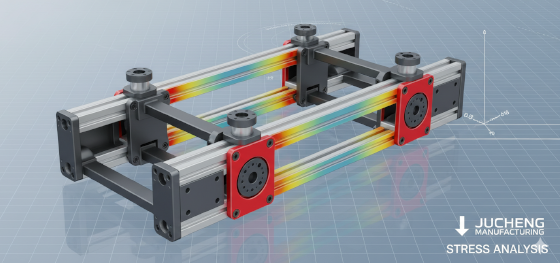
Choosing between aluminum and steel for a prototype robot chassis is a strategic decision that affects the entire drivetrain design. Aluminum 6061-T6 is the standard for collaborative and indoor mobile robots because it allows for a lighter machine that uses less power and responds faster to control inputs. However, aluminum has no "Endurance Limit"—meaning that even small loads will eventually cause it to crack over millions of cycles. JUCHENG recommends aluminum for Alpha builds and high-speed scouts where low inertia is the priority, but we always suggest thick-wall sections at motor interfaces to prevent thread-stripping.
High-strength steels like 4130 Chromoly are used when the robot must handle the crushing loads of industrial mining or heavy construction. Chromoly allows JUCHENG to use thinner wall sections than mild steel while maintaining superior impact toughness. We utilize specialized TIG welding with argon shielding to join these high-alloy skeletons, ensuring the joints are as strong as the base metal. This level of fabrication is essential for Prototyping robot chassis and frames hardware that will be subjected to the "Destructive Testing" phases required for industrial certification.
Surface treatments are tailored to the material choice. For aluminum frames, JUCHENG provides Type III Hard Anodizing, which creates a ceramic-like surface that is virtually scratch-proof and protects the mounting faces from "Galling." For steel frames destined for wet or muddy environments, we utilize a three-stage process: sandblasting, zinc-rich epoxy primer, and industrial powder coating. This ensures that the "Foundation" of your robot doesn't start to rust after its first week in the field, preserving the structural integrity of the prototype robot for years of iterative use.
Resonance damping must be considered during material selection. Steel frames are naturally more prone to "ringing" than aluminum ones. JUCHENG addresses this during the manufacturing process by integrating internal dampening plates or by overmolding high-stress joints with specialized elastomers. By controlling the harmonic noise of the chassis, we ensure that the robot's inertial measurement units (IMUs) and sensors receive a clean signal, free from the mechanical jitter that can confuse autonomy algorithms. Our Shenzhen facility provides the technical oversight to "tune" your frame for silence and stability.
Alignment Accuracy: Squaring Motor Mounts and Gearbox Seats
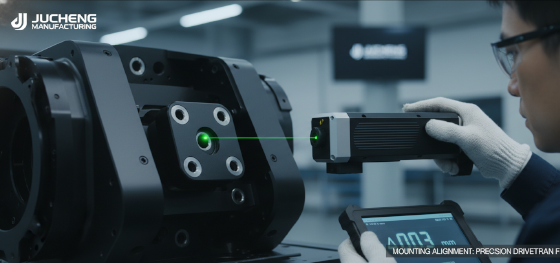
Dimensional "Squareness" is the silent requirement of high-performance Prototyping robot chassis and frames. If the four motor mounting plates on a four-wheel autonomous mobile robot (AMR) are not perfectly coplanar and square to the centerline, the robot will constantly "fight itself," leading to excessive tire wear and poor odometry accuracy. JUCHENG utilizes oversized coordinate measuring machines (CMM) to verify the geometric alignment of every frame we build. We ensure that the drivetrain registration features are square within 0.05mm across a two-meter span, providing the "Geometric Zero" your software expects.
Concentricity of axle bores is another critical focus area. In industrial robot parts, any eccentricity in the axle mount leads to cyclic vibration that destroys gearboxes. JUCHENG utilizes specialized line-boring techniques on our CNC mills to finish the axle seats *after* the frame is welded. This ensures that the left and right wheel axes are perfectly co-linear, reducing the parasitic friction in the drivetrain and extending the robot’s battery life. By machining the frame as a complete assembly, we eliminate the "tolerance stack-up" errors that occur when bolting multiple separate brackets together.
Thread integrity in the chassis is non-negotiable. A stripped thread in a two-meter steel frame is a nightmare to repair in the field. JUCHENG utilizes precision CNC tapping and provides hardened steel Helicoil or Keensert inserts in all high-torque aluminum chassis mounting points. This ensures that your motors and sensors can be swapped out dozens of times during the prototype robot development cycle without damaging the primary structure. We deliver a "Maintenance-Friendly" skeleton that is built to be disassembled and reassembled as your design evolves.
Integrated thermal interfaces are machined directly into the chassis hard-points. For robots with high-power motor controllers, JUCHENG machines mirror-flat mounting surfaces (+/- 0.005mm) that allow the frame to act as a giant heat sink. By providing a continuous thermal path from the motor through the chassis to the external air, we prevent the "Internal Cooking" effect that can kill sensitive AI compute stacks during high-load tests. This level of advanced thermal engineering is integrated into every Prototyping robot chassis and frames project we manage in our Shenzhen hub.
JUCHENG: The Shenzhen Hub for Large-Scale Robot Frames
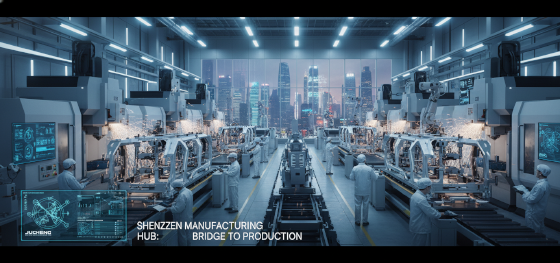
Dominating the [2026] robotics market requires a partner that can handle the physical scale of modern autonomous fleets. Jucheng Precision operates with a 24/7 manufacturing mindset in our Shenzhen precision manufacturing hub, delivering high-tolerance robot chassis and structural components with lead times as fast as 15 business days. We provide a "Bridge to Production" that allows you to move from a single hand-welded skeleton to a commercial fleet of 100 Alpha robots with consistent metallurgical and dimensional quality.
Integrating your structural design with JUCHENG’s expertise ensures that your prototype robot survives the "First-Field Season" and moves into mass adoption. We offer comprehensive DFM reviews within 24 hours, identifying potential fatigue points or "weld-traps" in your design before they become field failures. Whether you are building an autonomous vineyard scout or a heavy-duty industrial mobile base, Jucheng Precision provides the rigid, precise foundations that keep your innovation moving through the high-speed cycles and the years of hard labor.
Our facility is equipped with 150+ CNC machines, including oversized 5-axis trunnions and gantry mills, allowing us to manage the entire chassis lifecycle in one location. We manage the complexity of hybrid fabrication and precision alignment so your engineering team can focus on the autonomy and the AI. By combining Shenzhen's speed with industrial-grade material verification, JUCHENG remains the preferred partner for the world's most aggressive Prototyping robot chassis and frames challenges. Contact us today to start your next project.
FAQ: Engineering Skeletons for High-Performance Robotics
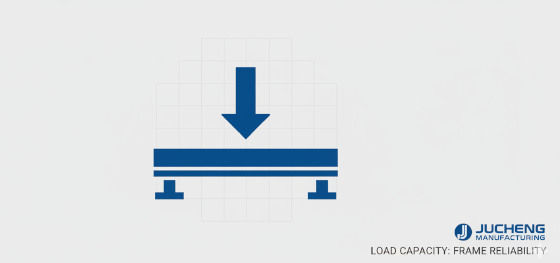
Is aluminum strong enough for an off-road robot chassis?
Only if thick-wall 6061-T6 or 7075-T6 is used. For heavy-payload AgTech, steel box-frames provide better fatigue resistance.
How do you prevent frame warping after welding?
We utilize precision welding jigs and perform post-weld CNC machining to ensure mounting surfaces are perfectly flat.
Can JUCHENG machine large-scale frames up to 2 meters?
Yes. Our gantry milling centers handle robot chassis and structural components up to 3,000mm in length.
What tolerance is required for motor mounting patterns?
We hold +/- 0.01mm on motor registration pilots to ensure zero-play coaxial alignment with the drivetrain.
What is the typical lead time for a custom welded robot frame?
Fully fabricated and finish-machined frames are typically delivered in 15 to 20 business days.
Structural failures in the field are absolute hardware killers. Partnering with Jucheng Precision ensures that your skeletons are built with the high-strength aluminum and specialized hybrid fabrication techniques the industry demands. Reach out to our Shenzhen manufacturing hub today for a complete DFM review and build the rigid foundation your autonomous fleet requires.

