


Validating high-stress mechanical fits using production-grade materials is a major hurdle in physical product development. Specifying cnc rapid prototyping provides your custom brackets, automotive manifold blocks, and medical device frames with unmatched dimensional precision and real mechanical strength. This subtractive process acts as the premier rapid prototyping service, utilizing automated cutting tools to shave material away from solid blocks, ensuring that your parts align perfectly under severe test vibrations.

Suffer from layered 3D printed brackets that delaminate, warp, or crack during initial functional stress trials? While additive printing is exceptionally fast for visual models, the resulting parts possess anisotropic grain structures and low density, making them highly vulnerable to mechanical failure. Transitioning to a high-speed CNC milling strategy completely removes these physical limits, delivering structural parts carved directly from certified billet stock.
Let's explore why direct milling outperforms additive manufacturing for structural testing, analyze the performance limits of engineering plastics and non-ferrous metals, and review the micron-level tolerances achieved by multi-axis machining centers.
Why Choose CNC Over 3D Printing for Prototypes?
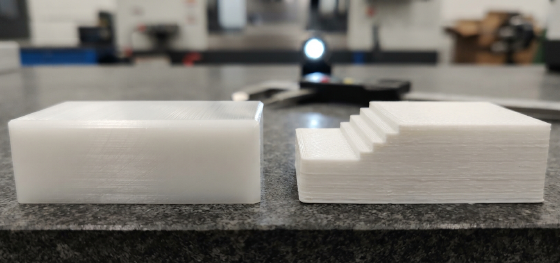
For engineers designing load-bearing components, choosing the correct cnc rapid prototyping path dictates whether your test data remains valid. Additive 3D printing builds parts layer-by-layer, introducing micro-gaps and weak planes between fused tracks. When these printed units experience torsional loads, they split easily along these laminate lines.
Subtractive machining completely eliminates these mechanical weaknesses. By carving parts directly from isotropic, extruded plastic blocks or forged metal billets, the finished components retain 100% of the raw material's physical density. This structural integrity ensures that your prototypes behave exactly like final, mass-produced parts, establishing a highly reliable rapid prototyping process for critical flight-tests or clinical evaluations.
Machining End-Use Engineering Plastics and Metals
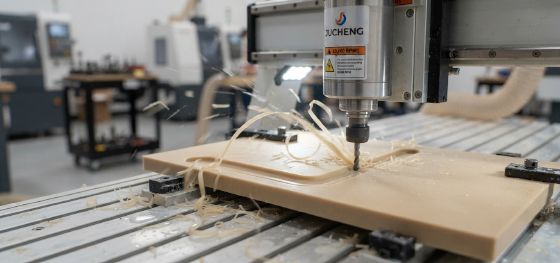
Sourcing advanced polymers and high-hardness alloys that cannot be easily printed is a primary advantage of subtractive machining. While standard 3D printers are restricted to brittle resins or soft nylons, our CNC workstations cut virtually any solid material, including ultra-hard PEEK, dimensionally stable POM-H (Delrin), and glass-filled engineering plastics.
This materials versatility is equally powerful for metal brackets. We cut and form high-purity aluminum alloys, high-nickel stainless steels, and aerospace-grade titanium with extreme accuracy. By utilizing high-volume coolant lines to dissipate friction heat, we prevent localized microstructural changes, delivering clean, warp-free prototypes with highly uniform mechanical properties.
Achieving Tight Tolerances with 5-Axis CNC

When your custom components feature complex, multi-angled geometries (such as internal hydraulic ports or angled sensor mounts), traditional 3-axis mills require multiple, manual part setups. Each repositioning step introduces positional alignment variations, making it nearly impossible to hold tight spatial tolerances across different faces.
We resolve these alignment errors by utilizing advanced five-axis CNC machining. Five-axis centers rotate the part along two additional rotational axes during cutting, allowing us to machine complex geometries in a single setup. This single-clamp processing completely eliminates cumulative repositioning drifts, allowing us to hold exceptionally tight tolerances down to ±0.015mm across all critical dimensions, ensuring perfect part-to-part alignment.
Massive Capacity at Jucheng Precision
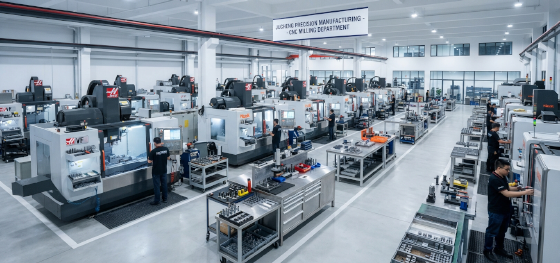
Bypassing lead-time bottlenecks during the critical prototype-validation phase is essential to securing your targeted time-to-market. Jucheng Precision operates a fully integrated, state-of-the-art 8000-square-meter facility housing over 150 CNC machining centers, including 25 high-precision 5-axis Haas and Mazak workstations. This massive in-house capacity ensures that your rapid prototyping runs are launched immediately, eliminating the multi-week delays common when outsourcing to fragmented, small-scale handtool shops.
Our machining floor operates under a unified quality system certified to ISO 9001 and IATF 16949 standards, ensuring that custom automotive and industrial brackets meet strict regulatory requirements. As your premier rapid prototyping service, we offer a 24-hour free DFM analysis to check your 3D CAD files for tool clearances and bend limits before production. Supported by our flexible no MOQ policy and rapid delivery guarantee, we manage your project from initial flat pattern cutting to final, high-durability packaging and assembly with zero dimensional drift.
FAQ: Critical Questions About CNC Rapid Prototyping
Our engineering team has compiled professional, concise solutions to the most common quality and cost challenges faced during custom CNC prototyping runs:
Is CNC prototyping faster than standard 3D printing?
For a single visual mock-up, 3D printing is often faster; however, for a batch of 5 to 50 functional brackets, Jucheng Precision's high-speed multi-axis mills deliver parts faster using production-grade materials.What are the tightest tolerances Jucheng Precision can achieve on milled prototypes?
We operate high-end 5-axis centers that hold standard linear tolerances of ±0.015mm, and can execute post-milling reaming to achieve exceptionally tight bore limits within ±0.008mm.Why is POM plastic heavily specified for custom prototyping?
POM features excellent dimensional stability, low water absorption, and high sliding lubricity, allowing us to machine intricate mechanical snap-fits and custom gears that behave predictably.How do you verify the dimensional tolerance compliance of custom cnc rapid prototyping batches?
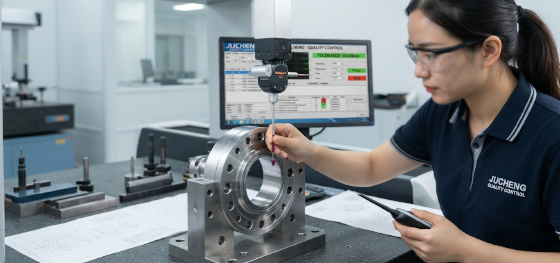
We execute rigorous in-process inspections using automated height masters and verify final complex spatial coordinates using our in-house Zeiss coordinate measuring machines (CMM) before final shipping.

