


Watching a 1.5-meter long robot fender droop on a hot afternoon in [2026] reveals the hidden physical limit of standard polymers: thermal expansion. While the reaction injection molding process is legendary for creating large, dent-resistant parts, pure polyurethane still behaves like a plastic when the sun hits it—it expands and loses rigidity. For heavy-duty Industrial Robot Parts or automotive body panels, this "part sag" is a mission killer. Achieving metal-like stability while keeping the weight and cost low requires a strategic shift toward Reinforced Polyurethane RIM (RRIM) to turn a standard liquid resin into a high-performance structural composite.

Dimensional stability in large-scale hardware is not just a cosmetic preference; it is a sensor requirement. If a robot's shell grows by 5mm due to heat, the mounting points for high-resolution LiDAR and cameras will shift, throwing off the autonomy stack's calibration. Jucheng Precision addresses these "Thermal Drift" challenges by providing High Strength Plastic Machining and molding that incorporates milled glass fibers or minerals directly into the liquid stream. 我们 deliver hardware that stands as rigid as a steel plate but weighs 50% less, ensuring your autonomous fleet maintains sub-millimeter precision in any climate.
Operating within the Shenzhen precision manufacturing hub, JUCHENG acts as the composite engineering partner for global OEMs. We transform raw liquid chemistry into validated, fiber-reinforced skins that protect your technology from the physical and thermal chaos of the field. This guide is a down-to-earth look at what makes RRIM different, how much stiffer it actually is, and why adding "milled glass" is the secret to building prototype robot units that never warp. Let's explore the science of Reinforced Polyurethane RIM (RRIM).
Defining RRIM: What is it and why add fibers?
Technical Data: Comparing CLTE and Flexural Modulus
Dimensional Stability: How to Stop Parts from Growing?
High-Heat Resilience: Surviving Foundries and Solar Loads
JUCHENG Hub: Managing Abrasive RRIM Slurries in Shenzhen
FAQ: Real Answers for Structural Reinforcement and Tool Wear
Defining RRIM: What is it and why add fibers?
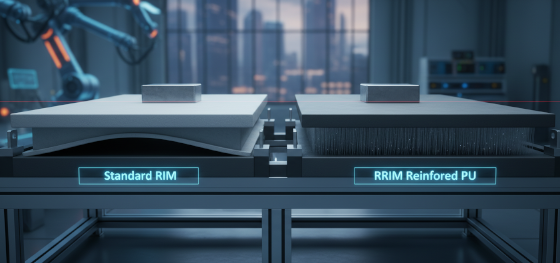
Think of standard RIM as unreinforced concrete and Reinforced Polyurethane RIM (RRIM) as rebar-reinforced concrete. The "muscles" of the part are the A and B components, but the "bones" are the millions of microscopic glass fibers mixed into the liquid polyol. During the high-pressure impingement mix, these fibers (typically 1.5mm to 3.0mm long) are suspended in the liquid. When the material enters the mold, the fibers orient themselves along the flow lines, creating a structured matrix. JUCHENG utilize specialized abrasion-resistant mixing heads to handle these "slurries," ensuring that the reinforcement is uniform and zero "clumping" occurs in the finished robot shell.
Does adding fibers make the surface rough?
Actually, no. JUCHENG utilizes a "Skinning" cycle where the liquid resin forms a smooth, fiber-free outer layer against the mold, keeping the glass internal and the surface ready for automotive paint.
Rigidity is the primary reason for choosing RRIM over standard RIM. In [2026] industrial automation, parts are getting larger and faster. A standard polyurethane enclosure can exhibit "oil-canning"—a popping or flexing effect when the robot accelerates. By adding just 15% milled glass fiber, JUCHENG increases the flexural modulus of the material by over 100%. This transforms a flexible fender into a structural component that can support internal electronics mounts and cable trays directly, reducing the need for heavy internal steel sub-frames and simplifying your assembly Bill of Materials (BOM).
Mineral reinforcement is an alternative to glass for parts requiring a high-gloss aesthetic. While glass fibers offer ultimate strength, mineral fillers like Wollastonite provide better surface smoothness and improved dimensional stability in all directions (isotropic shrinkage). JUCHENG’s engineering team analyzes your part's load profile during the DFM phase; if you need a mirror-finish medical housing that won't warp, we recommend mineral-reinforced RIM. If you need an unbreakable agricultural bumper that can take a rock-strike, we move to glass-reinforced slurries. This material flexibility is what defines high-tier Polyurethane Molding Services in our Shenzhen facility.
Technical Data: Comparing CLTE and Flexural Modulus

Success in High Strength Plastic Machining and composite molding depends on the numbers. If your design assumes the stiffness of aluminum but you receive the properties of rubber, your field trial will fail. Jucheng Precision provides full material characterization reports to help your FEA (Finite Element Analysis) teams predict hardware behavior. The following table compares the essential mechanical properties of Reinforced Polyurethane RIM (RRIM) against standard RIM and structural metals for the [2026] market.
| Property | Standard RIM PU | JUCHENG RRIM (15% Glass) | Aluminum 6061 |
|---|---|---|---|
| Flexural Modulus (psi) | 280,000 | 650,000 - 850,000 | 10,000,000 |
| CLTE (μm/m/°C) | 100 - 120 | 25 - 45 | 23 |
| Impact Strength (ft-lb/in) | 10.0 | 6.5 (Tougher core) | Low (Dents) |
| Specific Gravity | 1.05 | 1.25 | 2.70 |
The most shocking number in this table is the CLTE (Coefficient of Linear Thermal Expansion). By reinforcing the polyurethane, JUCHENG brings the thermal expansion of a plastic part down to the same level as aluminum. This is the "Holy Grail" for Industrial Robot Parts. It means that when you bolt a large RRIM shell to an aluminum chassis, they will grow and shrink at the same rate. This eliminates the stress on fasteners and the "buckling" of panels that occurs when standard plastics are forced to share a skeleton with metal.
Dimensional Stability: How to Stop Parts from Growing?
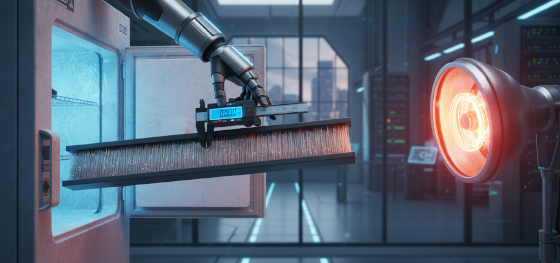
Controlling the "Growth" of large enclosures is the primary job of Reinforced Polyurethane RIM (RRIM). In outdoor AgTech or logistics robotics, parts can experience temperature swings of 50°C in a single day. A 2-meter long standard plastic part will expand by several millimeters in these conditions, causing doors to bind and sensor windows to pop out of their mounts. The glass fibers in RRIM act as internal "anchors" that physically restrain the polymer chains from moving. JUCHENG’s RRIM formulations maintain their dimensions within +/- 0.5mm across a massive span, providing the geometric certainty needed for high-precision autonomous navigation.
Is the expansion the same in all directions?
In standard RRIM, fibers align with the flow, making it stiffer in one direction. JUCHENG uses "Isotropic Fillers" (like minerals) if your part needs equal stability in all 3 axes.
Shrinkage management during the molding cycle is also improved with reinforcement. Pure resins have high shrinkage rates (up to 1.5%), which can make it hard to hit tight tolerances on large parts. Fibers reduce this shrinkage to less than 0.4%, essentially "locking in" the geometry of the aluminum mold. JUCHENG utilize 5-axis CNC to machine the molds with sub-micron precision, and the RRIM process ensures that the part that comes out is a perfect replica of the tool. This level of accuracy is what allows our clients to move from Alpha prototypes to Beta trials without having to "shim" their assemblies to make them fit.
Moisture absorption is the secondary enemy of stability. Some engineering plastics like Nylon swell when exposed to humidity. Polyurethane is naturally resistant to moisture, and the addition of glass reinforcement further reduces the surface permeability. JUCHENG’s High Strength Plastic Machining standards ensure that RRIM parts maintain their weight and dimensions even after being subjected to high-pressure washdown cycles or tropical humidity. This environmental resilience is why RRIM is the preferred material for the "Armor" of industrial robots working in foundries, car washes, and open-field farms in [2026].
High-Heat Resilience: Surviving Foundries and Solar Loads

Heat resistance is often the bottleneck for plastic Industrial Robot Parts. Standard ABS or PP will soften and deform when temperatures exceed 70°C. Reinforced Polyurethane RIM (RRIM) significantly increases the Heat Deflection Temperature (HDT) of the component. The fibers act as a structural scaffold that maintains the part's shape even when the polymer matrix begins to soften. JUCHENG’s RRIM parts can survive continuous exposure to 100°C+ environments, making them ideal for robot components mounted near engines, hydraulic pumps, or the high-output AI compute stacks that drive autonomous systems.
Does heat make the part more brittle?
No. The cross-linked thermoset nature of RIM polyurethane ensures it maintains its impact toughness even at high temperatures, unlike thermoplastics that can become unstable.
Solar loading is the most common high-heat challenge in [2026]. A dark-colored robot enclosure sitting in the sun can easily reach surface temperatures of 85°C. In these conditions, unreinforced parts will "creep"—deforming under their own weight over time. JUCHENG integrates UV-blocking additives and glass reinforcement to prevent this "thermal creep." By delivering hardware that resists the sun’s fire and the machine’s internal heat, we ensure your prototype robot stays calibrated and functional throughout the entire summer harvest or industrial shift, preventing the costly downtime of a "Sun-Warped" sensor mount.
Foundry and welding environments require even higher performance. JUCHENG utilizes specialized "Reinforced Structural Foam" RIM for these extreme scenarios. By combining glass reinforcement with a high-density skin and a cellular core, we create parts that act as thermal insulators. These RRIM shields protect the delicate internal wiring and sensors from the intense radiant heat of molten metal or welding arcs. Our Shenzhen hub manages the production of these "foundry-tough" components, allowing robotics OEMs to deploy their machines in environments that were previously reserved for heavy, expensive cast-iron assemblies.
JUCHENG Hub: Managing Abrasive RRIM Slurries in Shenzhen

Dominating the composite hardware market requires more than just mixing fibers; it requires machinery that can survive the process. Glass fibers are incredibly abrasive and can destroy standard molding pumps in days. Jucheng Precision operates with a 24/7 maintenance mindset in our Shenzhen precision manufacturing hub, utilizing hardened-steel pumps and specialized "non-clog" mixing heads designed specifically for Reinforced Polyurethane RIM (RRIM). We provide a "Bridge to Production" that ensures your innovations move from a CAD file to a commercial deployment of 5,000 units with consistent fiber density and dimensional quality.
Integrating your structural design with JUCHENG’s expertise ensures that your RRIM decision is based on performance data, not guesswork. We offer comprehensive DFM reviews within 24 hours, identifying potential fiber-orientation risks or "resin-rich" zones in your design before they become field failures. Whether you are building an autonomous vineyard scout or a heavy-duty industrial mobile base, Jucheng Precision provides the rigid, precise, and *reinforced* foundations that keep your innovation moving through the high-stakes cycles and the years of hard labor.
Our facility is equipped with 150+ CNC machines and dedicated high-pressure RRIM assembly cells, allowing us to manage the entire material and part lifecycle in one location. We manage the complexity of abrasive slurry mixing and robotic post-trimming so your engineering team can focus on the motion control and the AI. By combining Shenzhen's speed with industrial-grade material verification and global ISO 13485 standards, JUCHENG remains the preferred partner for the world's most aggressive High Strength Plastic Machining challenges. Contact us today to start your next project.
FAQ: Real Answers for Structural Reinforcement and Tool Wear

What is the maximum percentage of glass JUCHENG can add?
We regularly process RRIM formulations with 15% to 25% milled glass fiber, depending on the required stiffness and flow complexity.
Does glass reinforcement make the part heavier?
Slightly. Adding 15% glass increases density by about 20%, but the part is 3x stiffer, allowing you to use thinner walls and save total weight.
Can RRIM parts be CNC machined after molding?
Yes. We use specialized diamond-coated tooling to perform High Strength Plastic Machining on RRIM parts for sub-micron sensor fits.
How do you ensure the fibers are distributed evenly?
We use high-velocity impingement mixing and real-time slurry agitation to prevent glass settling in the tanks.
What is the typical lead time for a custom RRIM tool?
Custom aluminum RRIM molds are typically completed and delivering parts in 15 to 22 business days.
Thermal sagging and brittle warping are absolute innovation killers for large-scale robotics. Partnering with Jucheng Precision ensures that your functional iterations are built with the unyielding reaction injection molding process and specialized Reinforced Polyurethane RIM (RRIM) techniques the industry demands. Reach out to our Shenzhen manufacturing hub today for a complete DFM review and build the high-stiffness foundation your autonomous fleet requires.

