


Scaling the production of massive, structural enclosures for medical scanners or heavy-duty agricultural robots in [2026] requires a departure from traditional melt-flow physics. While standard injection molding struggles with the clamping forces and internal stresses of parts exceeding one meter, the reaction injection molding process offers a sophisticated alternative. By utilizing liquid chemistry rather than high-heat molten plastics, engineers can achieve complex geometries with significantly lower tooling investments. Understanding the technical nuances of the RIM molding cycle steps is essential for developers who need to balance large-scale rigidity with rapid iterative agility.
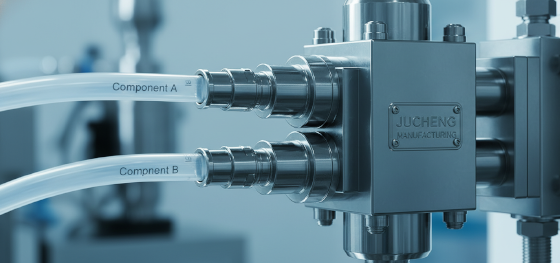
Thermoset polymers act fundamentally differently from thermoplastics during the fabrication cycle. Instead of melting pellets and pushing them into a mold under extreme pressure, RIM utilizes a high-speed chemical reaction between two liquid components. This liquid-to-solid transformation happens at low cavity pressures, allowing for the use of lightweight aluminum molds. Jucheng Precision addresses these large-format hardware challenges by providing high-tier Polyurethane Molding Services that prioritize dimensional stability and surface excellence for the world's most demanding industrial and medical sectors.
Operating within the Shenzhen precision manufacturing hub, JUCHENG serves as the high-velocity engine for global hardware OEMs. We transform oversized CAD files into validated, production-grade components in as fast as 15 business days. This guide explores the essential mold preparation standards, the physics of impingement mixing, and the curing dynamics required for mastering the RIM molding cycle steps to ensure your large-scale innovation reaches the market without the crushing NRE costs of conventional molding.
content:
Phase 1: Mold Preparation and Releasing Agent Protocols
Technical Data: Comparing RIM vs. Thermoplastic Cycle Variables
Phase 2: High-Pressure Mixing and Low-Pressure Injection
Phase 3: Mastering the Exothermic Reaction and Curing
Phase 4: Demolding and High-Precision Post-Trimming
JUCHENG: The Shenzhen Hub for Automated RIM Production
FAQ: Logistics and Capability for the RIM Cycle
Phase 1: Mold Preparation and Releasing Agent Protocols
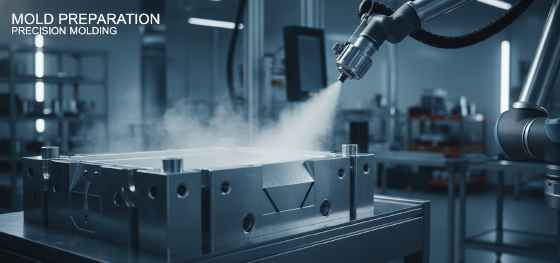
Geometric perfection in large-scale polyurethane parts begins long before the chemicals are mixed. In the first of the RIM molding cycle steps, the aluminum mold must be brought to a specific operating temperature, typically between 40°C and 60°C. If the mold is too cold, the chemical reaction will be sluggish, leading to surface swirling; if too hot, the part may experience localized "burns" or premature skinning. JUCHENG utilizes integrated thermal sensors and automated water-heating circuits to maintain mold temperature within +/- 2 degrees, providing a stable environment for the liquid polymer to flow.
How to ensure easy demolding for complex parts?
Utilize automated HVLP spraying systems to apply a uniform 5-micron layer of wax-based release agent, ensuring zero adhesion without clogging fine surface textures.
Release agent application is the second critical sub-step. Because polyurethane is a powerful adhesive, any missed spot in the mold cavity will result in a "stuck part" that requires destructive removal. JUCHENG employs specialized wax-based or silicone-free releasing agents depending on the final finishing requirements. If the part is destined for high-gloss automotive painting, we use silicone-free agents to prevent surface "fish-eyes" during the coating phase. This level of foresight during the initial preparation is what ensures our reaction injection molding process maintains high yields for multi-part diagnostic housings.
Insert placement often occurs during this preparation phase. Unlike traditional molding, RIM allows for the encapsulation of massive steel mounting plates, copper grounding wires, or even internal wood or foam cores to increase stiffness without adding weight. JUCHENG utilizes precision registration pins within the mold to lock these inserts in place. By holding +/- 0.1mm on insert position, we ensure that your internal electronics can be bolted directly into the molded shell with zero alignment issues in final assembly, providing a "Fastener-Ready" foundation for [2026] robotics.
Technical Data: Comparing RIM vs. Thermoplastic Cycle Variables
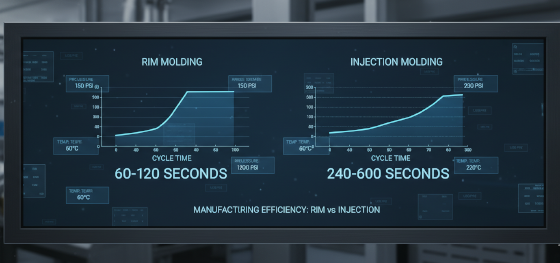
Selecting the right manufacturing path for large-scale hardware requires a clear understanding of the physical differences between high-pressure and low-pressure systems. While injection molding is a thermal process, RIM is a chemical one. Jucheng Precision provides technical consultations to help you optimize your production speed. The following table compares the essential operational variables of the reaction injection molding process against conventional high-pressure molding for the [2026] market.
| Variable | RIM process (Polyurethane) | Conventional Injection | Impact on Hardware |
|---|---|---|---|
| Mixing Pressure (psi) | 1,500 - 3,000 (Impingement) | N/A (Screw Melt) | Ensures Molecular Purity |
| Cavity Pressure (psi) | < 100 (Low Pressure) | 5,000 - 15,000 (High) | Prevents Internal Stress |
| Tooling Material | Aluminum / Composite | Hardened Steel | Reduces NRE by 70% |
| Curing Mechanism | Exothermic Chemical Bond | Thermal Phase Change | Maximum Impact Strength |
The low cavity pressure is the defining mechanical advantage of the reaction injection molding process. Because the liquid polymer flows like water before it begins to thicken, it does not require massive steel platens or multi-ton clamping forces to hold the mold shut. This allows JUCHENG to produce parts the size of a car bumper on machines that have a much smaller physical and financial footprint than an equivalent 3,000-ton injection press. For quantities between 100 and 5,000 units, this low-pressure logic provides the ultimate ROI for MedTech and AgTech startups.
Phase 2: High-Pressure Mixing and Low-Pressure Injection
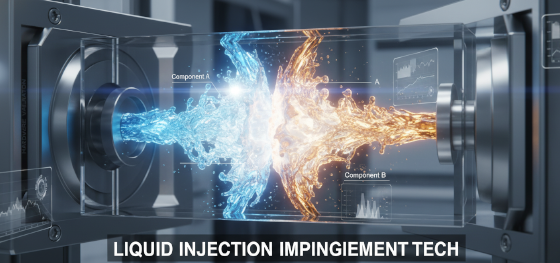
Achieving a perfect molecular bond requires a violent interaction between the A-side (Isocyanate) and B-side (Polyol) components. In the second stage of the RIM molding cycle steps, these two liquids are pumped at high pressure—up to 3,000 psi—into a small mixing chamber located within the mixing head. This "Impingement Mixing" tech uses the kinetic energy of the liquid streams to ensure total homogenization without the need for mechanical stirrers. JUCHENG utilizes self-cleaning mixing heads that use a physical piston to purge the chamber after every shot, eliminating the need for solvent flushes and preventing any chemical residue from contaminating the next cycle.
Why is impingement mixing superior?
It creates a consistent molecular cross-linking that ensures the final part has isotropic mechanical properties, meaning it is equally strong in all directions.
The "After-Mix" phase involves the liquid entering the mold cavity at significantly lower pressures. This transition is critical; if the flow is too turbulent, air bubbles will be trapped in the part. JUCHENG utilizes laminar-flow gating designs and "Tilt-Filling" machines. By tilting the mold at a specific angle during injection, we use gravity to help the liquid displace the air, ensuring that even complex geometries with deep recesses are filled with 100% solid polymer. This precision in fluid dynamics is what allows our reaction injection molding process to deliver parts with zero surface porosities.
Ratio control is the silent guardian of quality. A 1% deviation in the A/B ratio can result in a part that is too brittle or, worse, has "soft spots" that never fully cure. JUCHENG’s automated RIM systems monitor the flow rates and pressures of both components in real-time. If the system detects a fluctuation, the cycle is automatically aborted. This level of automated oversight is essential for industrial robot parts where structural reliability is non-negotiable. We provide our clients with a "Chemical Birth Certificate" for every batch, proving that the material integrity of their hardware meets the global standards of the [2026] market.
Phase 3: Mastering the Exothermic Reaction and Curing
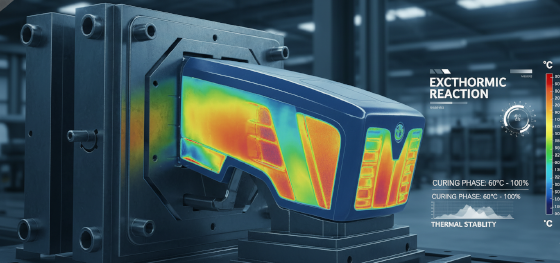
Transformation from liquid to structural solid occurs within the mold via a rapid exothermic reaction. Once the cavity is filled, the chemical bond creates its own heat, driving the polymerization to completion. In the third stage of the RIM molding cycle steps, the part remains in the mold for a "dwell time" that ranges from 2 to 10 minutes depending on wall thickness. JUCHENG manages this phase with precision cooling circuits within the aluminum mold to ensure the heat is dissipated uniformly. Uniform heat management is the only way to prevent internal stresses that lead to "oil-canning" or warpage in large-scale enclosures.
Can RIM parts have variable wall thicknesses?
Yes. Unlike injection molding, RIM can handle transitions from 3mm to 10mm in a single part without sink marks, making it ideal for structural ribs and bosses.
Structural foam vs. solid skins can be achieved during this curing phase. By injecting a small amount of blowing agent into the B-side polyol, JUCHENG can produce parts with a dense, solid exterior skin and a lightweight, cellular core. This "Sandwich Structure" provides incredible bending stiffness at a fraction of the weight of a solid part. This technique is frequently used for prototype robot chassis and diagnostic console bases, where the hardware must be extremely rigid to support heavy sensors but light enough for a single technician to move across a clinic floor.
Green strength is the metric used to determine when the part can be safely handled. When the polymer reaches about 80% of its final hardness, the mold is opened. JUCHENG’s technicians are trained to identify this "Window of Stability" to minimize cycle times without risking part deformation. After demolding, the parts often undergo a secondary "Post-Cure" in an industrial oven. This final thermal cycle ensures that the molecular cross-linking is 100% complete, reaching the maximum Shore D hardness and chemical resistance required for medical and industrial sanitization protocols in the [2026] sector.
Phase 4: Demolding and High-Precision Post-Trimming
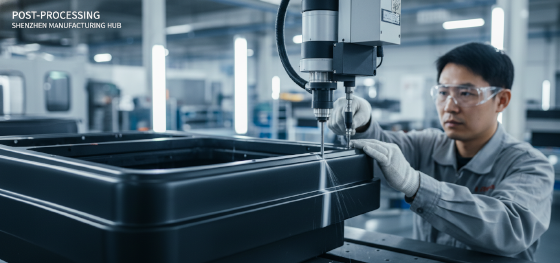
Removing a two-meter long part from a mold requires finesse to prevent surface tearing. In the final phase of the RIM molding cycle steps, JUCHENG utilizes integrated ejector pins and pneumatic lifters to gently break the seal between the part and the aluminum tool. Because RIM parts are molded with a "flash-gate" (a thin film of plastic at the parting line to ensure total air evacuation), the parts arrive at the demolding station with a rough edge. This flash is a sign of a well-vented mold, ensuring that the critical corners of the enclosure are perfectly filled and sharp.
How to achieve production-grade edges?
JUCHENG utilizes 5-axis robotic trimming cells to remove the parting-line flash with +/- 0.1mm accuracy, ensuring every enclosure fits the chassis perfectly.
Surface preparation for secondary processes occurs immediately after trimming. Polyurethane RIM parts are the industry standard for painting because they lack the "mold-release leaching" issues of many thermoplastics. JUCHENG performs an automated wash and "flame treatment" to increase surface energy, providing an ideal substrate for automotive-grade 2K urethane topcoats. Whether you require a matte VDI texture or a high-gloss medical white finish, our reaction injection molding process ensures that the finish adheres permanently, resisting the scratches and chemical wipe-downs of high-volume hospital or factory use.
Final dimensional verification at JUCHENG includes CMM and 3D laser scanning. For large-scale industrial robot parts, we verify the parallelism of mounting flanges and the concentricity of sensor bays across the entire span of the component. We provide a full inspection report with every shipment, ensuring that your parts are ready for immediate assembly. By managing the entire cycle—from the first spray of release agent to the final automated trim—JUCHENG delivers the "Bridge to Production" that allows your most ambitious hardware designs to become a physical, commercial reality in our Shenzhen hub.
JUCHENG: The Shenzhen Hub for Automated RIM Production
Dominating the [2026] large-format hardware market requires a partner that can scale from a single functional prototype to a commercial deployment of 5,000 units without losing a millisecond of momentum. Jucheng Precision operates with a 24/7 manufacturing mindset in our Shenzhen precision manufacturing hub, delivering high-tolerance RIM enclosures and structural components with lead times as fast as 15 business days. We provide a "Bridge to Production" that ensures your innovations move from concept to pilot run with 100% chemical and dimensional confidence.
Integrating your design with JUCHENG’s expertise ensures that your hardware survives the "First-Field Contact" and moves into mass adoption. We offer comprehensive DFM reviews within 24 hours, identifying potential gas-trap zones or thermal-expansion risks in your design before they become field failures. Whether you are building an autonomous tractor hood or a multi-part MRI housing, Jucheng Precision provides the rigid, precise, and *chemically optimized* foundations that keep your innovation moving through the high-stakes cycles and the years of hard labor.
Our facility is equipped with oversized high-pressure RIM machines and dedicated ISO 13485 certified quality labs, allowing us to manage the entire hardware lifecycle in one location. We manage the complexity of multi-component chemistry and robotic post-trimming so your engineering team can focus on the system integration and the AI. By combining Shenzhen's speed with industrial-grade material verification and global quality standards, JUCHENG remains the preferred partner for the world's most aggressive Polyurethane Molding Services challenges. Contact us today to start your next project.
FAQ: Logistics and Capability for the RIM Cycle
What is the maximum part size for the RIM process?
We regularly manufacture structural enclosures and fenders up to 2.5 meters in length with consistent wall thickness.
How long does a typical RIM cycle take?
Depending on part volume, a complete cycle ranges from 10 to 20 minutes from mold prep to demolding.
Can JUCHENG match specific Pantone colors in the resin?
Yes. We provide "color-through" parts by adding high-stability pigments to the B-side component during mixing.
Is aluminum tooling durable enough for 5,000 parts?
Yes. For the low pressures used in RIM, our 7075 aluminum tools can survive 5,000+ shots with zero dimensional drift.
What is the lead time for a set of 100 RIM enclosures?
Custom tooling and the first 100 parts are typically delivered in 20 to 25 business days.
Thermal stress and high NRE are absolute innovation killers for large-scale hardware. Partnering with Jucheng Precision ensures that your functional iterations are built with the low-pressure reaction injection molding process and specialized RIM molding cycle steps the industry demands. Reach out to our Shenzhen manufacturing hub today for a complete DFM review and build the secure foundation your autonomous fleet requires.

