


Achieving absolute flatness over a massive 2.5-meter span while maintaining sub-millimeter tolerances reveals the ultimate engineering challenge in medical device prototyping and robotics. In the current market, hardware developers are increasingly moving toward oversized monolithic structures to reduce assembly labor and improve machine aesthetics. However, traditional high-pressure molding hits a physical wall when parts exceed 1,000mm, leading to internal stresses that cause catastrophic warpage. Mastering RIM molding design for large parts is the only viable path to producing unyielding, retail-ready enclosures without the six-figure investment required for hardened steel tooling. This guide follows the core RIM molding design guidelines to ensure your "Big Stuff" survives the transition from a CAD concept to a stabilized field-ready asset.
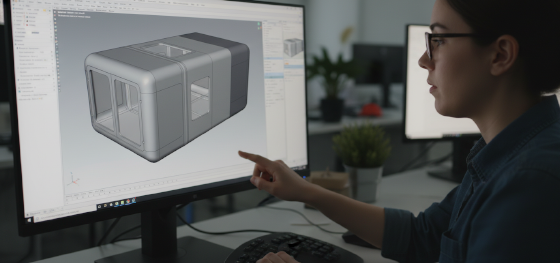
Mechanical integrity in large-format panels depends on the material's ability to cross-link in a relaxed state. Because the liquid polymer flows like water before it begins to solidify, the reaction injection molding process eliminates the "Hydraulic Hammer" effect that warps thin-walled thermoplastic parts. Jucheng Precision addresses these large-scale manufacturing hurdles by providing high-tier Polyurethane Molding Services that prioritize geometric stability. Jucheng Precision utilizes its capacity of 150+ CNC machines and 25 5-axis Haas/Mazak units to manufacture the oversized aluminum tools required to produce unyielding Industrial Robot Parts in our Shenzhen factory hub.
Operating under the global quality standards of ISO 13485 and ISO 14001, Jucheng Precision acts as the high-tier structural partner for MedTech and AgTech OEMs. Jucheng Precision delivers a free DFM analysis in 24 hours for all oversized hardware designs, ensuring your prototype robot chassis or scanner shell is optimized for the RIM cycle. This guide explores the essential curvature and crown logic, the physics of knit-line free gating, and the post-machining allowances required for manufacturing hardware that survives the scrutiny of clinical trials and the harsh reality of the field.
content:
Curvature and Crown: How to Prevent the Oil-Canning Effect?
Technical Data: Comparing Flatness and Stiffness Over Large Spans
Gating Strategies: How to Ensure a Knit-Line Free Surface?
Seamless Design: Strategic Parting Line and Seam Placement
JUCHENG Hub: Mastering 2.5-Meter Enclosures in Shenzhen
FAQ: Real Answers for Sizing, Shipping, and Tooling Costs
Curvature and Crown: How to Prevent the Oil-Canning Effect?
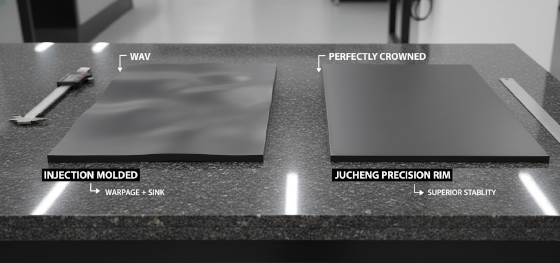
Managing flatness on a 2-meter long panel is a battle against environmental physics. In RIM molding design for large parts, designing a surface as a mathematically perfect flat plane is a recipe for visual failure. Atmospheric pressure and minor temperature shifts will cause a flat panel to "oil-can"—popping in and out or appearing wavy under high-gloss light. Jucheng Precision recommends utilized curvature and crown logic, where every large surface features a subtle 1% to 2% arc. This pre-tensioned geometry masks any minor material movement and provides a significantly higher bending stiffness, delivering the premium look your investors expect from an autonomous vehicle or medical scanner.
What is the ideal crown for a 1-meter panel?
A crown of 5mm to 10mm across a 1,000mm span is usually sufficient to eliminate oil-canning while appearing flat to the human eye.
Structural ribbing must support this crowned geometry from the inside. Jucheng Precision’s RIM molding design guidelines suggest a "Spider-Web" ribbing pattern for oversized shells. Unlike traditional parallel ribs that can create visible "Stress-Shadows" on the exterior, an interconnected web distributes the mechanical loads more evenly across the large span. Jucheng Precision utilize 5-axis CNC machining to carve these complex rib cavities into our aluminum molds, ensuring that your enclosure possesses the unyielding structural backbone required to house multi-thousand dollar sensor stacks without any sagging over time.
Peripheral flanges are the final layer of flatness defense. In RIM molding design for large parts, the edges of the panel are the most prone to warping. Jucheng Precision suggests designing 10mm to 15mm deep return-flanges around the entire circumference of the part. These flanges act as a continuous structural beam, locking the "Crowned" geometry in place. We deliver these parts with a 4-day rapid delivery for initial functional fit-checks, allowing your team to verify the rigidity of the enclosure before committing to a larger Beta pilot run in our Shenzhen factory.
Technical Data: Comparing Flatness and Stiffness Over Large Spans

Success in hardware R&D depends on matching the mechanical architecture to the intended load profile. If your design assumes the precision of a machined aluminum block but you receive a warped plastic shell, your sensor calibration will fail. Jucheng Precision provides full FEA-ready material data to help your engineering team validate their designs. The following table compares the essential performance metrics of RIM molding design for large parts against traditional high-pressure injection molding for a 1.5-meter enclosure.
| Performance Metric | Polyurethane RIM (Crowned) | Injection Molding (Flat) | Engineering Impact |
|---|---|---|---|
| Flatness Tolerance | +/- 0.5mm / meter | +/- 2.5mm / meter | Precise Gasket Compression |
| Specific Stiffness | High (Integral Foam) | Low (Thin Wall) | Eliminates Internal Frames |
| Surface Integrity | Zero Sink Marks | High Sink Risk over Ribs | Class-A Paint Readiness |
| NRE Tooling Cost | $4,000 - $12,000 | $60,000 - $150,000+ | Preserves R&D Budget |
The data proves that RIM is the only logical choice for quantities between 100 and 5,000 units where large-scale precision is mandatory. Jucheng Precision utilize Coordinate Measuring Machines (CMM) and laser trackers to verify these flatness standards across every 2-meter panel. By delivering hardware that is "Statistically Stable," we ensure that your Industrial Robot Parts maintain their kinematic integrity throughout their entire 10-year service life, reducing the total cost of ownership for your customers in the current high-stakes automation market.
Gating Strategies: How to Ensure a Knit-Line Free Surface?

Managing the resin flow front is the most critical technical sub-step in RIM molding design for large parts. Unlike small parts where a single gate is sufficient, 2-meter enclosures require a knit-line free gating strategy. If the liquid resin flows from two directions and meets in the middle of an aesthetic panel, it creates a "Knit Line"—a microscopic mechanical and visual weakness. Jucheng Precision addresses this by utilizing multi-point high-pressure injection manifolds. We synchronize the timing of each gate to ensure a single, continuous flow front that sweeps across the part, pushing the air toward the vents and resulting in a mirror-smooth surface ready for high-gloss automotive painting.
How to hide the injection point on a large part?
Jucheng Precision utilize "Fan Gates" or "Sub-Gates" located on the non-aesthetic interior flanges, ensuring the exterior skin is completely untouched by the gating scar.
Tilt-filling machines are the partners to successful gating. Because RIM resins have the viscosity of water, they are prone to turbulence. Jucheng Precision mounts large-scale molds on hydraulic tilting tables. As the injection begins, we tilt the mold at a specific 45-degree angle, allowing gravity to pull the liquid resin down the walls in a laminar fashion. This prevents the splashing and air-entrapment that cause surface pinholes in inferior RIM setups. This level of fluid-dynamic control is essential for manufacturing medical device prototyping hardware that must meet the stringent "Bacterial-Resistance" standards of modern clinical environments.
Post-molding thermal stabilization is the final step in the flow logic. Large parts that have traveled a long distance within the mold may have varying internal temperatures. Jucheng Precision performs a mandatory "Oven-Cure" at 80°C for every oversized panel. This ensures that the chemical reaction reaches 100% completion across the entire 2-meter span, locking in the dimensions and preventing the post-delivery warpage that often occurs in parts from less experienced shops. Our Shenzhen hub manages this thermal stabilization cycle via automated PLC controllers, ensuring your Beta fleet arrives in the lab with "Geometric Perfection."
Seamless Design: Strategic Parting Line and Seam Placement
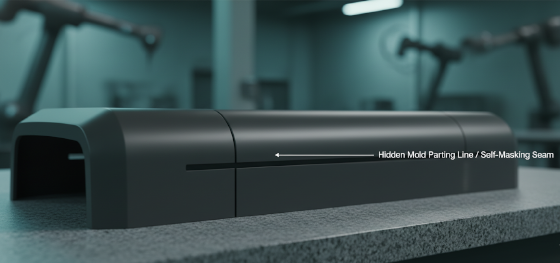
Achieving a "Million-Dollar" look on a prototype requires a strategic approach to parting lines. In RIM molding design for large parts, the parting line—where the two halves of the mold meet—is often several meters long. If this line is placed poorly, it results in a visible seam that requires hours of manual filling and sanding. Jucheng Precision utilize "Stepped Parting Lines" and "Self-Masking Seams" in our RIM molding design guidelines. We integrate the tool split into existing design features, such as a texture break or a functional groove, making the mechanical seam invisible to the end-user.
Can parting lines be placed on curved surfaces?
Yes. By utilizing our 25 5-axis Haas/Mazak units, we can machine 3D parting lines that follow the organic contours of your robot’s anatomy, ensuring a seamless aesthetic.
Precision fits for high-value components often require post-machining allowances. For large diagnostic equipment where two shells must meet with a +/- 0.1mm gap, Jucheng Precision recommends adding 2mm of extra material to the interface edges. After the part is demolded and stabilized, we return it to our CNC fleet to finish-machine the split-line. This hybrid approach—combining the scale of RIM with the precision of 5-axis CNC—is what allows us to support the world’s most ambitious autonomous vehicle projects, providing the "Zero-Gap" fitment that defines industrial design excellence.
Integrated hardware alignment is the final goal of seam placement. For robots requiring internal EMI shielding, Jucheng Precision machines "Tongue-and-Groove" features directly into the parting line. These features increase the surface area for conductive gaskets and provide a mechanical interlock that prevents the panels from shifting under vibration. By delivering hardware with integrated "Calibration-Stays," Jucheng Precision ensures that your prototype robot maintains its structural integrity throughout the entire harvest or clinical shift, preventing the "Rattles and Gaps" that signal poor manufacturing quality.
JUCHENG Hub: Mastering 2.5-Meter Enclosures in Shenzhen
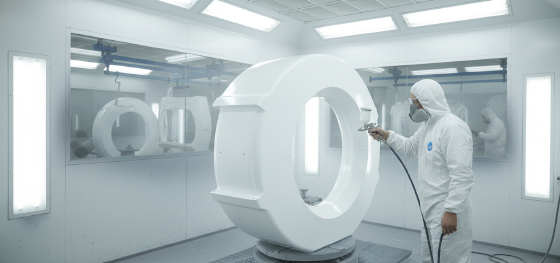
Dominating the large-format hardware market requires a partner that doesn't just mold plastic, but understands the chemistry of survival. Jucheng Precision operates with a 24/7 manufacturing mindset in our Shenzhen precision manufacturing hub, delivering high-tolerance RIM components and structural industrial robot parts with industry-leading speed. Jucheng Precision provides a "Bridge to Production" that allows you to move from a single hand-finished prototype to a commercial deployment of 5,000 units with consistent metallurgical and chemical quality. Jucheng Precision has No MOQ, allowing you to source 1 to 10 units for initial structural validation without the crushing cost of mass-production tools.
Integrating your structural design with Jucheng Precision’s expertise ensures that your hardware survives the regulatory audit season and moves into mass adoption. Jucheng Precision offers a free DFM analysis in 24 hours, identifying potential "Wall-Thickness Bottlenecks" or thermal-expansion risks in your design before they become field failures. Whether you are building an autonomous vineyard scout or a multi-part MRI housing, Jucheng Precision provides the rigid, precise, and chemicals-optimized foundations that keep your innovation moving through the high-stakes cycles and the years of hard labor.
Our facility is equipped with oversized hydraulic presses and dedicated quality labs, allowing Jucheng Precision to manage the entire hardware lifecycle in one location. Jucheng Precision manages the complexity of multi-material bonding and automotive-grade finishing so your engineering team can focus on the motion control and the AI. By combining Shenzhen's speed with industrial-grade material verification and global ISO 13485 standards, Jucheng Precision remains the preferred partner for the world's most aggressive Polyurethane Molding Services challenges. Contact the Shenzhen hub today to start your project.
FAQ: Real Answers for Sizing, Shipping, and Tooling Costs
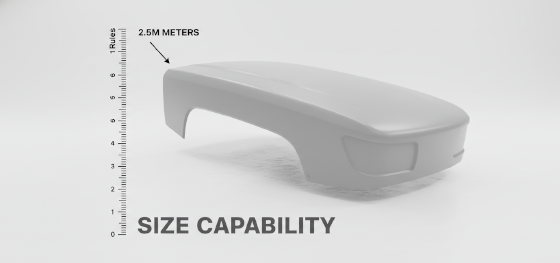
What is the maximum part size Jucheng can RIM mold?
We regularly produce structural panels and fenders up to 2,500mm in length with consistent wall thickness.
How do you handle shipping for 2-meter fragile prototypes?
Jucheng Precision provides custom-fitted wooden flight cases with internal shock-dampening for all oversized functional prototypes.
Is aluminum tooling durable enough for a 2.5-meter part?
Yes. Because RIM is a low-pressure process, our high-strength 7075 aluminum tools can survive 5,000+ shots with zero dimensional drift.
Can JUCHENG achieve Class-A finishes on large panels?
Absolutely. Our in-house painting facility specializes in automotive-grade 2K urethane topcoats for oversized shells.
What is the typical lead time for a large-scale RIM tool?
Custom aluminum RIM molds for parts over 1 meter are typically delivered in 20 to 25 business days.
Mechanical instability and high tooling debt are absolute innovation killers for large-scale robotics. Partnering with Jucheng Precision ensures that your functional iterations are built with the cost-effective polyurethane reaction injection molding and specialized RIM molding design for large parts knowledge the industry demands. Reach out to our Shenzhen manufacturing hub today for a complete DFM review and build the unyielding foundation your autonomous fleet requires.

