


Failing an assembly fit-test due to a 5mm warpage on a large-scale enclosure reveals the most critical hurdle in medical device prototyping: the battle against material contraction. In the high-stakes world of autonomous robotics and surgical systems, the enclosure is not just a cover; it is a rigid frame that must support perfectly aligned sensors and actuators. While traditional high-pressure molding suffers from unpredictable "Sink and Warp" cycles, the polyurethane reaction injection molding process offers a strategic advantage. Mastering the physics of RIM molding tolerances and shrinkage is the only way to ensure that multi-part assemblies—often exceeding 2 meters in length—fit together with the "Zero-Gap" precision that defines a premium industrial product.

Precision at scale is a byproduct of low-pressure liquid chemistry. Because RIM resins react and expand within the tool rather than being forced in at high temperatures, the internal stresses that drive warpage are virtually eliminated. Jucheng Precision addresses these dimensional challenges by providing a free DFM analysis in 24 hours to identify "Tolerance Risk Zones" in your CAD. Jucheng utilize its capacity of 150+ CNC machines to manufacture aluminum molds that compensate for specific resin shrinkage rates, delivering the unyielding foundations required for High Strength Plastic Machining and assembly in our Shenzhen precision manufacturing hub.
Operating under a triple mandate of ISO 13485, ISO 14001, and IATF 16949, Jucheng Precision serves as the high-tier metrology partner for global OEMs. We transform raw liquid chemistry into validated structural components that maintain their "Geometric Zero" throughout their entire service life. This guide explores the essential commercial tolerance standards, the post-molding thermal stabilization protocols, and the material-to-tool correlation required for manufacturing hardware that survives the scrutiny of clinical trials and the high-speed demands of modern automation.
content:
Shrinkage Physics: Why is RIM Ten Times More Stable?
Technical Data: Standard Commercial Tolerances for Large RIM Parts
Stability Logic: Post-Molding Curing and Creep Prevention
Verification: Mastering CMM and Laser Metrology for 2-Meter Parts
JUCHENG Hub: The Shenzhen Engine for Micron-Level Hardware
FAQ: Real Answers for Geometric Accuracy and Fitment Issues
Shrinkage Physics: Why is RIM Ten Times More Stable?

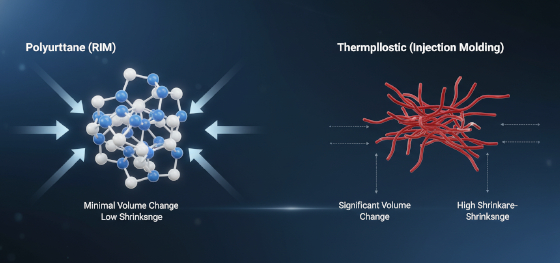
Mechanical predictability in large parts is governed by the volume change during solidification. In RIM molding tolerances and shrinkage, the baseline contraction rate is typically between 0.1% and 0.15%. For context, standard thermoplastics like Polypropylene or ABS often exhibit shrinkage rates of 1.0% to 2.5%. On a 1,000mm diagnostic enclosure, a 2% shrinkage means the part "grows" or "shrinks" by 20mm—a disaster for fitment. The polyurethane reaction injection molding process avoids this because the material starts as a liquid and forms a cross-linked matrix at relatively low temperatures (40-60°C). This low thermal delta minimizes the kinetic energy loss that causes standard plastics to pull away from the mold walls.
How does low shrinkage affect tooling design?
It allows Jucheng to machine aluminum molds that are nearly "Size-on-Size" with the CAD, reducing the complex math required for "Shrinkage Compensation" in high-pressure tools.
Laminar flow during the injection phase also contributes to dimensional stability. In high-pressure systems, the material is forced into the tool, creating "Molded-In Stress" that wants to relax as soon as the part is ejected. Because RIM polyurethane flows into the mold like water at less than 100 psi, the polymer chains are never stretched or strained. This results in a part that is in a "Relaxed State" from the first second of demolding. Jucheng utilize 25 5-axis Haas/Mazak units to machine the parting lines of our aluminum tools with micron-level fitment, ensuring that the parting line pressure is uniform across the entire span, preventing the asymmetrical stresses that lead to "Oil-Canning" on large panels.
Isotropic shrinkage is the third physical win for the RIM process. Standard injection-molded parts shrink differently along the flow path versus across it, leading to "Saddle-Warp" on large surfaces. Polyurethane RIM parts possess uniform molecular properties in all 3 axes because the chemical reaction happens simultaneously throughout the liquid mass. This predictability is why RIM is the preferred choice for prototype robot chassis where the left and right mounting holes must be perfectly parallel to ensure the drivetrain does not experience parasitic friction. Jucheng’s material experts verify these shrinkage profiles for every custom resin batch, providing the "Geometric Certainty" required for high-speed autonomous mobility.
Technical Data: Standard Commercial Tolerances for Large RIM Parts
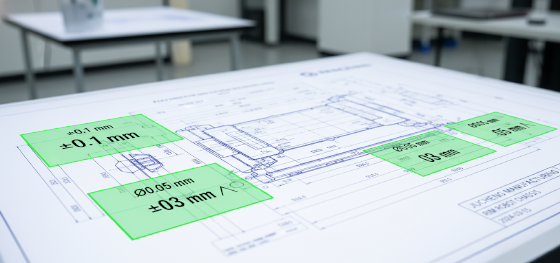
Success in multi-material assembly depends on the numbers. If your design assumes the precision of a machined aluminum block but you receive the tolerances of a roto-molded tank, your project will stall. Jucheng Precision provides transparent dimensional reports to help you manage your "Tolerance Stack-up." The following table compares the typical accuracy levels Jucheng achieves for RIM molding tolerances and shrinkage across different part lengths for the current MedTech and industrial markets.
| Dimension Span | Standard Commercial Tolerance | JUCHENG Precision Tier | Technical Goal |
|---|---|---|---|
| Up to 250mm | +/- 0.25mm | +/- 0.10mm | Precision Fits |
| 250mm - 1,000mm | +/- 0.75mm | +/- 0.40mm | Enclosure Sealing |
| 1,000mm - 2,000mm | +/- 1.25mm | +/- 0.65mm | Structural Alignment |
| Over 2,000mm | +/- 2.00mm | +/- 0.90mm | Large Scale Rigidity |
The "JUCHENG Precision Tier" is achieved through our integrated approach to RIM molding design guidelines. We don't just rely on the mold; we use post-molding fixtures and high-precision CNC secondary machining. For critical sensor windows or bearing seats that require +/- 0.01mm tolerances, Jucheng Precision performs 5-axis finishing on the molded part. This hybrid manufacturing approach ensures that your medical scanner or autonomous tractor remains a high-precision instrument, even when the primary components are massive plastic shells. Our Shenzhen hub manages this complexity, providing a single point of accountability for both the molding and the micron-level accuracy.
Stability Logic: Post-Molding Curing and Creep Prevention
Managing the "Life-Cycle Accuracy" of hardware requires more than just a good mold. In RIM molding tolerances and shrinkage, the part continues to chemically cross-link for hours after it is demolded. If a part is measured immediately after it leaves the tool, it may exhibit "Measurement Drift" as it reaches full hardness. Jucheng Precision implements a mandatory post-molding thermal stabilization protocol for all high-precision projects. We place the demolded parts in industrial "Oven-Curing" stations at 80°C for 4 to 8 hours. This accelerated aging process ensures the chemical reaction reaches 100% completion, "locking in" the dimensions before the final QC check.
How to prevent long-term part sag?
Utilize reinforced RRIM materials (milled glass) to increase the flexural modulus and reduce the Coefficient of Linear Thermal Expansion (CLTE), ensuring your 1-meter parts remain straight in the hot sun.
Post-molding fixtures are the second layer of stability defense. For large, thin-walled enclosures, the force of gravity alone can cause a part to sag while it is still "Green" (partially cured). Jucheng Precision designs and machines custom "Cooling Jigs" for every oversized RIM part. These jigs support the part in its exact CAD orientation as it undergoes the thermal stabilization cycle. This ensures that the flatness we achieve in the Shenzhen factory is the same flatness the surgeon sees in the operating room. By preventing "Creep" during the cooling phase, we eliminate the need for manual shimming or forced assembly during your Beta fleet integration.
Material Shore hardness also dictates the tolerance window. Rigid polyurethane systems, designed to simulate ABS, are more dimensionally stable than elastomeric "PP-like" systems. Jucheng’s engineering team analyzes your material choice during the DFM phase, adjusting the "Shrink Allowance" in the mold design to match the specific chemistry of your resin. This level of material-to-tool correlation is what allows us to hold tight tolerances on complex geometries like interlocking snap-fits and IP67-rated gasket tracks, providing the unyielding foundations that high-end autonomous systems require.
Verification: Mastering CMM and Laser Metrology for 2-Meter Parts
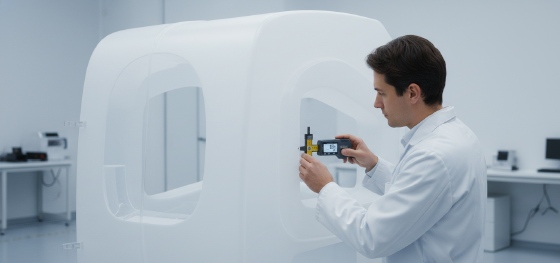
Proving the accuracy of a massive enclosure is often more difficult than molding it. In RIM molding tolerances and shrinkage verification, traditional hand-tools like calipers and tape measures are useless for detecting a 0.5mm deviation over a 2,000mm span. Jucheng Precision utilizes oversized Coordinate Measuring Machines (CMM) and high-resolution laser trackers to verify every structural node of your part. We perform 100% inspection on critical-to-quality (CTQ) dimensions, providing you with a full "Heat-Map" of the part’s accuracy compared to the original 3D CAD model. This data is essential for your internal hardware validation and future regulatory audits.
What is the accuracy of Jucheng’s laser trackers?
Our mobile laser metrology systems can verify spatial coordinates within 25 microns over a 5-meter radius, ideal for large autonomous tractor chassis and MRI frames.
3D Scanning is used for "Full-Surface" verification. Unlike a CMM that only measures specific points, our 3D scanners capture millions of data points across the entire organic surface of a robot shell. This allows us to detect subtle "Oil-Canning" or surface waves that might impact the aesthetic quality of your Class-A automotive paint finish. By identifying these issues during the T1 sampling phase in our Shenzhen hub, we can perform "Agile Tooling" modifications—welding and re-machining the aluminum mold in 48 hours—to correct the geometry before the Beta pilot run begins. This closed-loop manufacturing cycle is why Jucheng remains the preferred partner for global aerospace and defense robotics.
Statistical Process Control (SPC) is the final pillar of our precision standard. For commercial deployments of 500 units or more, Jucheng Precision tracks the dimensional stability of every 50th part. We monitor the "Tolerance Drift" over the life of the aluminum tool, ensuring that the tool-wear doesn't compromise the assembly fitment. By delivering hardware that is "Statistically Stable," we allow your assembly team to focus on the high-value AI and sensor integration rather than manual hardware rework. Jucheng’s commitment to metrology is why our industrial robot parts and medical shells move from concept to clinic with 100% dimensional confidence.
JUCHENG Hub: The Shenzhen Engine for Micron-Level Hardware

Dominating the large-format hardware market requires a partner that can scale from a single hand-balanced prototype to a commercial deployment of 5,000 units without losing a micron of accuracy. Jucheng Precision operates with a 24/7 manufacturing mindset in our Shenzhen precision manufacturing hub, delivering high-tolerance RIM components and structural industrial robot parts with industry-leading speed. JUCHENG provides a "Bridge to Production" that ensures your innovations move from concept to pilot run with 100% metallurgical and dimensional quality. we have No MOQ, allowing you to source 1 to 10 units for initial tolerance validation without the crushing cost of mass-production tools.
Integrating your structural design with JUCHENG’s expertise ensures that your hardware survives the "Regulatory Audit Season" and moves into mass adoption. JUCHENG offers a free DFM analysis in 24 hours, identifying potential shrinkage-risks or machining bottlenecks in your design before they become field failures. Whether you are building an autonomous medical assistant or a heavy-duty industrial mobile base, Jucheng Precision provides the rigid, precise, and verified foundations that keep your innovation moving through the high-speed cycles and the years of hard labor.
Our facility is equipped with dedicated high-pressure RIM assembly cells and dedicated ISO 13485 and ISO 14001 quality labs, allowing JUCHENG to manage the entire hardware lifecycle in one location. we manage the complexity of multi-material bonding and automotive-grade finishing so your engineering team can focus on the motion control and the AI. By combining Shenzhen's speed with industrial-grade material verification and global quality standards, JUCHENG remains the preferred partner for the world's most aggressive hardware challenges. Contact us today to start your next 4-day rapid delivery project.
FAQ: Real Answers for Geometric Accuracy and Fitment Issues

What is the tightest tolerance JUCHENG can hold on a RIM part?
By utilizing 5-axis CNC secondary machining on molded "blanks," we regularly hold +/- 0.05mm on critical bearing and sensor seats.
Does the part size affect the shrinkage rate?
No, the percentage remains constant (approx 0.15%), but the absolute dimensional change increases with length, making low-shrinkage RIM much more stable than injection molding for large parts.
How do you handle tolerances for multi-part assemblies?
We perform "Tolerance Stack-up" analysis during the DFM phase and suggest geometric registration features to ensure a zero-gap fit.
Can I get a CMM report for a single prototype?
Yes. JUCHENG provides full metrology verification for small-batch Alpha units to ensure your mechanical baseline is correct.
What is the typical lead time for a 1-meter precision-machined RIM tool?
Aluminum rapid tools with tolerance-compensation are typically delivered in 15 to 20 business days.
Dimensional drift and assembly gaps are absolute innovation killers for high-end robotic systems. Partnering with Jucheng Precision ensures that your functional iterations are built with the unyielding polyurethane reaction injection molding and specialized RIM molding tolerances and shrinkage knowledge the industry demands. Reach out to our Shenzhen manufacturing hub today for a complete DFM review and build the unyielding foundation your autonomous fleet requires.

