


Observing a high-precision welding robot in a Tesla or BMW facility reveals the critical role of industrial robot parts: the housing is the invisible guardian of motion. While the motor provides power, the joint housing dictates whether that power translates into micron-level accuracy or destructive vibration. If the housing for a Harmonic or RV drive is misaligned by even ten microns, the internal gears will experience uneven loading, leading to rapid wear and premature gearbox failure. Mastering Robotic joint housing machining is the only way to ensure the J1 through J6 axes maintain their zero-backlash performance over millions of cycles in [2026].
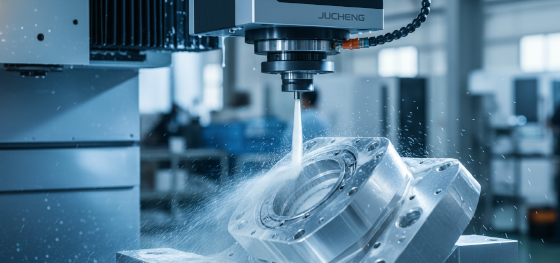
Concentricity dictates the lifespan of robotic drivetrains. In 6-axis kinematics, the housing must provide perfectly aligned bearing seats for the input and output shafts. Any tilt or offset in these seats creates "parasitic torque," which forces the motor to draw more current and generates localized heat. Jucheng Precision addresses these alignment challenges by utilizing 5-axis Mazak and Haas centers, ensuring that all critical rotational features are machined in a single setup to eliminate stacking errors.
Operating within the Shenzhen precision manufacturing hub, JUCHENG provides the "Bridge to Production" for collaborative and industrial robot OEMs. We transform raw aluminum billets or ductile iron castings into stabilized enclosures that act as the rigid "house" for the robot's heart. This guide explores the essential concentricity standards, the advantages of 5-axis integration, and the thermal stability strategies required for manufacturing robotic joint housings that never quit.
Concentricity Standards: Protecting the Gearbox Heart
Technical Data: Comparative Materials for Joint Enclosures
5-Axis CNC Precision: Eliminating Stacking Errors
Thermal Stability: Managing Dimensions in 24/7 Operations
JUCHENG: The Shenzhen Hub for Micron-Level Alignment
FAQ: Precision Machining for Robotic Motion Joints
Concentricity Standards: Protecting the Gearbox Heart
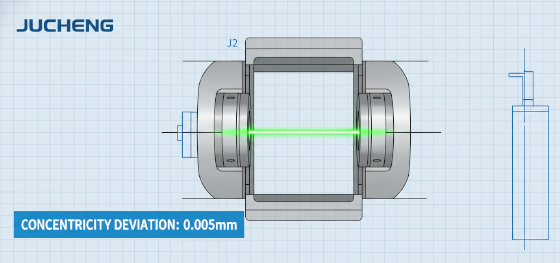
Concentricity between the bearing seats and the gear interface is the most significant metric in Robotic joint housing machining. In a typical J2 or J4 axis, the housing must accommodate a high-precision reducer, often a Harmonic drive. If the bearing seat is eccentric by even 0.01mm relative to the output flange, the gear teeth will not mesh uniformly. This creates "hot spots" where the lubricant is squeezed out, leading to microscopic metal-to-metal contact and the eventual unzipping of the gear teeth during high-torque move-sets.
Parallelism between the mounting faces is equally critical. Robotic joints are stacked in a kinematic chain; any deviation in the parallelism of one housing is multiplied as the arm extends. JUCHENG utilizes specialized sub-micron dial indicators and laser trackers to verify that the top and bottom mounting surfaces are parallel within 0.005mm. This ensures that the robot’s "Origin" point remains stable, preventing the software-drifting issues that plague low-quality robotic assemblies.
Perpendicularity of the axis of rotation relative to the mounting base ensures that the robot moves in a true plane. If the housing bore is "canted" by a few microns, the arm will exhibit a slight "wobble" during full-extension moves. JUCHENG’s 5-axis CNC process allows us to machine the bore and the mounting face in the same operation, ensuring that the axis of rotation is perfectly orthogonal to the mounting plane. This mechanical perfection reduces the compute load on the robot's controller, as it doesn't have to compensate for geometric "slop."
Surface finish in the bearing bore determines the "fit" and long-term stability of the joint. We machine these bores to a Ra 0.4 finish or better to ensure that the bearing race has maximum contact area with the housing. A rougher finish would allow the bearing to "settle" or move slightly under vibration, eventually loosening the press-fit and leading to axis jitter. JUCHENG’s commitment to micron-level industrial robot parts ensures that your joints stay tight and quiet for their entire operational life.
Technical Data: Comparative Materials for Joint Enclosures
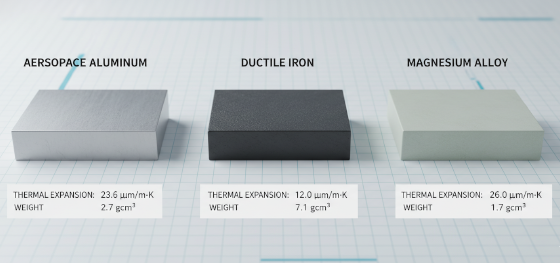
Selecting the right housing material requires balancing mass, stiffness, and thermal expansion. For collaborative robots (cobots), magnesium or aluminum is preferred for lightness; for heavy-duty 500kg payload robots, ductile iron is the standard. Jucheng Precision provides technical consultations to help you navigate these metallurgical trade-offs. The following table compares the materials most frequently used in high-performance Robotic joint housing machining for the [2026] market.
| Material Type | Density (g/cm³) | Thermal Expansion (μm/m·K) | Vibration Dampening |
|---|---|---|---|
| 7075-T6 Aluminum | 2.81 | 23.2 | Moderate |
| Ductile Iron (QT500) | 7.10 | 11.0 | Exceptional |
| Magnesium AZ91D | 1.81 | 25.0 | High |
| Carbon Fiber (Hybrid) | 1.60 | < 2.0 | Very High |
Ductile Iron (QT500) is the master of heavy-duty joints because its thermal expansion coefficient closely matches that of the steel bearings and gears inside. This ensures that the press-fit remains constant whether the robot is cold-starting in a winter factory or running at 80°C in a summer foundry. JUCHENG utilizes specialized tooling to machine this abrasive material, delivering the rigidity required for high-torque axes like the J1 and J2 while maintaining the dampen characteristics necessary to absorb gearbox noise.
Aluminum 7075-T6 is the dominant choice for cobot joints where safety and speed are paramount. Its high strength-to-weight ratio allows for ultra-compact housing designs that do not sacrifice rigidity. JUCHENG’s industrial robot parts facility utilizes high-speed spindles to process aluminum housings with zero residual stress, ensuring that the thin-walled sections of the joint enclosure do not warp during final assembly, a critical factor for maintaining IP67 sealing integrity.
5-Axis CNC Precision: Eliminating Stacking Errors
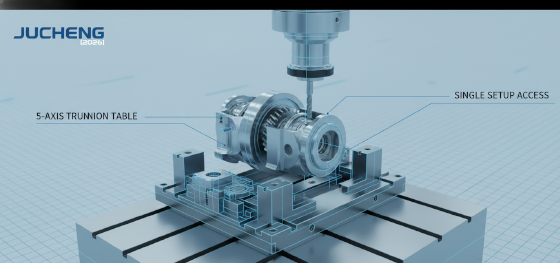
The geometry of a J3 or J5 robotic joint is often organic and complex, requiring the tool to reach internal features from multiple angles. Traditional 3-axis machining requires multiple setups (flipping the part), which introduces "setup errors" every time the part is reclamped. In Robotic joint housing machining, a setup error of even 0.02mm can lead to a misaligned bearing seat. JUCHENG utilizes continuous 5-axis CNC centers to machine the entire housing in a single setup, ensuring that every hole, bore, and flange is geometrically locked to the same coordinate system.
Deep-hole drilling and internal pocketing for cable routing are also optimized via 5-axis movement. Modern robots require internal channels for high-speed data and power cables to pass through the center of the joint. JUCHENG machines these internal cavities with smooth, deburred transitions, ensuring that the cables do not experience any abrasion during millions of flex cycles. By consolidating these features into a single CNC operation, we reduce the total lead time and guarantee that the "plumbing" of the robot arm is as precise as its skeletal structure.
Integrated cooling fins are becoming a standard feature in high-duty-cycle robot joints. To prevent the servo motors from overheating, JUCHENG machines complex fin arrays directly into the joint housing. This increases surface area for passive heat dissipation, allowing the robot to run at higher speeds for longer periods without thermal throttling. Our 5-axis capability allows us to machine these fins at optimized angles to match the airflow within the robot's specific installation environment, further enhancing the "Utility" of the industrial robot parts we provide.
Zero-point clamping systems ensure that if a part must be moved between machines, it returns to the exact same position within microns. JUCHENG utilizes these advanced work-holding technologies to maintain absolute consistency across a production run of 1,000 units. This "repeatability in manufacturing" is what allows our clients to swap out robotic joints in the field without any manual shimming or re-calibration, drastically reducing the total cost of maintenance for the end-user.
Thermal Stability: Managing Dimensions in 24/7 Operations
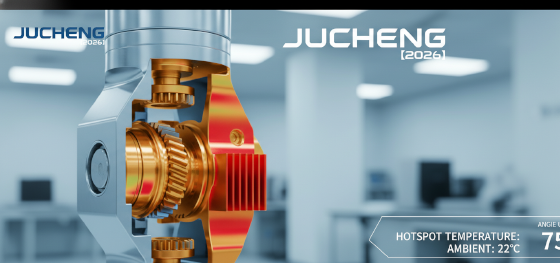
Robotic joints generate heat—it is an unavoidable byproduct of high-speed gear reduction. As the housing heats up, it expands. In Robotic joint housing machining, if this expansion is not managed, it can change the bearing preload and gear backlash, leading to a "tightening" of the joint that stalls the motor or a "loosening" that destroys accuracy. JUCHENG utilizes thermal stabilization cycles during the machining process, "pre-aging" the material so it remains stable throughout the thousands of temperature cycles it will face in the field.
Material selection for thermal compensation is a core JUCHENG expertise. For robots operating in extreme temperature fluctuations (like cold-storage warehouses or foundries), we recommend housing materials with low coefficients of thermal expansion (CTE) or design the housing with "expansion-friendly" geometries. This ensures that the micron-level concentricity we achieve in our Shenzhen hub is maintained whether the robot is at 0°C or 70°C, providing the environmental resilience required for [2026] industrial applications.
Secondary treatments like Hard Anodizing (Type III) for aluminum housings provide more than just corrosion protection; they offer a hard, wear-resistant surface for the bearing races to sit against. JUCHENG manages the "plating allowance" with extreme precision, machining the bores slightly oversized to account for the exact thickness of the anodized layer. This ensures that after the coating is applied, the bearing press-fit is exactly 0.005mm to 0.010mm, the "goldilocks zone" for smooth motion and long life.
Thermal-sink pads and integrated liquid-cooling channels are the next frontier in joint design. For ultra-high-speed SCARA or Delta robots, JUCHENG machines internal fluid paths directly into the joint housing. This allows the OEM to circulate coolant around the motor and gearbox, keeping the joint at a constant temperature regardless of the work cycle. This level of advanced industrial robot parts manufacturing is what allows JUCHENG to support the most demanding automation projects in the semiconductor and medical device sectors.
JUCHENG: The Shenzhen Hub for Micron-Level Alignment
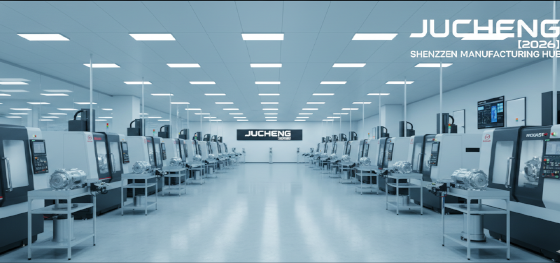
Dominating the [2026] industrial automation market requires a manufacturing partner that understands the high stakes of joint failure. Jucheng Precision operates with a 24/7 manufacturing mindset in our Shenzhen precision manufacturing hub, delivering high-tolerance joint housings and structural components with lead times as fast as 15 business days. We provide a "Bridge to Production" that allows you to move from a single hand-fitted prototype to a commercial fleet of 1,000 joints with consistent concentricity and thermal quality.
Integrating your joint design with JUCHENG’s expertise ensures that your robot survives the "First-Million Cycle" test and moves into mass adoption. We offer comprehensive DFM reviews within 24 hours, identifying potential concentricity risks or "heat-traps" in your housing design before they become field failures. Whether you are building a collaborative arm for electronics assembly or a 6-axis giant for aerospace milling, Jucheng Precision provides the rigid, precise "houses" that keep your innovation moving through the high-speed cycles and the years of hard labor.
Our facility is equipped with 150+ CNC machines, including the latest 5-axis Mazak centers and CMM inspection labs, allowing us to manage the entire housing lifecycle from raw material to finished, measured assembly. We manage the complexity of micron-level machining so your engineering team can focus on the motion control and the AI. By combining Shenzhen's speed with industrial-grade material verification, JUCHENG remains the preferred partner for the world's most aggressive industrial robot parts challenges. Contact us today to start your next project.
FAQ: Precision Machining for Robotic Motion Joints
What is the typical concentricity tolerance for a robotic joint housing?
High-performance joints require bearing seat concentricity within 0.005mm to 0.010mm to protect the gearbox.
Why is 5-axis machining necessary for joint housings?
It allows all critical bores and mounting faces to be machined in a single setup, eliminating the stacking errors of traditional 3-axis flips.
How do you handle thermal expansion in aluminum joints?
We utilize specialized heat treatment for stabilization and design the bearing fits with precise allowances for 24/7 heat cycles.
What is the maximum size housing JUCHENG can machine?
We can machine robotic joint housings and structural components up to 1,500mm in diameter with micron-level precision.
Joint misalignment in industrial robotics is an absolute hardware killer. Partnering with Jucheng Precision ensures that your enclosures are built with the micron-level concentricity and specialized 5-axis machining techniques the industry demands. Reach out to our Shenzhen manufacturing hub today for a complete DFM review and build the rigid foundation your autonomous fleet requires.

