


Touch is the most intimate form of engineering feedback. When a user interacts with a handheld device, the "tactile contract" is established by the softness of a grip, the resistance of a button, or the seal of a gasket. In the high-fidelity landscape of vacuum casting materials, achieving this organic response is a struggle against the rigidity of standard polymers. Most 3D printed elastomers offer a rubbery appearance but fail to replicate the true viscoelasticity of vulcanized rubber. This is the technical domain of Rubber like Urethane Casting. It is a process that utilizes two-part liquid polyurethanes to simulate the precise Shore hardness and tear strength of production-grade TPE and silicone, providing a functional surrogate that survives real-world mechanical abuse.
Jucheng Precision operates a technical sanctuary for engineers who recognize that "close enough" in flexibility is a total assembly failure. If a seal is too hard, it leaks; if a grip is too soft, it feels cheap and wears down instantly. We move past the era of generic visual mockups to provide an engineered palette of elastomeric resins. By utilizing premium chemical systems from manufacturers like Axson and Hei-Cast, we deliver parts that possess the exact elongation-at-break and rebound resilience required for industrial survival. This guide explores the physics of the Shore A scale, the mechanics of high-tearing resistance, and why JUCHENG’s commitment to vacuum-phase degassing ensures your flexible designs are as structurally dense as they are tactilely honest.
Profitability in the R&D cycle is won by the certainty of the tactile test. You aren't just buying a soft part; you are buying the ability to validate ergonomics and sealing integrity before committing to expensive production tooling. Whether you are building a medical-grade breathing mask or a series of ruggedized industrial bumpers, the logic of the elastomer is your primary manufacturing governor. Let us break down the mechanical and chemical pillars of rubber simulation and see how technical foresight can lock the integrity of your next flexible design into physical reality.
Shore A Hardness: Mapping the Human Touch
Mechanical Resilience: Elongation and Tear Strength Realities
Complexity Sovereignty: Flexible Bellows and Gaskets
Vacuum Dynamics: Eliminating Micro-Porosity in Elastomers
JUCHENG Customization: Matching Pantone and Performance
Shore A Hardness: Mapping the Human Touch
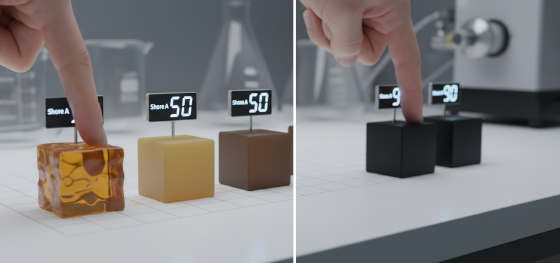
The primary technical language of Rubber like Urethane Casting is the Shore A scale. This measurement defines the resistance of the polymer matrix to localized indentation. In the world of rigid manufacturing, we talk about tensile strength; in the world of elastomers, we talk about "squish." At Jucheng Precision, we help our clients navigate this scale to match the tactile profile of their production intent. Shore 30A resins provide the softness of a gummy candy or a gel-insert—ideal for vibration dampening and medical cushions. Shore 50A to 60A mimics the feel of a pencil eraser, striking a balance between grip and structural stability. Move up to Shore 90A, and the material becomes as tough as a car tire or a high-performance shopping cart wheel—stiff enough to carry a load but resilient enough to absorb impact.
Selecting the correct durometer is an engineering decision driven by "Breakaway Friction" and "Compression Set." If you choose a material that is too soft for a dynamic seal, the rubber will "flow" out of its seat under high pressure, leading to a leak. If you choose a material that is too hard for an ergonomic handle, the user will experience fatigue and discomfort. Our engineers perform a "Touch Audit" for every flexible project, recommending specific polyurethanes that maintain their Shore hardness across a range of operating temperatures. We don't just provide a soft part; we provide a calibrated tactile experience that ensures your prototypes provide the same haptic feedback as your final vulcanized products. By locking in the durometer, JUCHENG ensures that your user-testing data is accurate and reproducible.
Mechanical Resilience: Elongation and Tear Strength Realities
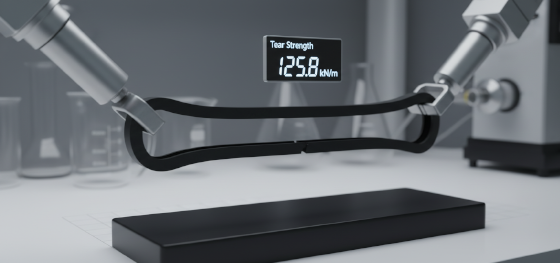
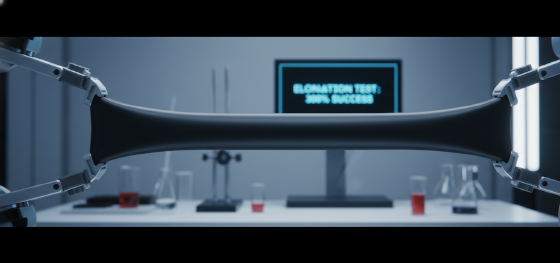
The failure mode of a rigid part is a crack; the failure mode of a flexible part is a tear. In the urethane casting process, we measure survival through "Elongation at Break"—the percentage a part can stretch before it physically separates. High-fidelity rubber-like resins can achieve elongation values of 400% to 600%. This is a massive leap over flexible 3D printed resins, which often snap at less than 50% elongation. This mechanical resilience is vital for parts like bellows, flexible couplings, and snap-fit assemblies that must survive violent deformation during installation.
Equally critical is "Tear Strength." A flexible part is often subjected to sharp edges or abrasive environments. If a material has low tear resistance, a tiny surface nick will instantly propagate into a catastrophic rip. JUCHENG utilizes high-performance polyurethane systems specifically designed for "Industrial Toughness." These resins incorporate long-chain molecules that tangle and knot at the atomic level, effectively stopping a tear in its tracks. We recommend these grades for heavy-duty industrial seals and protective covers that live in the abrasive world of the factory floor. By matching the "Toughness Profile" of the resin to the environment of the part, we ensure your vacuum casting materials strategy doesn't result in a failed endurance test. We bridge the gap between "rubbery look" and "rubber performance," delivering parts that can be pulled, twisted, and crushed without losing their structural soul.
Complexity Sovereignty: Flexible Bellows and Gaskets
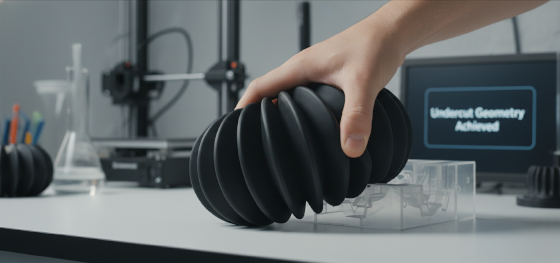
Traditional machining of rubber is a nightmare. The material deflects away from the tool, making it impossible to hold tight tolerances or create complex internal geometries. Rubber like Urethane Casting solves this through "Geometric Sovereignty." Because we are pouring a low-viscosity liquid into a flexible silicone tool, we can produce shapes that are physically impossible to machine or de-mold from a rigid steel tool. Think of a convoluted engine bellow with multiple internal undercuts—in an injection mold, this would require complex collapsible cores; in a silicone mold, the rubber simply stretches and pops out of the cavity.
This freedom allows designers to optimize for fluid dynamics and airflow without worrying about "Draft Angles" or "Tool Access." At Jucheng Precision, we use this capability to manufacture complex seals and manifolds for the medical and automotive sectors. We can integrate thin-walled membranes (down to 0.5mm) directly with thick mounting flanges in a single cast. The lack of internal stress in the casting process ensures that these complex features don't "warp" or move after they are removed from the mold. By leveraging the flexible nature of the tool, JUCHENG enables a level of design complexity that accelerates the R&D cycle for everything from orthopedic braces to high-pressure vacuum seals, ensuring your most ambitious geometries are realized with zero manufacturing compromise.
Vacuum Dynamics: Eliminating Micro-Porosity in Elastomers
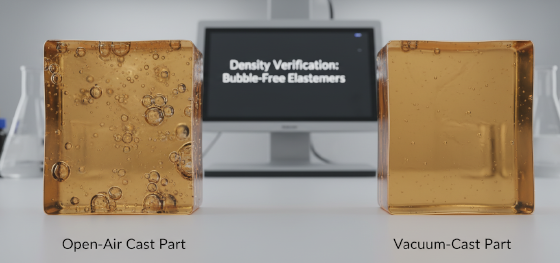
A flexible part is only as strong as its density. If a rubber-like part contains microscopic air bubbles, those bubbles act as "fracture initiators." Under the cyclic load of a vibrating motor or a pumping bellows, these internal voids will expand, leading to premature fatigue failure. This is why the "Vacuum" in our vacuum casting process is not a suggestion—it is a mandatory technical requirement for functional survival. Two-part polyurethanes are notorious for trapping gas during the mixing phase; if these gases are not removed, the part will be porous and structurally weak.
JUCHENG utilizes high-capacity, dual-chamber vacuum systems to manage this "Atmospheric Threat." We degas the resin both before and after the pour to ensure a 100% dense solid. This density is what provides the material's "Rebound Memory." A dense rubber part returns to its original shape instantly; a porous part stays deformed longer, a failure known as "Compression Set." For our clients building sub-sea sensors or high-vacuum gaskets, this bubble-free integrity is the primary reason they trust JUCHENG. We provide the structural density needed for parts that must operate at high pressures or across millions of cycles, ensuring that your flexible designs possess the same structural honesty as our 5-axis peek cnc machining components. We don't just "pour parts"; we manage the physics of the void to deliver perfection.
JUCHENG Customization: Matching Pantone and Performance
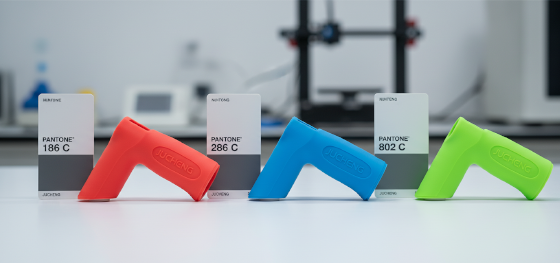
The final hallmark of a professional manufacturing partner is the move away from "industrial grey." In the world of consumer products and medical devices, color is information. A red gasket indicates a specific seal; a blue handle identifies a specific tool. Rubber like Urethane Casting allows for "Pigment Integration." Unlike painting, which would peel off a flexible part the moment it is bent, we mix the pigment directly into the liquid resin before the pour. This ensures the color is a permanent, structural part of the material’s DNA.
At Jucheng Precision, our finishing lab matches your exact Pantone or RAL color with a Delta-E variance of less than 1.0. We also specialize in "Soft-Touch" overmolding, where we cast a soft rubber skin over a rigid plastic core. This integrated approach allows you to deliver functional prototypes that are visuals-ready for the boardroom. We provide the material certifications and Shore hardness logs for every batch, ensuring your high-volume prototype runs are documented for quality assurance. Whether you are building an innovative heart-rate wearable or a high-durability industrial bumper, our expertise in rubber simulation ensures your vision is delivered with absolute visual and mechanical integrity. Contact Jucheng Precision today for a technical DFM review and see how our flexible additive protocols can armor and accelerate your next ergonomic breakthrough.

