


Thermal failure is the most unforgiving critic of material selection. In the high-stakes sectors of automotive engine development and power electronics, the ability to maintain dimensional integrity under intense heat is not a luxury—it is a functional mandate. Most standard prototyping resins reach their physical limit at 60°C, turning into soft, pliable rubber the moment the environment warms up. This is the technical boundary where High Temp Urethane Casting provides a strategic sanctuary. By utilizing specialized polyurethanes with high cross-linking densities, we enable the production of small batches that can survive in "warm zones" previously reserved for expensive machined metals. Achieving success here requires a move away from the "look-and-feel" mockup toward an engineered component that respects the laws of thermodynamics.
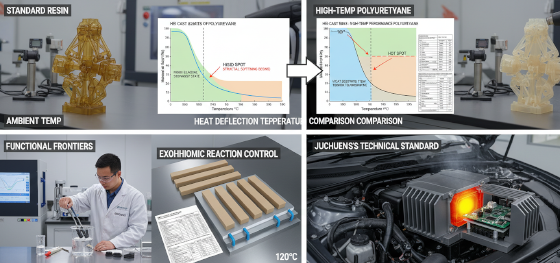
At Jucheng Precision, we recognize that for a drone motor mount or a medical sterilization tray, a "nearly stable" part is a liability. We have engineered our facility to act as a center of technical resilience, utilizing premium vacuum casting materials from industry leaders like Hei-Cast. We understand that high-heat performance is not just a line on a datasheet; it is a result of a meticulously managed cure cycle that locks in the polymer's crystalline structure. This guide moves past the basic tutorials to explore the physics of Heat Deflection Temperature (HDT), the management of exothermic peaks during curing, and why JUCHENG’s integrated approach to thermal stabilization ensures your prototypes are mission-ready for the most aggressive real-world environments.
Efficiency in the R&D cycle is won by identifying the point where material softening leads to assembly failure. You aren't just buying a plastic shape; you are buying the verified relationship between temperature and torque. Whether you are building a high-voltage connector or a structural shroud for a jet engine, the logic of the heat is your primary manufacturing governor. Let us break down the physical and chemical pillars of high-temperature replication and see how technical foresight can lock the integrity of your next design into reality.
Thermal Thresholds: Understanding HDT and Glass Transition
Material Selection: The Power of Hei-Cast and High-Performance Resins
Exothermic Management: Controlling Heat During the Cure
Functional Frontiers: Engine Bays and Electronic Enclosures
JUCHENG’s Technical Standard: Validating Thermal ROI
Thermal Thresholds: Understanding HDT and Glass Transition
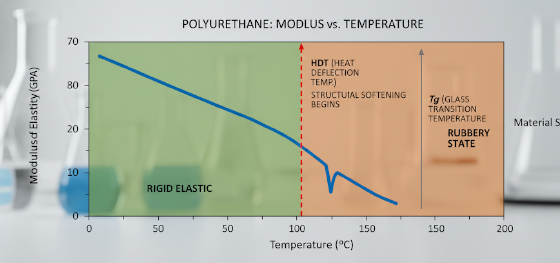
To master High Temp Urethane Casting, one must move past the simple "Melting Point" and look at the Heat Deflection Temperature (HDT). In the polymer world, materials don't usually turn from solid to liquid instantly. Instead, they undergo a "Glass Transition" (Tg), where the rigid molecular chains begin to slide past each other, turning the part from a hard solid into a leathery, flexible state. A part can be technically "solid" but still be an engineering failure because its modulus of elasticity has dropped by 90% due to ambient heat.
At Jucheng Precision, we use HDT as the definitive governor of our material selection. While standard resins might have an HDT of 65°C, our high-temp urethanes are specifically formulated to push this threshold to 120°C or higher. This stability is achieved through "Cross-Linking Density." By engineering the chemistry to form a tighter, more interconnected molecular web during the vacuum casting process, we ensure that the part maintains its structural "spine" even when the thermometer rises. This is vital for parts like intake manifolds or high-power server housings where the part must carry a mechanical load while being subjected to high-temperature airflow. By understanding the thermodynamic curve of the resin, we help our clients design for the "Worst-Case Temperature," ensuring that your assembly doesn't bind or warp during an intensive functional test. We don't just provide a part; we provide the thermal safety margin your high-performance hardware requires.
Material Selection: The Power of Hei-Cast and High-Performance Resins
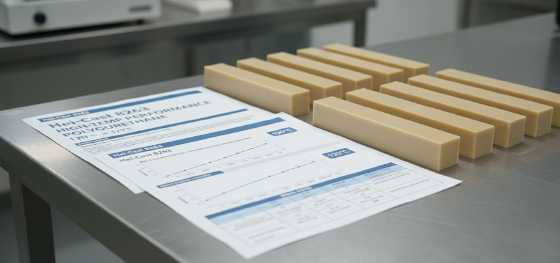
Material mimicry is the soul of high-fidelity casting. For projects requiring high-heat resistance, JUCHENG utilizes elite resin systems from manufacturers like Hei-Cast and Axson. One of our primary weapons is **Hei-Cast 8263**. This material is a technical powerhouse, designed specifically to simulate the thermal and mechanical behavior of high-heat thermoplastics like Polycarbonate or ABS/PC blends. It offers an HDT that can exceed 120°C after a stabilized post-cure cycle, making it the industry standard for functional automotive prototypes.
Beyond raw heat resistance, these high-temp resins offer exceptional chemical stability. In a vacuum casting materials audit, we look at how the part will interact with oils, fuels, and cleaning agents at elevated temperatures. Heat often acts as a catalyst for chemical degradation; a part that is resistant to oil at 20°C might soften and dissolve at 90°C. By selecting resins with an optimized "B-side" chemistry, JUCHENG delivers parts that maintain their chemical immunity across the entire operating range. This material depth allows our clients to perform high-fidelity field trials—installing 3D-cast sensor mounts directly onto a running engine or inside a high-temperature chemical reactor. We bridge the gap between "visual mockup" and "functional survivor," giving your engineers the data they need to commit to mass-production tooling with zero thermal doubt.
Exothermic Management: Controlling Heat During the Cure

There is a technical paradox in high-temp casting: the heat that makes the part strong is the same heat that can destroy it. The chemical reaction between polyol and isocyanate is exothermic—it releases thermal energy. High-temperature resins are particularly aggressive in this regard; if a massive part is cast in a single pour, the internal "Exothermic Peak" can reach temperatures that would char the resin or melt the silicone mold from the inside out. Mastering High Temp Urethane Casting is a game of thermal mitigation.
At Jucheng Precision, we use a "Staged Thermal Strategy." We don't just pour and walk away. We monitor the mold surface temperature and utilize actively cooled casting chambers for large-volume parts. We also account for "Thermal Shrinkage." High-temp resins often shrink more than standard grades because the temperature drop from the cure-peak to room-temperature is much larger. We compensate for this during the master-pattern phase, utilizing our 5-axis CNC machines to carve a master that is slightly oversized. This ensures that after the part has undergone its intense thermal birth and cooling cycle, it "shrinks into" the exact tolerance required by your CAD file. This level of thermodynamic foresight is why JUCHENG can deliver +/- 0.15mm accuracy on parts that other shops find impossible to manage. We treat heat as a manufacturing tool, not an uncontrollable byproduct.
Functional Frontiers: Engine Bays and Electronic Enclosures
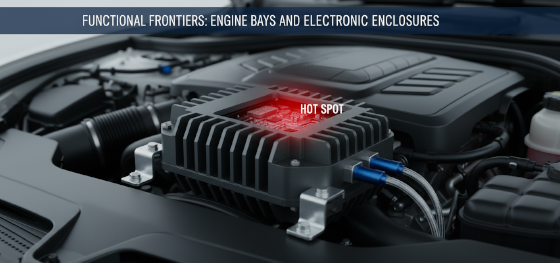
Where does the requirement for high-heat casting meet the reality of the field? The automotive "Hot Zone" is the most frequent use-case. We produce functional prototypes for air intake manifolds, radiator shrouds, and under-the-hood cable organizers. These parts must survive the "Heat-Soak" effect—the moment an engine stops and the temperature inside the bay reaches its peak. A standard 3D print or low-temp cast part would sag or warp within minutes of this soak. Our high-temp urethane parts maintain their rigidity, ensuring that critical clearances and fastener tensions are preserved.
Another vital sector is the power electronics industry. High-performance inverters and battery chargers generate significant internal heat. We machine and cast high-temp enclosures that act as primary insulators and thermal radiators. By integrating high-heat resins with the geometric freedom of the vacuum casting process, we allow engineers to design intricate cooling fins and internal fluid channels that keep sensitive semiconductors alive. Because these resins are also excellent electrical insulators, they provide a safe sanctuary for high-voltage components. JUCHENG’s technical rigor ensures that your electronic designs don't just fit into the box—they survive the thermal environment of a working high-power system, providing a production-grade experience in the R&D phase.
JUCHENG’s Technical Standard: Validating Thermal ROI
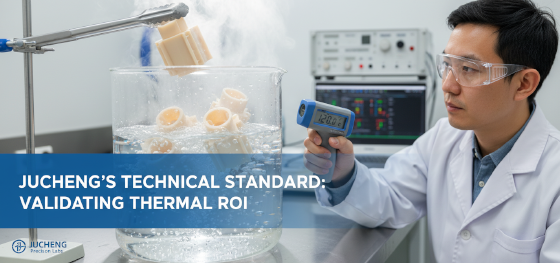
The final hallmark of a professional manufacturing partner is the move beyond visual inspection toward functional validation. You cannot "see" heat resistance. Jucheng Precision eliminates the risk of material failure through our integrated "Thermal Audit." Every batch of High Temp Urethane Casting we produce is subjected to a post-cure "Bake Cycle"—a stabilized thermal treatment that ensures the polymer chains have reached their full cross-linking potential.
We utilize digital HDT testers to verify that the specific batch of resin used in your parts meets the technical requirements of the print. We provide full material lot traceability and documented cure-logs, ensuring your aerospace or automotive auditors have the paper trail they need for certification. This transparency is the cornerstone of our service; we don't just ship plastic parts, we ship verified engineered solutions. Whether you are building an innovative heart pump or a high-performance EV battery housing, our expertise in thermal management ensures your vision is delivered with absolute precision and durability. Contact Jucheng Precision today for a technical DFM review and see how our high-temp protocols can clarify and armor your next manufacturing breakthrough. Stop guessing about material survival and start engineering for thermal sovereignty.

