


Managing lead-time bottlenecks on custom chassis or bracket fabrication is a constant battle for product designers. Sourcing sheet metal parts shouldn’t involve endless back-and-forth emails over simple tolerances. Finding an expert partner for sheet metal laser cutting is the decisive move that protects your project budget and prevents assembly mismatches on your test bench.
Slapping generic budget assumptions onto complex structural parts always ends in disaster. Every single geometric detail, from tiny draft angles to thick interior mounting ribs, directly alters how much money your company bleeds on the factory floor. Partnering with a transparent, turnkey manufacturer allows you to calculate every cent before cutting a single block of steel.
Balancing heavy mold investments against ongoing unit pricing separates successful hardware rollouts from bankrupt startups. Let's dissect the four primary cost factors, analyze how volume dictates your manufacturing strategy, and learn how our advanced global supply chain delivers maximum return on investment.
content:
How Fiber Laser Cutting Revolutionizes Sheet Metal
Material Capabilities and Thickness Limits
Laser Cutting vs. Punching: Which is Better?
Get High-Precision Laser Cut Parts at JUCHENG
FAQ: Critical Questions About Precision Metal Laser Slicing
How Fiber Laser Cutting Revolutionizes Sheet Metal
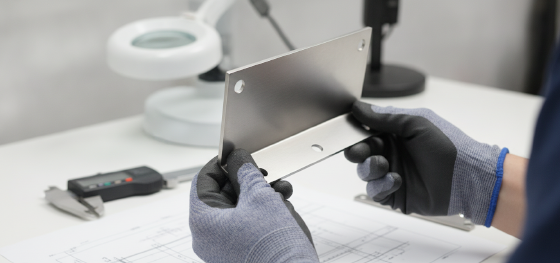
How does fiber laser technology improve sheet metal processing?
Fiber lasers concentrate high-density energy onto a micro-focused spot, enabling faster cutting speeds, narrower kerf widths, and vastly reduced thermal warping compared to older CO2 lasers.
Understanding how modern fiber laser cutting technology operates allows engineers to design complex enclosures with tighter tolerances. Unlike older CO2 systems that rely on reflective mirrors and fragile gas mixtures, a fiber system transmits a high-density light beam directly through a flexible optical cable. This direct power delivery means the laser beam is concentrated into a microscopically tight kerf, vaporizing the metal instantly.
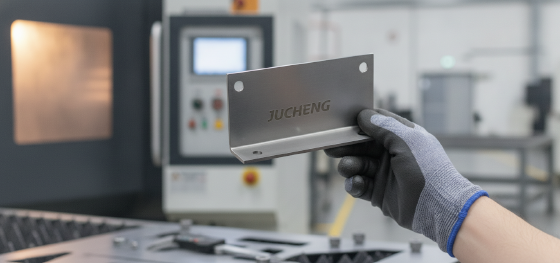
This high concentration of energy reduces the overall thermal distortion across the metal plate. When a part absorbs too much heat during fabrication, it warps and ruins flat patterns. By choosing high-performance fiber cutting, you protect thin-gauge features and achieve sharp, burr-free profiles. The metal feels solid and cool in your hand right after cutting, showcasing the minimal heat absorption of this process.
Material Capabilities and Thickness Limits
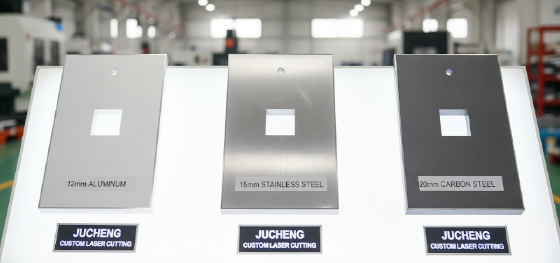
What is the maximum metal thickness that can be laser cut with precision?
Using our high-power industrial fiber cutters, we process aluminum up to 12mm, stainless steel up to 15mm, and mild steel up to 20mm while maintaining extremely clean edges.
Selecting the right alloy and thickness is critical to optimizing mechanical strength and cutting costs. Our manufacturing floor utilizes advanced fiber optics backed by high-purity assist gases to slice through thick metals without leaving thick dross or irregular taper profiles.
To prevent oxide buildup on delicate edges, we run a pressurized nitrogen assist gas system when processing aluminum and stainless steel. This keeps the cut edge perfectly bright, shiny, and ready for immediate welding without any secondary manual grinding. For heavy structural components, oxygen assist is deployed to cleanly slice through carbon steel up to 20mm. Here is our direct material limit chart:
| Material Type | Maximum Thickness | Edge Quality Assist Gas | Best B2B Application |
|---|---|---|---|
| Aluminum (e.g., 5052, 6061) | 12 mm | Nitrogen (High Pressure) | Lightweight brackets, electronic housings |
| Stainless Steel (e.g., 304, 316) | 15 mm | Nitrogen (Oxygen-Free) | Medical enclosures, marine hardware |
| Mild Steel / Carbon Steel | 20 mm | Oxygen (Active Cut) | Heavy-duty structural plates, automotive parts |
Laser Cutting vs. Punching: Which is Better?
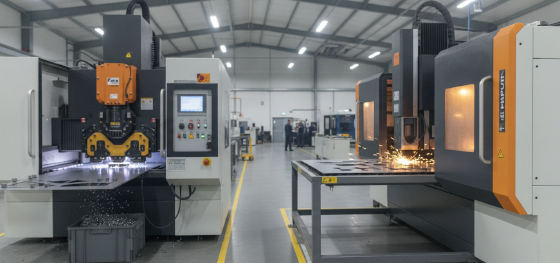
When should you choose laser cutting over CNC punching?
Choose laser cutting for complex geometries, prototype runs, and rapid design changes; select punching for high-volume standard holes, louvers, or embossments.
While modern sheet metal laser cutting has gained massive popularity due to its extreme flexibility, mechanical punch presses still dominate specific high-volume manufacturing sectors. Knowing when to deploy each method is crucial to maintaining a healthy budget.
If your design requires complex contours, variable hole sizes, or rapid prototype changes, laser slicing is the superior path. It completely eliminates the NRE tooling costs of custom hard punches. Conversely, for standardized grids of uniform holes, sheet metal punching remains the faster and more cost-efficient approach. Our advanced fiber laser cutting systems deliver faster cut cycles on thin-gauge materials like 1mm stainless steel, whereas the punch press is reserved for repeating patterns. At JUCHENG, we don't force you into a single process. We leverage our diverse workshop to combine both methods, reducing your overall part costs.
Get High-Precision Laser Cut Parts at JUCHENG
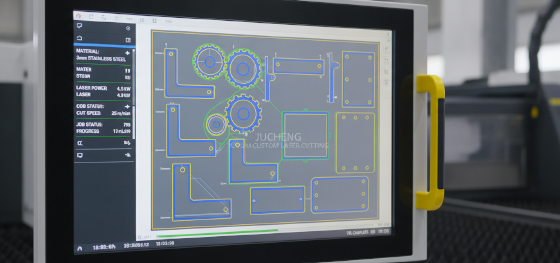
How does JUCHENG guarantee tight tolerances on custom laser-cut parts?
We combine advanced optical calibration on our CNC machines with a rigorous engineering check, providing instant feedback within 24 hours to eliminate fabrication errors before cutting.
Why struggle with unreliable suppliers who fail to meet your tolerances? Our high-speed sheet metal laser cutting stations are fully integrated into our digital manufacturing network, meaning we can move from CAD files to physical metal plates in minutes.
As the foundational step of the comprehensive sheet metal fabrication process, laser slicing sets the geometric accuracy for all downstream operations like bending and welding. JUCHENG bridges the gap between rapid prototyping and volume production, ensuring that your initial laser-sliced flat patterns align perfectly with the final formed enclosure. We operate an IATF 16949 and ISO 13485 certified facility to ensure that medical-grade enclosures and automotive brackets meet strict industrial regulations.
Our digital manufacturing queue is backed by 150+ high-performance CNC machines to handle any capacity bottlenecks. We offer a 24-hour free DFM analysis, allowing you to optimize your flat layout before we cut the first piece of metal. Whether you need a single prototype bracket or a production run of several thousand, our no minimum order quantity (no MOQ) policy and 4-to-15 day delivery guarantee keep your hardware schedule on track. We specialize in seamless low-to-medium volume manufacturing, handling your parts from initial slice to final surface powder coating.
FAQ: Critical Questions About Precision Metal Laser Slicing
Is laser cutting suitable for custom medical instrument enclosures?
Yes. Because our process introduces no physical tooling contact, there is zero risk of cross-contamination or surface scratching. Our specialized medical manufacturing line produces surgical brackets and analyzer housings under strict ISO 13485 standards.
How does JUCHENG avoid edge burnouts on tiny geometric features?
We utilize advanced CNC software that dynamically scales the laser power down as the cutting head slows around tight corners. This precise energy modulation prevents overheating, eliminating melted corner points and keeping your complex features intact.
What file formats should I upload to get a quote?
We accept 3D CAD files in STEP or IGES formats for automatic sheet metal unfolding, as well as 2D DXF or DWG files for flat-pattern cutting profiles. Our team will verify your design and deliver an active estimate within twenty-four hours.
How does thermal heat from cutting affect thin stainless steel parts?
Excessive heat concentrated on thin parts can cause serious warping. To prevent this, we calibrate our machine power outputs and optimize nested paths to allow the material to cool between close cuts. This minimizes the heat-affected zone (HAZ), ensuring that parts remain flat and free from thermal distortion.

