


Validating mechanical clearances on complex enclosures, server brackets, and modular cabinets is a critical milestone before launching high-volume production. Specifying sheet metal rapid prototyping provides product designers with a highly agile path to test functional tolerances and check electromagnetic shielding without paying expensive mold fees. This physical validation operates as a critical rapid prototyping service, utilizing software-driven cutting and folding tools to translate 3D CAD files into physical hardware in days.

Sourcing catalog casings or relying on fragile plastic 3D prints often compromises your functional testing. Standard boxes lack the precise connector ports needed for modern electronic arrays, while polymers cannot handle high structural loads or provide built-in electrical grounding. Shifting to custom-cut metal prototypes is the best way to verify spatial alignments and validate structural performance under real operating conditions.
Let's explore why tool-less processing is highly economical for short runs, analyze the fitting checks required for electronic box-builds, and review how to scale your prototypes cleanly into ongoing manufacturing runs.
The Advantage of Tool-Less Sheet Metal Prototyping
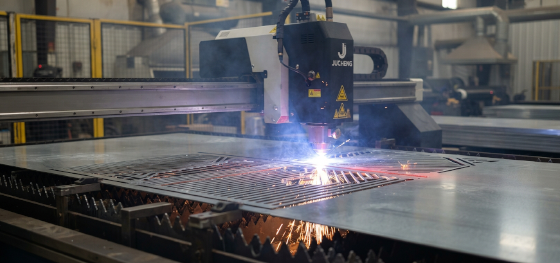
To minimize your upfront development budgets, bypassing hard tooling is essential. Traditional high-volume manufacturing utilizes expensive stamping dies and matching punch guides that require weeks of CNC grinding. Designing prototype assemblies under these rigid parameters makes rapid iteration virtually impossible due to long lead times.
Modern prototype workshops solve this limitation by utilizing a software-driven, tool-less workflow. We cut flat pattern blanks using high-precision CNC fiber lasers, slicing intricate outer boundaries and mounting holes within ±0.1mm. The blanks are then folded on programmable CNC press brakes. This software-driven process allows us to implement design changes instantly by simply updating the CAD vectors, delivering physical parts with zero mold fees.
Testing Fit and Function for Electronic Assemblies

A 3D CAD model displays geometric dimensions with perfect mathematical precision, but it cannot simulate the physical behavior of manual wiring, component heat limits, or screw torque limits. Assembling a multi-component electronic chassis physically is the only way to verify that your hardware integrates cleanly.
Physical prototyping exposes potential assembly interferences, such as card guides that bind or mounting holes that stretch out of round due to localized tensile stresses during folding. We verify these tolerances by mounting real PCBs, cabling arrays, and cooling systems inside the folded brackets, ensuring that your parts align perfectly with no forced fitments before releasing designs to volume production.
Seamless Transition to Low-Volume Sheet Metal Production
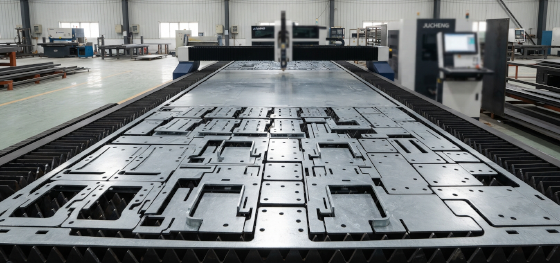
Transitioning custom hardware from a single flat blank to continuous output is the most critical bridge of the rapid prototyping process, requiring a balanced tooling strategy. Running laser cutting and CNC bending is perfect for validating designs under 500 units. However, once your volume demands scale, transitioning to custom hard stamping dies is necessary to drive per-part costs down.
By executing both sheet metal rapid prototyping and final manufacturing under one roof, we eliminate dimensional discrepancies. Our engineers reuse the flat CAD offsets and K-factor allowances verified during your prototyping runs to build our progressive dies, ensuring that your small-batch production units match the physical characteristics of your approved prototypes with zero dimensional drift.
Custom Surface Finishes for Prototypes

A functional prototype must evaluate more than just bare geometric limits; it must simulate the final aesthetic appeal and corrosion resistance of the retail product. As a full-service rapid prototyping service, we integrate professional surface treatments directly into our quick-turn workflow. We run advanced post-processing cells to completely finish your parts before delivery.
For lightweight aluminum bezels, we perform chemical anodizing to grow a hard, non-conductive oxide layer that accepts vibrant color dyes. For robust carbon steel frames, we apply electrostatic powder coatings, curing the parts in high-temperature ovens to build an impact-resistant, moisture-proof barrier. This integrated finishing provides you with presentation-ready, fully tested enclosures that are completely ready for client demonstrations.
FAQ: Critical Questions About Sheet Metal Rapid Prototyping
Our engineering team has compiled professional, concise solutions to the most common quality challenges faced during quick-turn metal fabrication runs:
Can you prototype sheet metal without a stamping die?
Yes, absolutely. We utilize CNC fiber lasers and programmable press brakes with universally compatible standard tooling, completely bypassing NRE mold expenses.What causes sheet warping near laser-cut slot clusters, and how is it prevented?
Concentrated thermal cuts inject high localized heat that warps thin panels. We prevent warping by optimizing our laser cutting paths to distribute the heat input evenly across the sheet.Why is pre-plating important before assembling aluminum panels?
Applying conversion coatings before final assembly protects overlapping flanges from corrosion while providing the low resistance electrical contact essential for electronic chassis grounding.How do you verify the dimensional tolerance of sheet metal rapid prototyping orders?
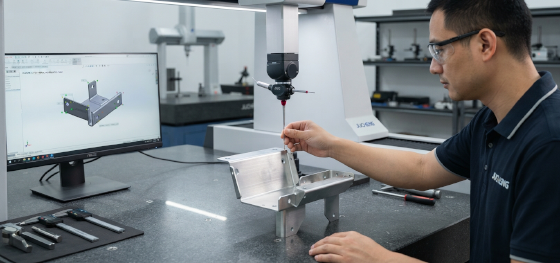
We verify flat layouts using digital scanners after laser blanking, and conduct multi-point coordinate measuring machine (CMM) audits to ensure perfect fold alignments before final packing.

