


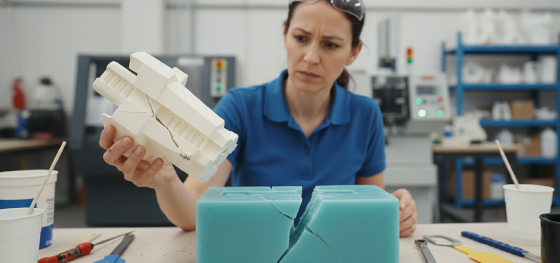
Manufacturing certainty evaporates when an engineer assumes a soft tool is eternal. Vacuum casting relies on a physical paradox: we use a flexible, delicate medium to replicate high-performance, rigid engineering resins. This relationship is inherently self-destructive. Every successful cycle brings the tool one step closer to catastrophic failure. Understanding the variables of Silicone Mold Life constitutes the difference between a smooth product launch and a panicked production halt. Most amateur suppliers promise a generic "fifty shots per mold" to secure a contract, but this is a dangerous fabrication. Reality is dictated by the chemical hostility of the resin, the geometric aggression of the part, and the thermal profile of the curing oven. This guide provides a forensic look at the mortality of a silicone mold for casting, ensuring your procurement team can accurately forecast tool replacement costs and maintain part quality across a complete fifty-unit batch.
Standardizing Shot Count: The 15-25 Unit Threshold
Molecular Fatigue: The Impact of Exothermic Heat
Geometric Aggression: Where Molds Physically Tear
Surface Dissolution: Preventing the Orange Peel Effect
JUCHENG Performance: Strategies for Lifespan Extension
Standardizing Shot Count: The 15-25 Unit Threshold
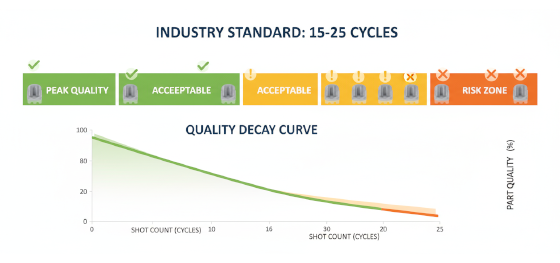
Establishing a baseline for production planning requires ruthless honesty about material limits. In the professional vacuum casting industry, the consensus for a high-quality silicone tool hovers between fifteen and twenty-five copies. This is not an arbitrary number; it represents the point where the chemical and mechanical integrity of the RTV silicone begins to drift outside of tight engineering tolerances. For a simple enclosure with generous draft angles and standard ABS-like polyurethane, reaching twenty-five units is achievable with meticulous care. However, if the project requires high-clarity transparent resins or aggressive snap-fit features, the mold may begin to fail as early as the twelfth unit. Attempting to push a mold into its fortieth or fiftieth cycle is a gamble with your brand's reputation. At this late stage, the part's dimensions shift as the silicone wall loses its modulus, and the surface finish degrades into a cloudy, textured mess. Procurement managers must view the tool as a consumable asset, budgeting for a fresh mold for every twenty units of demand to ensure every part in the box looks identical to the first approved sample.
Molecular Fatigue: The Impact of Exothermic Heat

Chemical warfare occurs inside the mold during every curing cycle. Polyurethane resins are thermosets, meaning they solidify via an exothermic reaction that generates significant internal heat. As the resin sits inside the vacuum chamber and subsequently the curing oven, it undergoes "thermal soaking." This heat aggressively attacks the molecular cross-links of the silicone. Simultaneously, the aggressive chemicals within certain resin systems—particularly those used for optically clear parts or high-heat-deflection components—act as solvents. These chemicals gradually leach the silicone oil out of the mold's surface. This process, known as "silicone poisoning," leaves the mold cavity brittle and dry. As the silicone oil vanishes, the material loses its natural lubricity and elasticity. The result is a mold that becomes increasingly prone to micro-cracking. Once these microscopic fissures appear, they capture the next pour of resin, which then acts as a wedge to widen the crack during demolding. This cycle of chemical leaching and thermal fatigue is the primary driver of Silicone Mold Life depletion.
Geometric Aggression: Where Molds Physically Tear
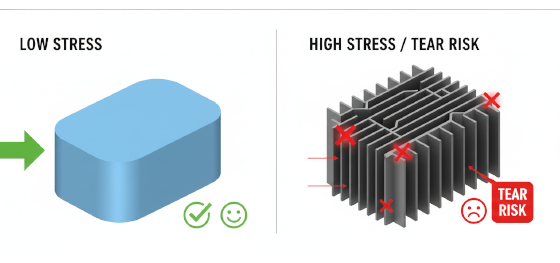
Physical geometry dictates the mechanical strain placed on the elastomeric walls during the "extraction" phase. Parts featuring deep, thin ribs or sharp internal corners create "stress risers" within the silicone. When the technician pries the mold halves apart to remove the part, these thin silicone features are subjected to intense tensile forces. If a rib has zero draft angle, the friction between the cured polyurethane and the silicone wall is immense. After several cycles, the silicone reaches its "tear strength" limit. A tiny piece of the mold will eventually stick to the part and pull away, leaving a permanent pit in the tool. From that moment on, every part produced will have a corresponding "zit" or defect in that exact location. We frequently see this failure in complex heat sinks or interlocking electronic chassis where the designer has prioritized compact features over manufacturing reality. Managing these geometric stresses through clever DFM—such as adding a mere one-degree draft or filleting a sharp corner—can often extend the life of a mold by 30%, delaying the inevitable tearing that kills a high-complexity tool.
Surface Dissolution: Preventing the Orange Peel Effect
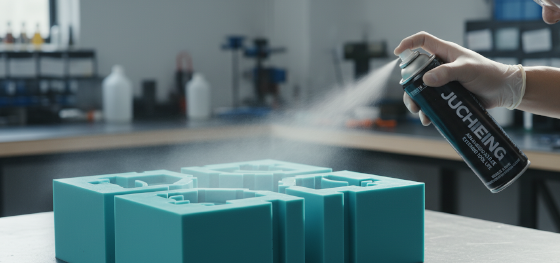
Surface realism dissolves long before the mold physically breaks. The first sign of an aging tool is often the "Orange Peel Effect." Because the silicone is leaching oil and suffering from thermal shock, the once-smooth, mirror-like surface of the cavity begins to warp and pucker on a microscopic level. This change is subtle at first, appearing as a slight loss of gloss. By the twentieth shot, the surface of the cast part will look mottled and uneven. For consumer-facing products like high-end smartphones or medical handhelds, this loss of aesthetic fidelity is a deal-breaker. Furthermore, as the surface becomes "sticky" due to oil depletion, the technician must apply more release agent spray. Excessive release agent builds up in the corners of the mold, rounding off sharp details and further muddying the part's crispness. This is the "Aesthetic Horizon"—the point where the part is still dimensionally correct but no longer represents the premium design intent. Jucheng Precision monitors this surface transition with hawk-like intensity, advising clients to refresh the tool the moment the optical clarity or texture uniformity begins to drift.
JUCHENG Performance: Strategies for Lifespan Extension
Jucheng Precision treats Silicone Mold Life as an engineering challenge to be optimized, not an inevitable defeat. Our performance preservation strategy begins with material selection. We refuse to use generic, low-cost silicones. Instead, we invest in premium, high-tear-strength RTV-2 systems that exhibit superior chemical resistance to polyurethane attack. Simultaneously, we employ "Active Thermal Management." Instead of "blasting" molds in high-heat ovens, we utilize stabilized, gradual cooling cycles that minimize the thermal shock to the polymer chains. We also leverage our surgical mold-cutting techniques to create "Low-Stress Parting Lines" that reduce the force required for demolding. Crucially, our engineers perform a complimentary DFM review for every project, flagging the specific "mold killers" in your design before the first tool is ever poured. We don't just deliver parts; we deliver a managed manufacturing lifecycle that protects your budget and your timeline. Experience the peace of mind that comes from professional process control. Contact JUCHENG today to discuss your next high-volume prototype run.

