


Complexity in manufacturing is usually expensive. In the traditional 3D printing process, creating overhanging features or internal hollows requires a forest of sacrificial support structures that must be laboriously removed by hand, often leaving behind scars on the surface. But there is a technical sanctuary where gravity is ignored and geometry is truly free. This is the realm of sls 3d printing, or Selective Laser Sintering. It is the industrial workhorse of additive manufacturing, built on the principle of a self-supporting powder bed. Instead of building scaffolding, the material itself provides the foundation, allowing for the creation of intricate, interlocking, and structurally sound components that were once thought to be physically impossible.
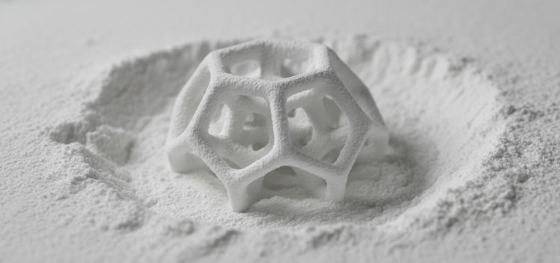
At Jucheng Precision, we recognize that functional prototypes must do more than just look the part—they must survive the rigors of mechanical testing. SLS technology is our primary solution for components that require the raw toughness of engineering-grade nylon. By utilizing high-power CO2 lasers to weld microscopic particles of Polyamide together, we deliver parts with exceptional heat resistance and mechanical strength. This guide moves beyond the surface-level definitions to explore the thermal mechanics of powder fusion, the strategic selection of nylon grades, and why JUCHENG’s integrated finishing hub ensures your grainy prints are transformed into production-ready hardware.
Reliability in additive manufacturing is found in the management of the thermal gradient. You aren't just melting plastic; you are conducting a high-speed metallurgical event inside a bed of fine powder. Whether you are building an innovative drone chassis or a complex set of medical manifolds, understanding the logic of the sinter is essential. Let us examine the technical pillars of Selective Laser Sintering and see how it redefines the survival of your most ambitious designs.
Powder Bed Sovereignty: Sintering Without Supports
Molecular Fusion: How CO2 Lasers Bind Polyamides
Material Resilience: Navigating PA11, PA12, and Beyond
Surface Texture Realities: From Grainy to Smooth Finish
Functional Validation: The Snap-Fit and Hinge Test
JUCHENG’s Standard: The Integrated Finishing Hub
Powder Bed Sovereignty: Sintering Without Supports
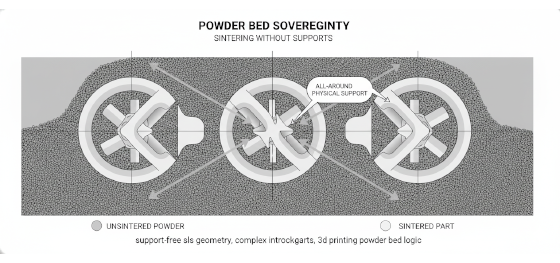
The primary technical differentiator of sls 3d printing is the total elimination of support structures. In standard light-cured or extrusion-based methods, every overhang must be propped up by temporary columns of material. This creates a geometric limitation: you cannot easily print "internal" moving parts or complex, nested geometries because you cannot reach inside the part to remove the supports. SLS operates within a heated chamber filled with fine nylon powder. As the laser sinters each layer, the unsintered powder remains in place, acting as a dense, omnipresent support medium.
This "Powder Bed Sovereignty" allows JUCHENG to manufacture parts with an unprecedented level of complexity. We can print a chain assembly, a ball-and-socket joint, or a duct with complex internal cooling fins—all fully assembled and functional directly from the machine. For the engineer, this means you can consolidate multi-part assemblies into a single monolithic component, reducing the need for fasteners and manual labor. The powder also enables us to "nest" dozens of different parts into a single build volume, stacking them vertically to maximize production efficiency. By removing the physical barrier of supports, SLS provides the ultimate freedom for generative design and functional optimization, ensuring your most complex CAD visions are realized with absolute fidelity and structural continuity.
Molecular Fusion: How CO2 Lasers Bind Polyamides
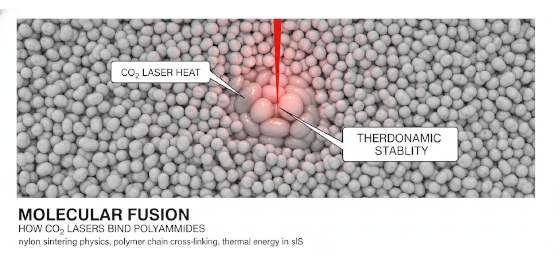
The strength of an SLS part is decided at the microscopic shear zone where the laser meets the powder. Unlike FDM, which merely glues hot plastic together, SLS is a process of thermal fusion. An industrial CO2 laser—operating with high-wattage precision—traces the cross-section of the part on the surface of the powder bed. The temperature of the chamber is maintained just below the melting point of the nylon, so the laser only needs to provide a small amount of additional energy to trigger the "sintering" event. The nylon particles don't just melt; they fuse together into a dense, solid mass.
This molecular fusion creates parts that are nearly isotropic. While most 3D printed parts are significantly weaker along the Z-axis (the layer lines), JUCHENG’s SLS parts maintain a high degree of structural integrity in all directions. We manage the "Cool-Down Cycle" with extreme technical rigor. After the build is complete, the massive block of powder must cool slowly over several hours to prevent the parts from warping or developing internal stresses. This patient approach to thermal management is the secret to achieving consistent dimensional accuracy and high-tensile strength. By controlling the thermodynamics of the fusion, we deliver nylon components that possess the mechanical "spine" required for high-stress industrial applications, from pneumatic manifolds to automotive engine brackets.
Material Resilience: Navigating PA11, PA12, and Beyond
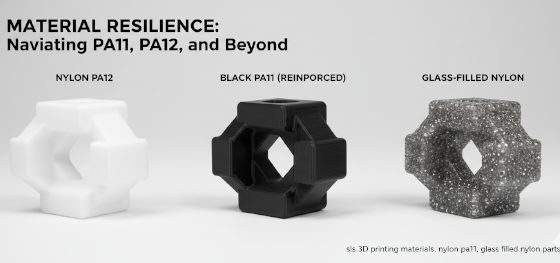
Choosing the right powder is an exercise in engineering pragmatism. At Jucheng Precision, we offer a specialized palette of polyamides to match the mechanical destiny of your part. Nylon 12 (PA12) is the industrial standard. It offers a balanced profile of strength, stiffness, and chemical resistance, making it ideal for enclosures and structural components. It is the most predictable material in the SLS inventory, allowing us to hold tight tolerances across large production runs.
For applications that demand extreme impact resistance or environmental durability, we utilize Nylon 11 (PA11). Derived from sustainable castor oil, PA11 is more ductile than PA12; it bends where PA12 might snap. This makes it the premier choice for athletic gear, living hinges, and aerospace components that must survive high-vibration environments. We also specialize in "Composite Powders," such as Glass-Filled Nylon (GF-Nylon) and Alumide (Aluminum-filled). By introducing glass beads into the nylon matrix, we create a part with massive rigidity and a much higher heat-deflection temperature. This allows SLS parts to replace die-cast metal components in some functional assemblies. JUCHENG helps you navigate these material choices during our DFM review, ensuring the molecular makeup of your part aligns with the harsh reality of the field.
Surface Texture Realities: From Grainy to Smooth Finish
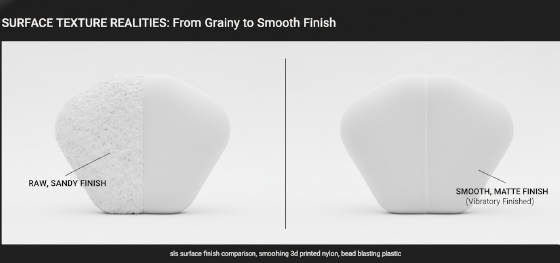
We must address the characteristic "Grain" of SLS. Because the part is born in a bed of powder, its natural surface finish is somewhat porous and textured—similar to a fine-grit sandpaper. For many industrial applications, this "matte" look is desirable because it hides fingerprints and minor scratches. However, for medical devices or consumer-facing electronics, a smoother finish is often required. Achieving aesthetic perfection in SLS is a secondary act of craftsmanship.
At Jucheng Precision, we operate an integrated finishing center. Every SLS part undergoes a mandatory bead-blasting cycle to remove any loose, unsintered powder. For parts requiring a high-end look, we utilize "Vibratory Finishing," where parts are tumbled with abrasive media to smooth out the grainy texture. For the ultimate in smooth aesthetics, we offer "Chemical Vapor Smoothing." This advanced process uses a specialized gas to partially melt the outer skin of the nylon, sealing the pores and creating a glossy, liquid-resistant finish that looks almost like an injection-molded component. This treatment doesn't just improve the look; it makes the part hygienic and easy to sanitize, which is essential for our healthcare and food-processing clients. We don't just ship raw prints; we provide finished engineered solutions that match the visual expectations of your brand.
Functional Validation: The Snap-Fit and Hinge Test
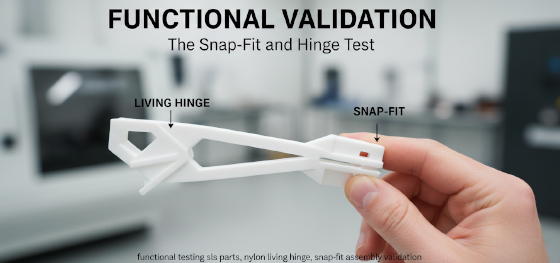
The real power of sls 3d printing is its ability to perform under load. In the early stages of the product development cycle, you need to know if your snap-fits will click and if your hinges will flex without failing. Brittle resins or weak filaments cannot provide this data. Nylon parts from an SLS machine are functional survivors. Because the fusion is so complete, a well-designed snap-fit will maintain its spring-like tension over hundreds of cycles.
JUCHENG’s SLS parts are used extensively for "Kinematic Prototypes"—parts that must move and interact. We produce living hinges—thin webs of nylon that connect two parts—that can be folded and unfolded without tearing. This is only possible because of the material's high fatigue life and isotropic bonding. When we perform a DFM review for an SLS part, we look specifically at the thickness of these flexible features. We suggest radii and geometry tweaks that maximize the material's ductility. By providing you with a part that behaves like a production nylon part, we allow you to conduct real-world ergonomic audits and mechanical stress tests with 100% confidence. If it works as an SLS prototype, you can be certain it will work when you move to mass-production injection molding.
JUCHENG’s Standard: The Integrated Finishing Hub
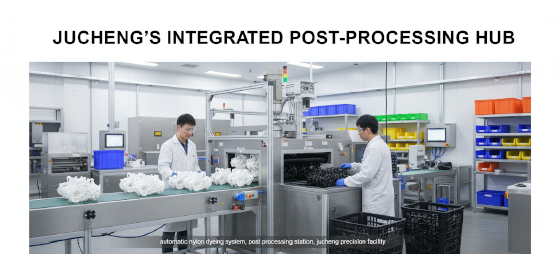
The hallmark of a professional manufacturing partner is the transition from the machine to the warehouse. At Jucheng Precision, we don't treat SLS as a "raw" output. Our facility is equipped with automated dyeing systems that can color nylon parts in deep, permanent blacks, blues, or reds. Unlike paint, this dye penetrates the porous surface of the nylon, ensuring that the color won't chip or peel off even if the part is scratched. This is vital for industrial tools and handheld equipment that must maintain a professional appearance in a dirty environment.
Our quality control team performs rigorous inspection cycles, ensuring that the dimensional accuracy of your sintered parts matches your original STEP file. We understand that in high-volume industrial orders, consistency is everything. Whether you need a single complex manifold or a production run of 500 durable brackets, Jucheng Precision has the technical rigor and the massive capacity to deliver. We don't just print nylon; we engineer performance. Our expertise in sls 3d printing clarifies the path from prototype to production, giving you the durable hardware you need to succeed. Contact our engineering team today for a technical review and see how our powder-bed protocols can elevate your next functional project.

