


Validating rugged mechanical actions, interlocking clips, and high-temperature manifolds requires raw material that can handle true physical strain. Specifying sls rapid prototyping provides your engineering teams with exceptionally tough, isotropic thermoplastic components that can be used directly for functional field trials. This powder-bed fusion process serves as an essential, high-durability rapid prototyping service, utilizing precise CO2 lasers to sinter micro-fine polymer powders into complex, support-free parts with extreme geometric freedom.

Suffer from delicate, layered 3D prints that snap during simple snap-fit tests or visual models that scar heavily when support structures are cut away? Traditional additive techniques require physical pillars to anchor overhangs, which leaves ugly surface scars that require expensive secondary manual finishing. Shifting to a self-supporting powder sintering strategy completely removes these geometric and surface flaws, delivering highly consistent structural parts straight from the powder bed.
Let's explore the physical mechanisms of laser powder-bed fusion, analyze the superior mechanical limits of polyamide nylons, and review how functional snap-fits and living hinges are validated under dynamic loads.
Selective Laser Sintering (SLS) Explained
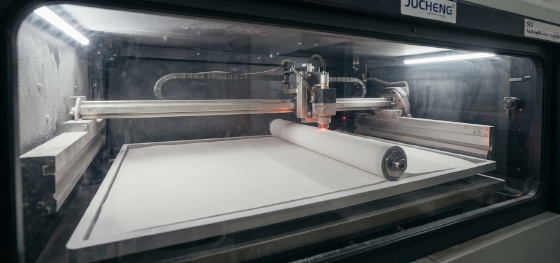
To design high-integrity functional parts, understanding the physical powder-bed fusion process is vital. This advanced additive method utilizes a sealed build chamber heated to just below the melting point of the target polymer powder. A mechanical roller sweeps across the build platform, depositing a micro-thin layer of raw nylon powder before a high-power CO2 laser traces the exact cross-sections.
As the laser scans the bed, it applies localized thermal energy to sinter the powder particles into a solid layer. Once complete, the platform lowers, a fresh layer of powder is spread, and the process repeats. Because the unsintered powder surrounds the part during the entire build cycle, it acts as a natural, continuous support structure. This eliminates the need for physical anchoring columns, enabling designers to build complex hollow geometries and interlocking assemblies that are impossible to machine.
The Superior Mechanical Properties of SLS Nylon (PA12, PA11)
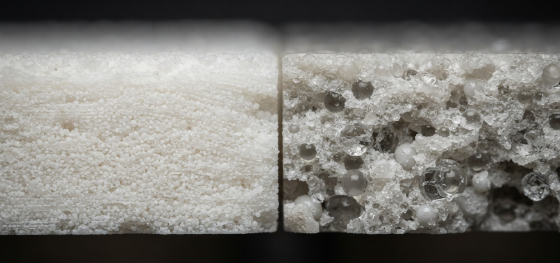
Selecting the correct materials class is the most critical stage of the rapid prototyping process. Unlike brittle photopolymers, laser-sintered nylons exhibit outstanding elongation-at-break, high impact strength, and excellent chemical resistance. The industry-standard choice is nylon 12 (PA12), providing outstanding dimensional stability and stiffness, which is ideal for structural electronic enclosures and custom bracket arrays.
For assemblies requiring extreme ductility and fatigue resistance, nylon 11 (PA11) is specified. Nylon 11 is an organic-derived polymer that exhibits exceptional flexibility, making it perfect for custom protective gear, athletic wear, and impact-absorbing bumpers. For high-temperature or load-bearing brackets, we also offer glass-filled (PA12-GB) and carbon-filled composites, which increase structural stiffness by up to fifty percent.
Functional Testing: Snap-Fits, Living Hinges, and Durability
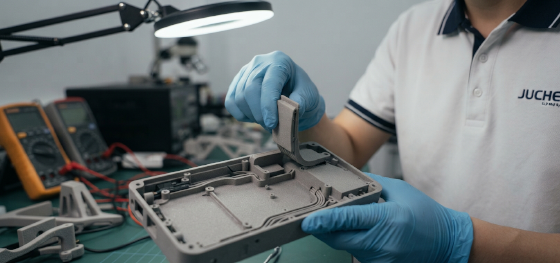
The primary engineering value of utilizing sls rapid prototyping is the ability to conduct direct, high-stress functional tests. Because sintered polyamide parts possess nearly isotropic mechanical properties, they can easily handle the physical stresses of snap-fit clipping joints. This allows engineers to verify interlocking force profiles and adjust clearances before committing to injection molds.
Sintered nylon is also the premier additive choice for testing integrated living hinges. Our engineers optimize the printing orientation so that the thin hinge membrane is built perpendicular to the laser scan path, maximizing the tensile limits. This allows the living hinge to survive hundreds of physical folding cycles without delaminating, providing valuable, real-world data to evaluate your hardware durability.
Fast SLS Printing Services at Jucheng Precision

Sourcing high-integrity nylon prototypes requires strict process control on the shop floor. Jucheng Precision operates multiple large-capacity industrial selective laser sintering systems integrated with advanced powder-delivery controls. This high-end setup allows us to monitor bed temperature gradients in real time, completely preventing thermal curling and warpage to ensure that your parts maintain dimensional accuracy across long runs.
Our additive lines are fully backed by an automated finishing department. We operate specialized bead blasting and mechanical tumbling cabins to remove all residual powder, reducing the raw surface roughness of sintered parts down to a smooth, uniform satin-matte finish. As your premier rapid prototyping service, we analyze your CAD models to optimize parts nesting, ensuring that your quick-turn brackets and manifolds are completed under a unified quality system, ready for direct assembly.
FAQ: Critical Questions About SLS Rapid Prototyping
Our engineering team has compiled professional, concise solutions to the most common quality challenges faced during selective laser sintering runs:
Is the surface roughness of SLS parts comparable to injection molded plastics?
No, raw SLS parts have a powdery, slightly rough texture (Ra ~15µm). We run finished parts through automated tumbling and bead blasting to reduce roughness below Ra 4µm, delivering a uniform, satin-matte finish.Can we thread-tap SLS printed parts directly without inserts?
Yes, because sintered nylon is highly ductile, it can handle standard mechanical thread tapping. However, for parts requiring repeated assembly cycles, we recommend installing brass threaded inserts to prevent thread wear.What is the minimum recommended wall thickness for SLS enclosures?
To ensure structural stability and prevent localized curling during the cool-down stage, we recommend maintaining a minimum wall thickness of 1.0mm, and ideally 1.5mm to 2.0mm for load-bearing brackets.How does Jucheng Precision guarantee the dimensional consistency of sls rapid prototyping orders?
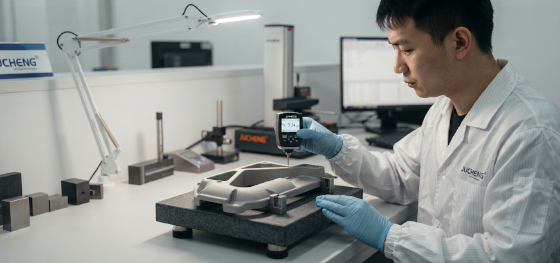
We verify mounting clearances using digital gauges, monitor laser energy densities to ensure uniform sintering, and execute multi-point coordinate measuring machine (CMM) dimensional checks on completed parts, guaranteeing zero-defect delivery.

