


Every veteran of the additive floor remembers the first time they peeled a support structure in 3d printing away, only to find the part's surface looked like a tactical war zone. In the digital vacuum of CAD, gravity doesn't exist, but the moment your design enters the physical build chamber, it becomes a slave to the laws of physics. Additive manufacturing builds parts layer-by-layer, and each layer requires a solid foundation. If your geometry hangs over thin air without a support pillar, the molten plastic or liquid resin has nowhere to land, leading to sagging, spaghetti-like failures, or a total build collapse. However, these necessary evils come with a heavy tax: manual labor, material waste, and surface degradation.

Developing a high-performance part requires a sophisticated 3D printing design strategy that anticipates the removal process before the first photon hits the resin. At JUCHENG, we treat scaffolding as an engineering problem, not a software default. We understand that a part requiring four hours of manual sanding to hide support "nubs" is a part that has been poorly designed. By utilizing advanced orientation algorithms and geometric workarounds like teardrop profiles, we aim to place supports only where they are functionally mandatory, protecting your critical mating surfaces and preserving the geometric truth of your design. This guide moves past basic slicer settings to explore the mechanical realities of overhanging masses, the technological divide between powder and resin, and why JUCHENG’s integrated DFM protocols ensure your prototypes are born with a finish that requires no apologies.
Profitability in 3D production is won or lost in the post-processing lab. A part that is optimized for minimal contact is a part that reaches the market faster. Whether you are building a complex aerospace manifold or a high-detail medical housing, the logic of the scaffold is your primary manufacturing governor. Let us break down the physical laws of overhangs and see how technical foresight can lock the integrity of your most ambitious designs into physical reality without the burden of excessive manual finishing.
Gravitational Logic: Physics of the 45-Degree Rule
Technology Variance: Scaffolding vs. Powder Bed Support
Strategic Orientation: Minimizing Surface Scars
Geometric Self-Defense: Designing Chamfers and Teardrops
JUCHENG’s Integrated Standard: Software-Driven Optimization
Gravitational Logic: Physics of the 45-Degree Rule
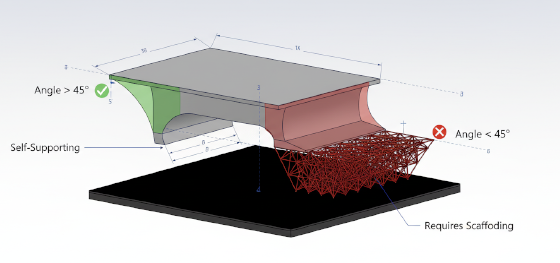
The first hurdle in the 3D printing design cycle is the "Overhang Threshold." Most additive technologies, particularly FDM and SLA, follow a strict geometric limit known as the 45-degree rule. As the print head or laser builds a part, each new layer must be supported by the one beneath it. When a feature angles outward, it "overhangs." Up to 45 degrees, the layers overlap enough to provide their own structural base. Once you cross that 45-degree boundary, the material begins to sag, resulting in a "cauliflower" surface finish or complete structural failure.
Understanding this threshold allows you to design with the machine in mind. If you can chamfer a horizontal ledge to 45 degrees, you instantly eliminate the need for a support structure in 3d printing. This isn't just about saving material; it's about preserving the "Down-Facing" surface quality. Supports always leave a visual footprint—a series of tiny pockmarks where the scaffold was attached. By designing within the 45-degree limit, you ensure that your visible surfaces are defined by the machine's precision, not by the quality of a technician's sanding sponge. At JUCHENG, we analyze these angles during our initial DFM review, often suggesting slight angle shifts that look identical to your original intent but remove hours of labor from the production cost.
Technology Variance: Scaffolding vs. Powder Bed Support
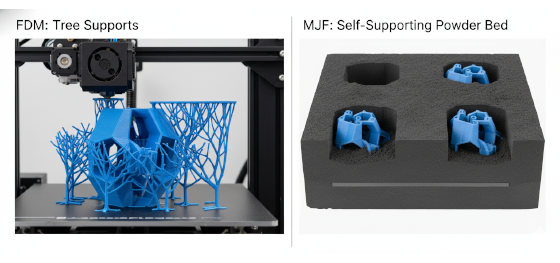
The requirement for a support structure in 3d printing is not a universal constant—it is a byproduct of the chosen process. In SLA (Stereolithography) and FDM (Fused Deposition Modeling), the build environment is a liquid or air-filled void. Gravity is an aggressive opponent here. For metal printing (DMLS), the supports also act as vital heat sinks, pulling intense thermal energy away from the part to prevent warping. In these technologies, designing for minimal support is a mandatory technical skill.
However, the world of powder-bed fusion, specifically SLS and MJF, operates in a different dimension. In these systems, the parts are born inside a massive cake of fine nylon powder. As each layer is fused, the surrounding unsintered powder remains in place, acting as a natural, self-supporting medium. This is "Geometric Freedom" in its purest form. You can print captured ball valves, complex internal lattices, and nested assemblies without a single scaffold line. When we perform a technical audit at JUCHENG, we often suggest switching from SLA to MJF if a design features intricate internal hollows that would be impossible to clean. By choosing a technology that eliminates the need for physical scaffolding, you eliminate the primary bottleneck of 3D printing design, allowing for a level of complexity that was once the sole domain of science fiction.
Strategic Orientation: Minimizing Surface Scars
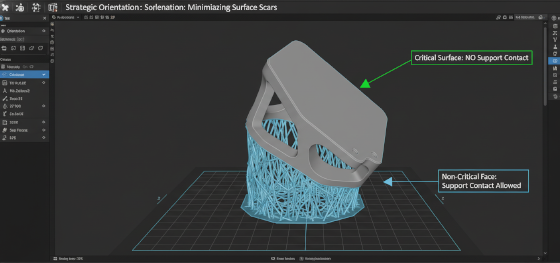
If your design must use a technology that requires scaffolding, the "Orientation" is your most powerful lever. Slicer software often chooses the orientation that uses the least material or finishes the fastest. JUCHENG’s engineers choose the orientation that protects the functional soul of your part. We rotate parts on the build plate so that the support structure in 3d printing only makes contact with non-critical internal faces or hidden aesthetic surfaces.
Consider a medical housing with a high-gloss exterior. If you print it flat, the bottom will be covered in support nubs. If we tilt it at a 45-degree angle, we can anchor the part from the mounting points on the interior. This "Stealth Scaffolding" approach ensures that the visible exterior remains pristine and dimensionally accurate. Orientation also dictates the "Z-axis resolution." Because the layer lines follow the build direction, tilting the part can hide the stair-step effect on curved surfaces. We balance these two factors—surface clarity and layer resolution—to deliver prototypes that look like production-grade plastic directly from the machine. We don't just "hit print"; we choreograph the part's birth to minimize its manufacturing scars.
Geometric Self-Defense: Designing Chamfers and Teardrops
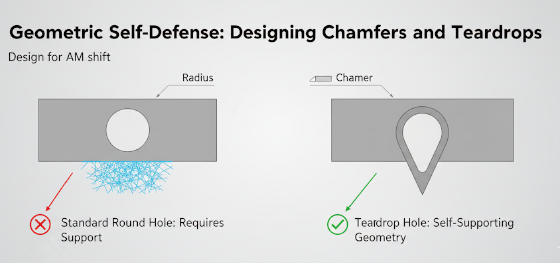
True 3D printing design mastery involves modifying the geometry itself to avoid the need for supports. This is "Geometric Self-Defense." The most common example is the internal hole. A horizontal hole in a 3-axis milled block is easy. In a 3D printer, the top of that hole is an overhang that will collapse without support. Removing support from inside a 3mm hole is virtually impossible.
The engineering fix is the "Teardrop Hole." By changing the top of the circular hole into a pointed arch, you create a self-supporting geometry that needs zero scaffolding. The same applies to horizontal ledges; replacing a round fillet with a 45-degree chamfer allows the tool-path to support itself. These small shifts in your CAD model have a massive impact on the per-part cost. At JUCHENG, we provide our clients with a library of these "Additive Workarounds." We show you how a slight change to a gusset or a rib can turn a difficult support structure in 3d printing nightmare into a high-yield production run. By designing for the machine's inherent strengths, you lock in a level of quality and price that "un-optimized" designs can never achieve.
JUCHENG’s Integrated Standard: Software-Driven Optimization
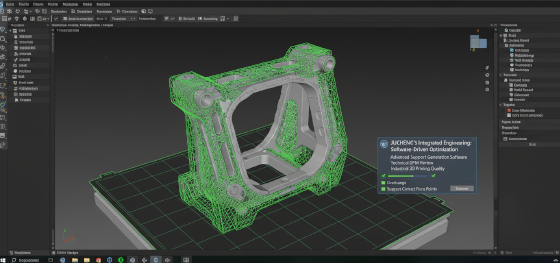
The final hallmark of a professional manufacturing partner is the investment in high-end pre-processing software. At Jucheng Precision, we utilize industrial suites like Materialise Magics to perform a "Support Simulation" before a part ever reaches the machine. This software allows us to generate "Smart Supports"—honeycomb or perforated structures that are rigid enough to hold the part but thin enough to be peeled away by hand with minimal force.
For metal support structure in 3d printing, where the scaffolding is as hard as the part itself, this software control is a mandatory safety feature. We design "Perforated Interface Layers" that allow us to snap metal supports off, or we program specific Wire EDM paths to saw them away with zero vibration. This technical rigor ensures that the "Post-Processing Labor" is accounted for during the quote phase, preventing the surprise delays that plague smaller bureaus. When you receive a component from JUCHENG, you are getting the benefit of a fully integrated manufacturing roadmap. We bridge the gap between digital theory and the physical assembly table. Contact Jucheng Precision today for a technical DFM review and see how our support protocols can clarify and elevate your next high-complexity project.

