


Molecular destiny in the manufacturing bay is decided long before the first gram of resin enters the hopper. For hardware engineers and procurement managers, the fundamental divide in thermosetting vs thermoplastic polymers dictates not just the mechanical potential of a part, but its entire production lifecycle—from the design of the cooling channels to the strategy for end-of-life recycling. In the high-velocity environment of precision manufacturing, confusing these two classes of polymers is a strategic error that leads to catastrophic failures in high-heat or high-stress applications. While thermoplastics offer the efficiency of physical reversibility, thermosets provide the uncompromising structural spine of permanent chemical cross-linking. Jucheng Precision operates as a high-fidelity manufacturing partner, navigating the binary physics of Injection molding materials to ensure your hardware choice is anchored in technical truth rather than marketing convenience.
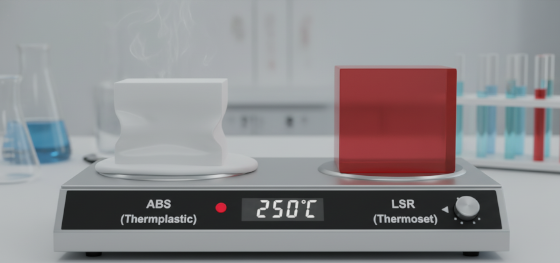
Establishing the correct material roadmap requires a forensic interrogation of "Bond Integrity." Thermoplastics behave like ice—they melt when heated and solidify when cooled, a process that can be repeated indefinitely. Thermosets, conversely, behave like a baked cake—once the chemical reaction has occurred, the material has reached its final state and cannot be returned to its liquid form. Jucheng Precision eliminates manufacturing doubt by performing a comprehensive material audit on every project, identifying whether your design requires the "Re-meltable" versatility of an ABS shell or the "One-Way" thermal sovereignty of a Liquid Silicone Rubber (LSR) seal. This guide deconstructs the molecular divide, the radical differences in injection processing, and the economic realities of each polymer class to ensure your product launch is both robust and sustainable.
The Molecular Divide: Van der Waals vs. Covalent Bonds
Engineering Matrix: Side-by-Side Comparison Data
Reverse Thermodynamics: Injection Logic Discrepancies
Lifecycle Realities: Recycling and Environmental Compliance
JUCHENG Protocol: Routing the Right Physics to the Right Mold
The Molecular Divide: Van der Waals vs. Covalent Bonds
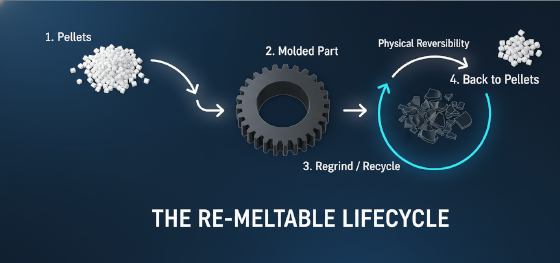
Structural performance is born from the forces that hold atoms together. In the debate of thermosetting vs thermoplastic polymers, the distinction is purely energetic. Thermoplastics consist of long, discrete molecular chains that are entangled but not physically bonded to one another. They are held together by relatively weak secondary forces, such as Van der Waals interactions or hydrogen bonding. When heat is applied, these chains slide past one another, allowing the material to flow into a mold. Once cooled, they entangle again, locking in the shape. This physical phase change is reversible, which is why ABS or Polypropylene can be recycled or "re-melted." However, this same reversibility means thermoplastics lose their structural spine at relatively low temperatures (Glass Transition or Tg). If you overheat a thermoplastic part in the field, it will sag and fail as the chains begin to slide again.
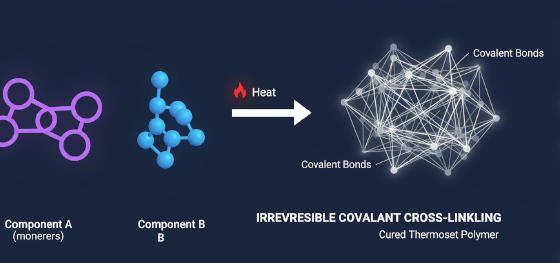
Thermosetting polymers reject this fluidity through the creation of a three-dimensional molecular grid. During the curing process—whether triggered by heat, UV light, or a chemical catalyst—the polymer chains form permanent covalent cross-links with their neighbors. They are effectively "welded" together at the molecular level into a single, monolithic network. This transformation is a "One-Way Trip." Once baked, a thermoset cannot be melted; if subjected to extreme heat, it will char and undergo thermal decomposition rather than soften. This "Covalent Sovereignty" is why materials like LSR (Liquid Silicone Rubber) or Epoxy provide unmatched stability in extreme temperatures and high-vibration environments. At Jucheng Precision, we leverage this chemistry for hardware that must survive under-the-hood automotive heat or surgical sterilization cycles where thermoplastics would simply warp.
Engineering Matrix: Side-by-Side Comparison Data
Selecting the correct polymer family requires a dispassionate look at the mechanical and environmental tradeoffs. To assist engineers in early-stage material routing, Jucheng Precision provides the following definitive comparison matrix:
| Feature | Thermoplastic Polymers | Thermosetting Polymers |
|---|---|---|
| Synthesis Logic | Entangled linear chains | Cross-linked 3D network |
| Effect of Heat | Softens / Melts (Reversible) | Hardens / Strengthens (Irreversible) |
| Typical Materials | ABS, PC, Nylon, PP, PEEK | LSR, Epoxy, Phenolic, Polyurethane |
| Recyclability | High (Regrind is possible) | Low (Grinding for filler only) |
| Dimensional Stability | Moderate (Prone to creep) | Superior (Resists cold flow) |
Observing the data reveals that while thermoplastics dominate high-volume consumer goods due to their rapid cycle times and low waste, thermosets remain the mandatory choice for specialized seals, gaskets, and electrical insulators where chemical and thermal permanence are the primary requirements.
Reverse Thermodynamics: Injection Logic Discrepancies
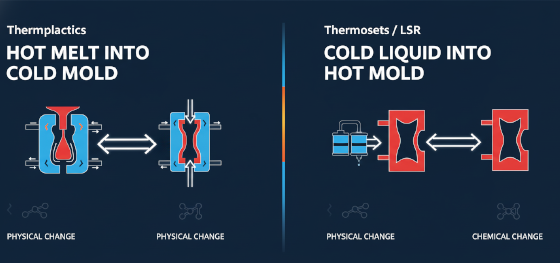
Manufacturing logistics are completely inverted when shifting between these material families. In thermoplastic molding, the goal is "Thermal Quenching." We inject a molten polymer at 250°C into a chilled steel tool at 30°C. The part hardens as it loses heat to the mold. The faster we can pull the heat out, the shorter the cycle time. In thermosetting vs thermoplastic polymers processing, particularly with LSR, the logic is reversed. We inject a chilled liquid mixture (kept at 20°C in a cold runner) into a scorching hot mold (heated to 180°C). The part hardens because it *gains* heat, which triggers the chemical cross-linking reaction. Jucheng Precision maintains separate, specialized bays for these processes. We understand that a "Thermoplastic Mindset" applied to a thermoset mold will lead to "Scorching" (premature hardening) in the gates and a failed production batch. We manage these thermodynamic counter-flows with surgical precision, ensuring that your parts are dimensionally accurate whether they are quenched in cold steel or baked in hot cavities.
Lifecycle Realities: Recycling and Environmental Compliance

Sustainability goals often dictate the polymer selection at the procurement stage. Thermoplastics are the champions of the circular economy. Because their phase change is physical, we can take an ABS computer housing at the end of its ten-year life, grind it into "Regrind," and re-extrude it into new pellets for another production run. This "Closed-Loop" capability is vital for brands aiming for RoHS and REACH environmental compliance. Thermosets, however, present a "Linear Lifecycle" challenge. Once the covalent bonds are set, the material cannot be returned to a virgin state. While a cured LSR or Epoxy part can be ground into a powder and used as an inert filler in concrete or other plastics, its value in the manufacturing loop is significantly lower. Jucheng Precision advises clients to utilize thermoplastics for large-volume cosmetic housings where recycling is a consumer expectation, while reserving thermosets for mission-critical functional components where performance permanence outweighs the need for re-meltability.
JUCHENG Protocol: Routing the Right Physics to the Right Mold

Engineering excellence at Jucheng Precision is built on the foundation of material-agnostic advisory. We do not push a material because it is easy to mold; we route your project based on the mechanical soul it requires to thrive. Our facility, housing over 150 CNC machines and elite injection bays, is equipped to process the entire spectrum of Injection molding materials. When you upload a CAD file to our facility, our veteran engineers perform a comprehensive "Material Integrity Audit." We interrogate your thermal requirements, chemical exposure risks, and assembly loads to determine the optimal victor in the thermosetting vs thermoplastic polymers standoff. We provide the material lot traceability and dimensional inspection reports needed to move from the clinical lab to the global market with 100% confidence. Stop gambling with "general purpose" resins. Leverage our decade of polymer mastery to validate rapidly and scale profitably. Contact our technical team today for a free DFM review and see how we can anchor your design's physical future with the molecular certainty of professional material replication.

