


Ask a machinist about titanium, and you will get a story of contradictions. It is a strange and challenging metal.

Cutting it can feel like trying to machine hardened steel. Yet, at the same time, it can feel like trying to cut a block of sticky chewing gum. It is incredibly strong, but it can also catch fire on the machine.
This is the paradox of the aerospace metal. The process of titanium cnc machining is one of the most demanding challenges in all of manufacturing. It requires specialized knowledge, advanced equipment, and a deep respect for the material's difficult personality.
A Machinist's Paradox: Strong and Gummy
Choosing Your Titanium: Grade 2 vs. Grade 5
Our Strategy: A Battle of Attrition
Safety is Not an Option
A Machinist's Paradox: Strong and Gummy
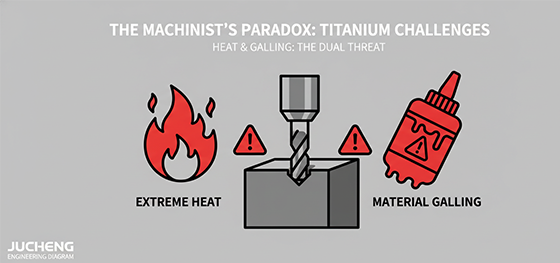
The challenges of machining titanium come from a unique combination of properties that no other common metal has.
First, it has a very high strength-to-weight ratio. This is why it is loved by the aerospace industry. But this also means the cutting forces are very high.
Second, it is a terrible conductor of heat. Like stainless steel, all the heat from the cutting process concentrates on the tool, not the part. This can destroy a cutting tool in seconds.
Third, and most strangely, it has a tendency to chemically react with and weld itself to the cutting tool at high temperatures. This is called "galling." The material sticks to the tool, which ruins the surface finish and can cause the tool to break. So, it is both strong like steel and sticky like gum.
Choosing Your Titanium: Grade 2 vs. Grade 5
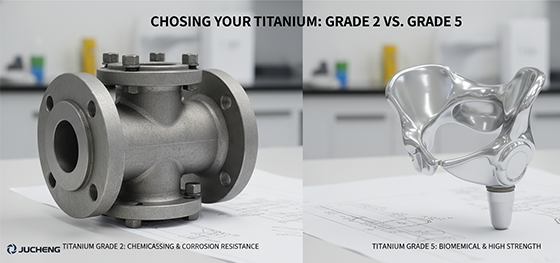
There are many titanium alloys, but two dominate the world of CNC machining materials.
Grade 2 Titanium is "commercially pure." It is not alloyed with other elements. It is not as strong as other alloys, but it has the best corrosion resistance. It is also biocompatible. This makes it a great choice for chemical processing equipment and some medical implants. It is the "easiest" of the titaniums to machine.
Grade 5 Titanium, or Ti-6Al-4V, is the undisputed king. It is an alloy of titanium with 6% aluminum and 4% vanadium. These additions dramatically increase its strength, making it comparable to steel, but at only 60% of the weight. This is the workhorse of the aerospace industry. It is also the standard for high-strength medical implants like hip and knee joints. However, it is also much more difficult to machine than Grade 2.
| Property | Grade 2 Titanium | Grade 5 Titanium (Ti-6Al-4V) |
|---|---|---|
| Strength | Good | Excellent (Steel-like) |
| Corrosion Resistance | Superior | Excellent |
| Machinability | Difficult | Very Difficult |
| Common Use | Chemical, Medical | Aerospace, Medical |
Our Strategy: A Battle of Attrition
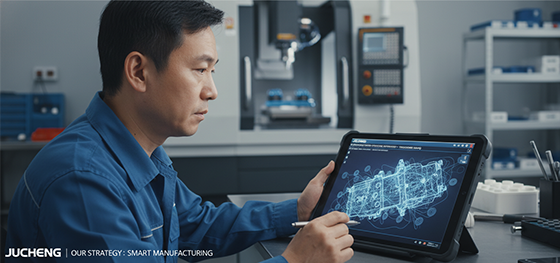
The strategy for successful titanium cnc machining is a battle of attrition. It is about managing heat and reducing cutting forces at all costs.
First, we use very rigid and powerful machines. Any vibration will cause the tool to chatter and fail. Our 5-axis CNC machines are ideal for this, as they allow us to use shorter, more rigid tools.
Second, we use very slow spindle speeds and carefully controlled feed rates. This reduces the amount of heat generated. We also use special toolpaths, like trochoidal milling, which take many small, arcing cuts instead of one heavy, straight cut. This also helps to manage heat and tool pressure.
Third, we use a massive amount of high-pressure coolant. This is non-negotiable. The coolant must flood the cutting zone constantly to pull heat away from the tool and prevent the chips from welding to it.
Safety is Not an Option
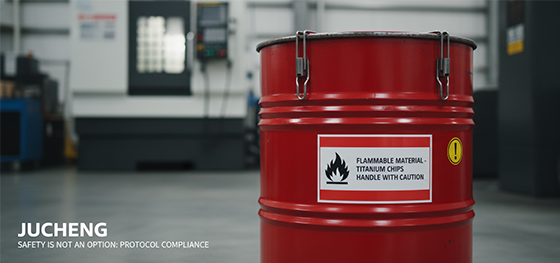
There is one final, critical aspect of machining titanium. The fine chips and dust can be flammable, especially under the right conditions.
A professional shop must have strict safety protocols for handling titanium. This means never letting chips accumulate on the machine. It means using the correct type of coolant. And it means storing titanium chips in dedicated, sealed, fire-safe containers.
This commitment to safety is a key sign of an experienced and responsible manufacturing partner.
Titanium is the ultimate performance material. It enables us to build stronger, lighter, and more durable products. But it demands a level of expertise and discipline that few possess. At JUCHENG, our advanced equipment and deep process knowledge allow us to tame this aerospace metal, turning your most challenging designs into reality.

