


A part that measures 50.01mm on a standard pair of calipers but fails to fit into its assembly is the ultimate ghost in the machine shop. In the traditional world of linear dimensioning, we obsess over "size"—the distance between two points. But a part can have the perfect size and still be functionally useless because it is bent, twisted, or its features are misaligned. This is the technical crisis solved by What is GD&T (Geometric Dimensioning and Tolerancing). It is the move from a primitive measurement of length to a sophisticated language of function. It doesn't just ask "how big is it?" but "where is it, and how does it relate to the rest of the assembly?" In the realm of high-end CNC machining tolerances, GD&T is the absolute authority.
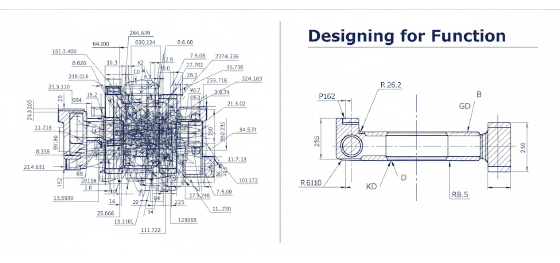
At Jucheng Precision, we have seen thousands of projects where a lack of geometric control led to expensive assembly failures. We understand that for a satellite housing or a surgical robotic arm, the relationship between features is more critical than the features themselves. GD&T allows engineers to communicate exactly how much variation is acceptable while ensuring the part still works. This guide moves beyond the textbook definitions to explore the 14 geometric symbols, the anatomy of the feature control frame, and why JUCHENG utilizes advanced CMM metrology to ensure that the "invisible" tolerances of your CAD file are locked into physical reality.
Efficiency in modern manufacturing is born from the removal of ambiguity. When you speak the language of GD&T, you eliminate the "interpretive dance" that often happens between the design office and the shop floor. Let us break down the technical pillars of geometric control and see how they redefine the integrity of your most complex CNC designs.
The Functional Imperative: Why Size Isn't Everything
The 14 Symbols: Mapping the Geometry of Survival
Decoding the Feature Control Frame: The Sentence of Precision
The Economic Reality: Inspection Costs vs. Functional ROI
JUCHENG’s Metrology Standard: Validating the Invisible
The Functional Imperative: Why Size Isn't Everything

To master What is GD&T, one must first recognize the failure of traditional +/- tolerances. Imagine a long, slender shaft designed to fit into a precision-honed hole. Your drawing might specify a diameter of 20mm +/- 0.01mm. The machinist uses a micrometer and confirms the shaft is exactly 20.00mm at every point. By linear standards, the part is perfect. However, if that shaft has a slight "banana" bow—a straightness error—it will never slide into the hole. The linear dimensioning failed to account for the shape.
GD&T moves the goalposts from 1D numbers to 3D "Tolerance Zones." Instead of just defining a distance, it defines a cylindrical or planar volume where the entire feature must exist. It allows an engineer to say: "I care that this shaft is 20mm, but I care *more* that it is straight within 0.005mm." This functional focus allows for "Bonus Tolerance"—a critical concept in the CNC machining process. If a hole is machined slightly larger than its minimum size, GD&T (using modifiers like MMC) can actually grant the machinist more room for the hole's position. This reduces scrap rates without compromising the assembly’s ability to fit. At Jucheng Precision, we use this functional logic to optimize our tool paths, ensuring we hit the specifications that matter to your bottom line, not just the numbers on a page.
The 14 Symbols: Mapping the Geometry of Survival
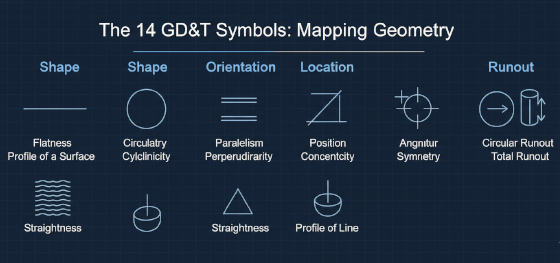
The power of GD&T is condensed into 14 distinct symbols, governed by the ASME Y14.5 or ISO 1101 standards. These symbols are the roadmap for CNC machining tolerances. We categorize them into four primary families based on what they control. Understanding which symbol to use is the difference between a high-performance part and a manufacturing nightmare.
1. Form Controls: These define the shape of an individual feature. Flatness, Straightness, Circularity, and Cylindricity ensure that a surface isn't wavy or egg-shaped. These don't require a "Datum" (reference point).
2. Orientation Controls: These relate a feature to a datum. Perpendicularity, Parallelism, and Angularity ensure that a bore is perfectly "square" to a mounting face.
3. Location Controls: This is the heart of GD&T. Position (True Position) is the most powerful symbol, defining exactly where a hole or boss sits in 3D space. Concentricity and Symmetry are the rarer, more expensive cousins of Position.
4. Runout Controls: These are essential for rotating parts. Circular Runout and Total Runout measure how much a feature "wobbles" as it spins around an axis. At Jucheng Precision, we specialize in high-speed rotational components where total runout must be kept within single-digit microns to prevent bearing failure at 10,000 RPM.
Decoding the Feature Control Frame: The Sentence of Precision
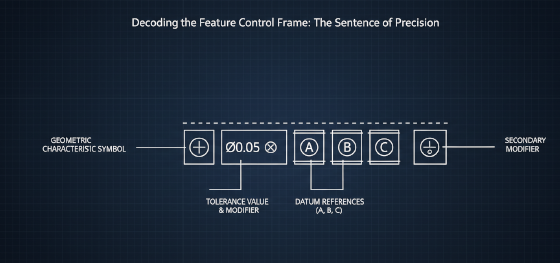
If the symbols are the vocabulary of What is GD&T, then the Feature Control Frame (FCF) is the sentence. It is a rectangular box that contains all the technical instructions needed to machine a specific feature. An FCF is read from left to right, providing a logical progression of geometric intent. To the uninitiated, it looks like an encrypted code; to a JUCHENG machinist, it is a surgical command.
The first compartment houses the geometric symbol (e.g., Position). The second compartment defines the shape and size of the tolerance zone (e.g., a diameter of 0.05mm). This is often followed by a material modifier like MMC (Maximum Material Condition), which is the engineer’s secret weapon for cost reduction. MMC essentially says: "If the hole is at its smallest (hardest to fit), the position must be perfect. But if the hole is larger, you get extra 'bonus' tolerance for its location." The final compartments define the "Datums"—the A, B, and C faces that the part will be measured from. At Jucheng Precision, we use our 5-axis machines to establish these datums in a single setup, ensuring that the entire "Datum Reference Frame" is perfectly synchronized with the machine's coordinate system. This eliminates the manual error associated with trying to find a zero-point across multiple fixtures.
The Economic Reality: Inspection Costs vs. Functional ROI

Let’s talk about the invoice. There is a persistent myth that GD&T always makes parts more expensive. This is a misunderstanding of manufacturing economics. While it is true that a What is GD&T callout requires more advanced inspection—you cannot verify "True Position" with a ruler—it actually lowers the *total cost of quality*. Traditional linear tolerances are often too tight because the engineer is trying to "guarantee" a fit they can't accurately describe. This leads to parts being scrapped that would have actually assembled perfectly.
GD&T provides the "functional wiggle room" that manufacturing needs. By using MMC and defining tolerance zones instead of rigid lines, you give JUCHENG the ability to hit the functional requirements without having to maintain impossible linear precision on non-critical features. The investment shifts from the machine floor (where high scrap rates are expensive) to the QC room (where precision validation is a known, fixed cost). For high-volume production in the automotive and medical industries, GD&T is a massive budget protector. It ensures that the assembly line never stops because of a part that "measures right but fits wrong." We help our clients perform this ROI analysis during the DFM phase, showing you where a single Position callout can replace ten linear dimensions and save you 20% on your unit price.
JUCHENG’s Metrology Standard: Validating the Invisible
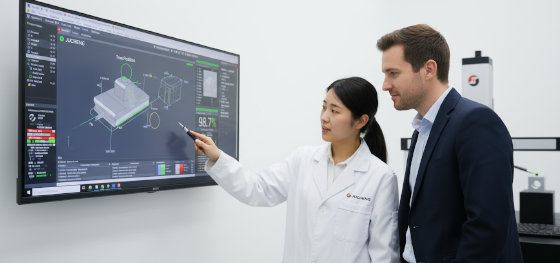
The final hallmark of a 5-axis facility is the ability to prove the geometry. CNC machining tolerances are only as good as the metrology that validates them. You cannot "see" a parallelism error of 0.02mm, but you will certainly feel the heat it generates in a high-speed assembly. Jucheng Precision has invested in the ultimate GD&T validation tool: the Coordinate Measuring Machine (CMM).
Our CMMs are not just checking sizes; they are checking relationships. We use specialized software to interpret your GD&T callouts and generate a graphical "True Position" report. We can show you exactly where the center of a hole is relative to its theoretical master coordinate. This transparency is essential for aerospace and defense contracts where every micron of geometric deviation must be documented. When you receive a component from JUCHENG, you aren't just getting metal; you are getting a verified engineering solution. We bridge the gap between a complex series of symbols on a blueprint and a functional physical part that assembles perfectly every time. Whether you are building an innovative medical device or a high-performance EV drivetrain, our GD&T expertise clarifies your design vision and protects your reputation. Contact Jucheng Precision today for a technical review of your next precision project.

