


Evaluating zinc die casting vs aluminum die casting usually triggers massive internal debates among hardware engineering teams. Procurement managers often make the fatal mistake of looking strictly at raw ingot prices, instantly choosing the cheaper option without calculating the brutal downstream factory costs. Slashing your material budget upfront means absolutely nothing if your chosen metal aggressively attacks your steel tooling or requires hundreds of hours of manual secondary CNC threading. Deciding between these two industrial heavyweights dictates your entire supply chain strategy, from the machine architecture required down to the final cosmetic paint job.

Hardware startups scaling into commercial mass production cannot afford to guess their baseline metallurgy. Picking a heavy metal for a flying drone destroys battery life, while picking a lightweight metal for a luxury door handle ruins the premium tactile feel consumers demand. Operating our massive dual-capability factory in the Shenzhen precision manufacturing hub, Jucheng Precision regularly guides clients through this exact financial crossroad.
Relying on unbiased engineering data is the only way to protect your profit margins. Because we operate both cold and hot chamber systems in-house, we never force your design into the wrong machine just to secure a contract. Let's break down the hidden tooling costs, the CNC machining realities, and the exact physical tradeoffs you must evaluate when selecting your core die casting materials.
content:
Strength and Weight: The Physical Trade-Offs
Tooling Life and Cost: Winning the Amortization Game
Surface Finish and Plating: Eliminating Cosmetic Defects
Technical Data: The Ultimate Metal Comparison Matrix
JUCHENG Hub: Unbiased Manufacturing for Both Alloys
FAQ: Honest Answers About Rust, Machining, and Cost
Strength and Weight: The Physical Trade-Offs
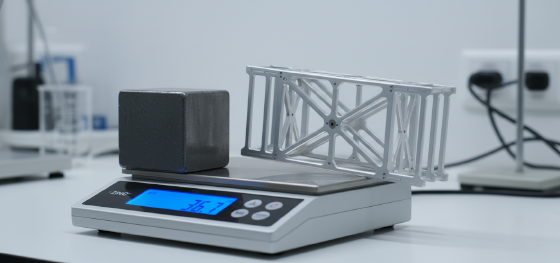
Which metal should you choose when building large structural components?
Aluminum is the undisputed champion for massive structures like automotive engine blocks and telecom heatsinks because it sheds thermal heat rapidly while weighing roughly 2.5 times less than its heavier counterpart.
Replacing heavy steel brackets with lightweight alloys completely transforms fuel efficiency and portability. If your product flies, drives, or must be carried by a human operator all day, you absolutely must prioritize weight reduction to remain competitive in the modern commercial market.
Conversely, luxury consumer goods require a completely different tactile experience. When a customer grabs a premium smart-lock or a high-end optical lens, they equate heavy physical mass with expensive quality. Deploying Zamak alloys delivers this incredible, solid heft, providing an unyielding premium feel that lightweight metals simply cannot replicate without feeling cheap and hollow.
Tooling Life and Cost: Winning the Amortization Game
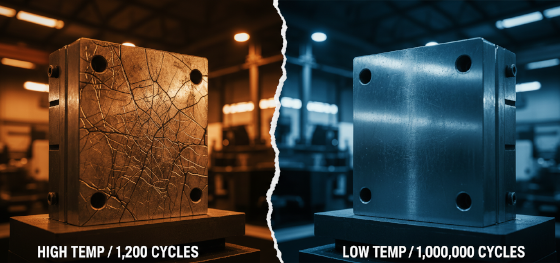
Why do some factories charge expensive tool replacement fees every 100,000 shots?
Because casting high-heat metals physically attacks the steel cavity, causing severe thermal fatigue and heat-checking that eventually destroys the mold surface, requiring costly factory rebuilds.
Budgeting for your initial die casting mold material is only half the financial equation. If you are casting high-temperature alloys, your heavy H13 tool steel mold will degrade continuously. For massive million-unit production runs, you will be forced to buy several replacement molds, drastically increasing your overall amortized cost per unit.
Switching to a lower-melting-point alloy completely neutralizes this severe financial drain. Because Zamak melts at a fraction of the temperature, it subjects the tooling to virtually zero thermal shock. A well-maintained mold running these cooler metals can easily surpass one million shots, making it mathematically superior for immense, multi-year supply contracts.
Surface Finish and Plating: Eliminating Cosmetic Defects
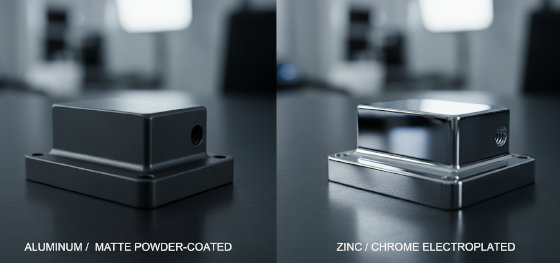
How do you achieve a flawless, mirror-like chrome finish on raw metal hardware?
By pouring an alloy that cures with an incredibly dense, non-porous outer skin, allowing electroplating chemicals to adhere perfectly without blistering or bubbling over time.
Attempting to electroplate standard lightweight alloys is a notorious factory nightmare. The inherent microscopic porosity traps the acidic plating chemicals inside the metal. Months later, those trapped chemicals bleed out to the surface, causing your expensive chrome or gold finish to peel off in ugly flakes.
Heavy zinc alloys cure with a remarkably tight, defect-free molecular surface. This pristine canvas accepts copper, nickel, and decorative chrome flawlessly. If your design requires a brilliant luxury aesthetic rather than a matte industrial powder coat, this heavier metal remains the absolute industry standard.
Technical Data: The Ultimate Metal Comparison Matrix
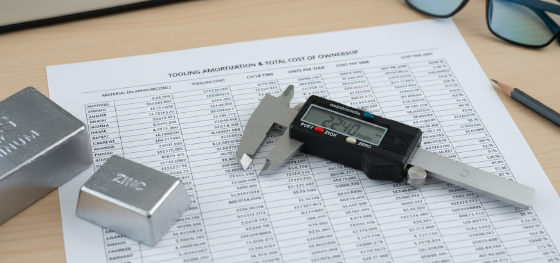
Cross-referencing secondary processing capabilities reveals the true cost of manufacturing. The benchmark data below proves why paying slightly more for raw material often saves you thousands of dollars in the CNC machining bay.
| Manufacturing Metric | JUCHENG Aluminum Alloy (A380) | JUCHENG Zinc Alloy (Zamak 3) |
|---|---|---|
| Secondary CNC Threading | High (Frequent manual tapping required) | Virtually Zero (Excellent net-shape threads) |
| Machine Architecture | Cold Chamber (Slower robotic pouring) | Hot Chamber (Ultra-fast submerged pump) |
| Tooling Lifespan Limit | Approx. 100,000 Shots | 1,000,000+ Shots |
| Thermal Conductivity | Excellent (Ideal for heatsinks) | Moderate (Retains heat longer) |
Evaluating zinc die casting vs aluminum die casting ultimately hinges on your design's complexity. If you need tiny, intricate internal threads and zero post-machining, Zamak wins instantly. If you need a massive, lightweight chassis that sheds heat perfectly, the high-heat alloy remains undefeated.
JUCHENG Hub: Unbiased Manufacturing for Both Alloys
Why is using a single supplier with multiple machine architectures absolutely critical?
Because brokers who only own one type of machine will inherently lie to you, forcing your specific CAD design into their incompatible equipment just to secure your production contract.
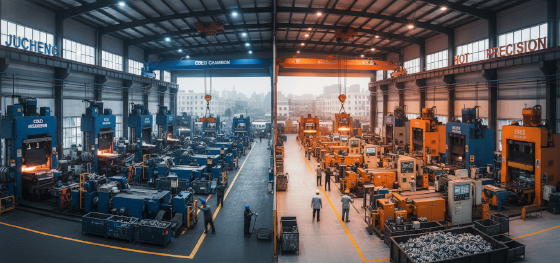
Shoehorning a lightweight aerospace bracket into a heavy Zamak machine ruins your payload capacity. Operating our massive Shenzhen precision manufacturing hub, Jucheng Precision houses both automated hot chamber and heavy-duty cold chamber presses directly side-by-side.
Stop trusting vendors who only offer you one solution. Send your intricate 3D CAD files to our engineering team today. We provide a completely free, mathematically unbiased DFM analysis, calculate your total tooling amortization, and deliver the exact metal your product genuinely requires.
FAQ: Honest Answers About Rust, Machining, and Cost

Which metal is generally cheaper if I am only buying 5,000 pieces?
For lower volumes where tooling replacement is not an issue, aluminum is usually cheaper due to lower raw material ingot costs and significantly lighter shipping weights.
Can I cast both of these metals inside the exact same steel mold?
No. The shrinkage rates and the thermodynamic cooling paths are entirely different. Pouring a different alloy into an existing mold guarantees the final parts will fail your dimensional tolerances.
Do both of these metals naturally resist red rust outdoors?
Yes, because neither contains significant amounts of iron, red rust is impossible. However, both will develop dull surface oxidation over time, making protective powder coating or anodizing highly recommended.
Why can't I just use a 5-axis CNC to machine the entire part from scratch?
You absolutely can for prototypes, but CNC milling wastes massive amounts of raw material and takes hours per part. Injection molding creates the shape in seconds, making it the only viable method for mass production.

