


Translating a complex three-dimensional bracket into a flat cutting layout requires far more than simple linear dimensions. Mastering the mathematics of calculating k factor sheet metal bending is the primary step in ensuring that your unfolded patterns correspond perfectly to physical formed assemblies. This key engineering calculation allows designers to predict the precise elongation behavior of the metal during plastic deformation, identifying the exact shift of the neutral axis under compression and tension.

Ignoring this physical stretch parameter is one of the most common causes of dimensional drift on the assembly line. When an engineer models a chassis using a generic default K-factor, the finished component will either exceed or fall short of its intended dimensions once folded. Properly configuring your CAD unfolding software with empirical, material-specific variables is the best way to secure your tolerances and eliminate costly pre-production prototypes.
Let's examine why the neutral axis shifts during press operations, establish the standard formula and values for common industrial alloys, and review how bend allowance and bend deduction calculations rely on this critical ratio.
content:
What is the K-Factor, and Why Does it Matter?
Formula and Standard K-Factor Values for Common Metals
How Bend Allowance and Bend Deduction Rely on the K-Factor
Let JUCHENG's Engineers Handle Your Flat Patterns
FAQ: Critical Questions About Calculating K Factor Sheet Metal Bending
What is the K-Factor, and Why Does it Matter?
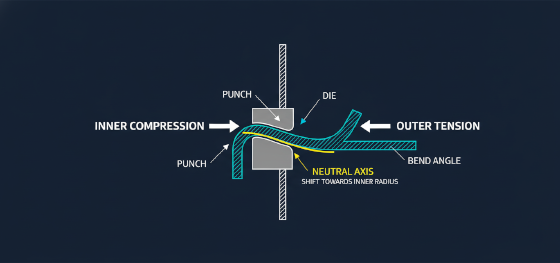
What physical phenomenon does the K-factor represent during metal forming?
The K-factor is a mathematical ratio representing the location of the neutral axis relative to the overall material thickness after the metal has been plastically deformed.
As the top punch forces the sheet into the V-die, the inner surface compresses while the outer surface stretches. Somewhere between these opposing forces lies a theoretical region that experiences zero dimensional change, known as the neutral axis. When the sheet is flat, this axis sits exactly in the middle of the thickness (at 50%), but bending forces it to shift inward toward the compressed inner radius.
We define this shifting ratio as the K-factor. Harder alloys undergo different levels of tensile stress and compressive stress compared to softer plates, causing the neutral axis to shift to different depths. If you fail to calculate this shift, your CAD flat patterns will not incorporate the correct stretch allowances, leading to severe assembly misalignments.
Formula and Standard K-Factor Values for Common Metals
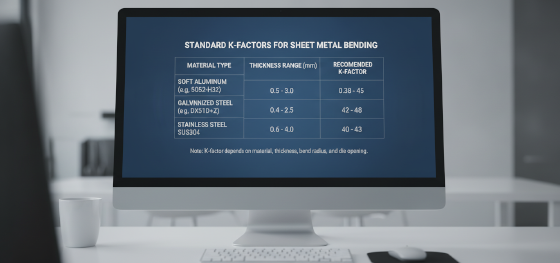
What is the mathematical formula used to calculate the K-factor?
The K-factor formula is K = t / T, where "t" is the distance from the inner surface to the shifted neutral axis, and "T" is the overall material thickness.
When calculating k factor sheet metal bending parameters, designers can refer to empirical charts based on material ductility. Because the exact location of the neutral axis cannot be measured directly on flat sheets, it must be calculated using the physical thickness (T) and the inner bend radius (R). Standard values generally range from 0.3 to 0.5 depending on the selected alloy class:
| Material Class | Standard K-Factor Range | Minimum Bending Radius | Deformation Characteristics |
|---|---|---|---|
| Aluminum (e.g., 5052-H32) | 0.40 - 0.43 | 1.0 x Material Thickness | Highly ductile, neutral axis stays closer to the center |
| Stainless Steel (e.g., SUS304) | 0.44 - 0.46 | 1.5 x Material Thickness | Work-hardens rapidly, neutral axis shifts deeper |
| Carbon Steel (e.g., SPCC) | 0.41 - 0.45 | 0.8 x Material Thickness | Excellent ductility, highly predictable deformation limits |
How Bend Allowance and Bend Deduction Rely on the K-Factor
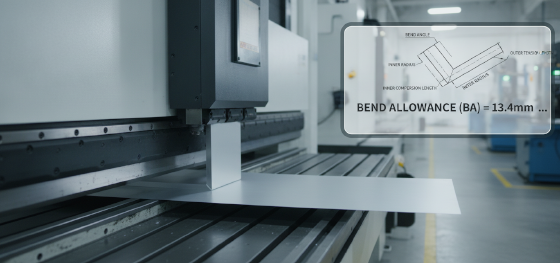
How do bend allowance and bend deduction calculations utilize the K-factor value?
The K-factor is the foundational variable used to calculate bend allowance (material elongation) and bend deduction (the amount subtracted from flat sheets to compensate for stretching).
Every physical folding process begins with a calculated flat pattern. If you simply add up the outer flange lengths of a 3D part without subtracting the material elongation, your finished components will always exceed their intended dimensions. To prevent this, unfolding software utilizes the K-factor to calculate the exact bend allowance, which is the arc length of the neutral axis around the bend.
By subtracting the calculated bend deduction from the sum of the outer flanges, we obtain the exact flat length of the raw plate. This ensures that when the laser cutter blanks out the flat sheet and the operator bends it, the metal stretches precisely to the target dimensions, maintaining tight tolerances across complex assemblies.
Let JUCHENG's Engineers Handle Your Flat Patterns
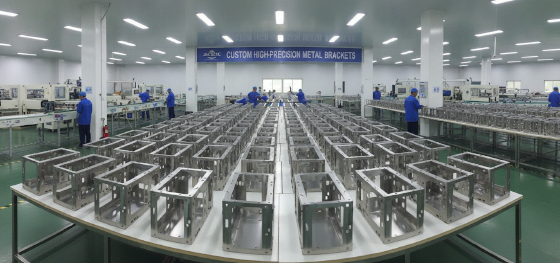
How does JUCHENG eliminate the complexity of calculating K-factors on custom hardware orders?
Our engineers utilize advanced CAD software integrated with empirical shop-floor bending databases to automate all unfolding and springback compensations.
Integrating precise calculations into your early sheet metal design phase is the single most effective way to eliminate production defects. JUCHENG integrates these advanced geometric and material validations into our digital manufacturing network, ensuring that your CAD files translate into fully finished, durable assemblies with extreme dimensional precision.
We process a wide range of raw sheets, including lightweight aluminum, high-yield stainless steel, and easily formable carbon steel. Our technical department provides a 24-hour free DFM analysis to check your CAD models, checking tolerances and tool clearances before production. Supported by our no MOQ policy and rapid delivery guarantee, we manage your project from initial flat pattern cutting to final packaging and assembly.
FAQ: Critical Questions About Calculating K Factor Sheet Metal Bending
How does the bending method (air bending vs. bottoming) affect the K-factor?
The K-factor is not a fixed physical constant; it varies based on the bending method. Air bending allows the metal to deform naturally, which can cause the neutral axis to shift slightly differently compared to bottoming or coining, where extreme compressive force is applied to stamp the corner, requiring different K-factor adjustments in your unfolding software.
Why does a tight inner bend radius yield a smaller K-factor?
When the inner bend radius is set extremely tight relative to the thickness, the outer fibers of the metal experience intense tensile stresses, forcing the neutral axis to shift deeper toward the inner surface. This deeper shift results in a smaller K-factor (down toward 0.30), whereas gentle bends maintain a neutral axis closer to the center, yielding a K-factor near 0.50.
Does material hardness affect the K-factor calculation?
Yes, heavily. Harder alloys (such as stainless steel 304) resist compressive forces more than softer metals (such as annealed aluminum 5052), which alters how the neutral axis shifts under stress. Our engineers calibrate our software with material-specific K-factors to ensure that different alloys are unfolded using precise, empirically verified deductions.
How does JUCHENG prevent thickness variations in cold rolled steel sheet metal orders?
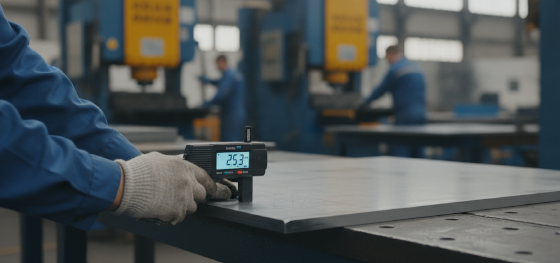
We bypass the inaccuracies of standard theoretical tables by physically measuring every incoming batch of raw sheet stock using calibrated digital micrometers. Our team inputs these measured values into our CAD unfolding systems, ensuring that our progressive calculations and tool setups are perfectly matched to the actual metal thickness, eliminating dimensional springback variations.

