


Dropping a solid billet of 7075 aluminum onto a steel workbench produces a satisfying, heavy thud. It feels dense, freezing cold, and entirely indestructible. That raw physical weight explains exactly why aerospace engineers refuse to compromise when structural integrity is on the line.
Executing flawless cnc machining requires stripping away marketing hype and respecting brutal kinetic forces. You cannot negotiate with the physics of a spinning carbide cutter plunging into solid alloy at ten thousand revolutions per minute. The machine spindle demands absolute rigidity to prevent shattering expensive tools.

Walking the floor of the Shenzhen precision manufacturing hub, you instantly smell vaporizing high-pressure cutting fluid. Holding a perfectly milled titanium bracket delivers an immediate sense of absolute precision. Every single micrometer violently removed dictates the survival or catastrophic failure of your final assembly on the highway.
content:
Overcoming Tool Deflection in Hard Metals
Transitioning Hardware from Prototype to Production
Medical Quality Control and Polymer Selection
Controlling Secondary CNC Costs and Finishes
Frequently Asked Questions
Overcoming Tool Deflection in Hard Metals

Can you cut heavy tool steel at the exact same spindle speed as standard aerospace aluminum?
Absolutely not. Attempting those aggressive speeds will instantly melt the carbide insert and violently destroy the expensive workpiece due to massive thermal buildup.
Dealing with microscopic tool deflection separates amateur garage operations from true industrial powerhouses. When a cutting tool extends too far into a deep cavity, the kinetic resistance of the raw metal violently pushes back. This physical resistance causes the long tool to bend slightly under extreme load.
Advanced CAM programmers combat this reality by utilizing dynamic toolpaths that take incredibly shallow, high-speed bites out of the raw material. By drastically reducing the radial engagement, operators eliminate the terrifying squeal of spindle runout. This highly mathematical approach guarantees perfectly vertical, mirror-like internal walls.
Upgrading to continuous 5-axis milling allows the heavy machine spindle to physically tilt and rotate around the stationary workpiece seamlessly. This eliminates catastrophic alignment errors historically caused by humans unbolting a part and meticulously clamping it down again. Robotic controllers execute complex fluid dynamics inside dense aviation turbines in a single setup.
Transitioning Hardware from Prototype to Production

Is it financially viable to subtractively mill ten thousand units of a highly complex automotive bracket?
Often no. Massive consumer volumes are typically better suited for expensive injection molding, but subtractive metal cutting remains fundamentally perfect for mid-volume, load-bearing runs.
Jucheng Precision acts as the ultimate bridge to production, safely guiding ambitious hardware startups through the dreaded scaling phase. Cutting a massive steel injection tool paralyzes cash flow when you only need five hundred functional field-testing units. Smart procurement managers refuse to trap their budget in rigid hard tooling too early.
Subtractive hardware scaling bypasses this financial trap completely. Maintaining an aggressive fleet of 150+ automated cnc machining centers allows us to absorb sudden inventory demand spikes without breaking a sweat. We turn digital CAD files into physical metal overnight.
Procuring reliable milling services without drowning in massive NRE overhead is entirely possible because we strictly enforce a no MOQ policy for B2B clients. Agile supply chain flexibility allows mechanical engineers to seamlessly pivot and update the CAD geometry between production batches.
Medical Quality Control and Polymer Selection

Will standard industrial surface finishes safely survive harsh hospital autoclave sterilization cycles?
Never. Medical hardware requires highly specialized, biocompatible engineering polymers or raw surgical-grade steel to prevent dangerous biological contamination.
Promising single-digit micron tolerances means absolutely nothing if the facility lacks the hardcore quality control paperwork to legally back it up. Supplying critical surgical tools means adhering rigidly to strict ISO 13485 medical frameworks. Traceability for every raw material batch is non-negotiable.
Milling complex bone drill guides out of solid PEEK plastic or heavy stainless steel triggers a merciless verification process. Our temperature-controlled metrology laboratory utilizes automated coordinate measuring machines to physically probe every critical dimension. We aggressively cross-reference real-world geometry against your original digital blueprint.
| Raw Material Selection | Spindle Machinability Rating | Thermodynamic Risk Factor | Optimal Factory Application |
|---|---|---|---|
| Aerospace Aluminum | Extremely Fast | Low (Excellent heat dissipation) | Autonomous drone chassis |
| Surgical Stainless Steel | Difficult (High tool wear) | Moderate (Requires heavy coolant) | Implantable medical plates |
| PEEK Medical Polymer | Moderate (Prone to melting) | High (Severe warpage risk) | High-temperature fluid valves |
Controlling Secondary CNC Costs and Finishes

Does protective surface treatment actually change the final dimensional accuracy of a precisely milled metal part?
Yes. Protective chemical coatings physically grow a microscopic layer on the surface that must be mathematically accounted for by the CAM programmer prior to cutting.
Raw cut metal straight off the machine bed requires aggressive secondary operations to achieve consumer-grade aesthetics. Providing reliable one-stop post-processing eliminates the horrific logistical nightmare of shipping scratch-prone parts across the globe. Keeping the entire chemical workflow under one roof actively drives your BOM reduction goals.
Centralized in-house finishing ensures that your final assembly fits together seamlessly without unpredictable tolerance stacking. Reckless third-party vendors applying a powder coat just ten microns too thick will cause precision bearing press-fits to violently fail on the assembly line. We meticulously plug critical threaded holes with custom silicon stoppers to protect them from unwanted chemical buildup.
Eliminating unpredictable scrap rates forces engineers to heavily scrutinize their tooling amortization strategy. Catching microscopic dimension failures during the early cnc machining prototyping phase saves millions in downstream mass production. Our factory veterans perform mandatory DFM analysis to identify impossibly tight tolerances before the spindle ever turns.
Frequently Asked Questions
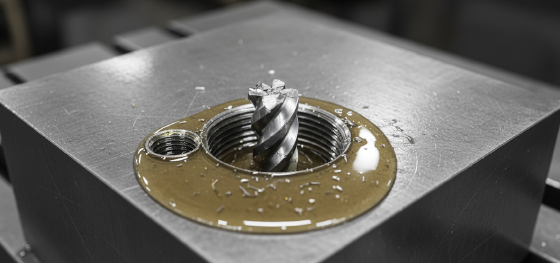
Can a spinning circular endmill create a perfectly sharp internal square corner?
It is mathematically and physically impossible. Round cutting tools always leave an internal radius exactly matching their own diameter, forcing engineers to design specialized dog-bone reliefs.
Why did my thin-walled plastic prototype warp severely hours after being removed from the machine vise?
Aggressive material removal heavily strips the outer protective skin from extruded industrial polymers like Delrin. This violent action instantly releases massive internal mechanical stresses, causing the part to physically relax and twist out of shape.
Is it safe to blindly tap extremely deep threads directly into a solid alloy block?
Tough aerospace alloys work-harden rapidly under extreme pressure and will snap standard hardware store taps instantly. Operators must deploy highly specialized coated threading tools and continuously flood the deep cavity with extreme high-pressure coolant.

