


While Nylon 6 is often celebrated for its incredible impact resistance and ductility, industrial engineers frequently require a material that can withstand higher temperatures and maintain greater structural rigidity under load. This is where Polyamide 66, more commonly known as PA66, enters the production floor. If Nylon 6 is the versatile gymnast of polymers, Nylon 66 is the high-performance weightlifter. It is a material designed for the rigors of the engine bay, the high-torque gearbox, and the heavy-duty structural mount where failure is not an option.
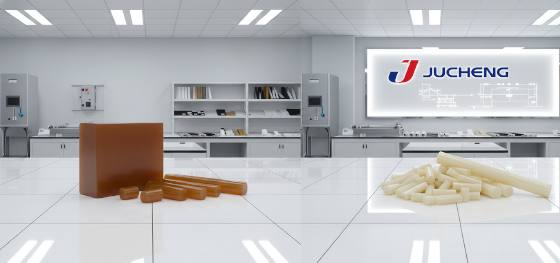
Mastering nylon cnc machining for PA66 requires a different mindset than processing standard plastics. Because it features a more crystalline molecular structure than its cousins, it presents both a cleaner cutting experience and a more demanding set of thermal constraints. Treating PA66 as a simple commodity plastic often leads to dimensional instability and surface smearing that can ruin a precision part. At Jucheng Precision, we specialize in Machining Nylon 66 for global clients who demand the highest levels of wear resistance and structural integrity.
Whether you are designing a high-speed gear set or a thermally stable bushing, understanding the unique characteristics of PA66 is vital for a successful manufacturing outcome. This guide provides a technical deep dive into the properties of Nylon 66, its behavior under the cutting tool, and the advanced moisture-mitigation strategies JUCHENG employs to ensure your parts remain within tolerance from the moment they leave our facility to the moment they are installed in the field.
content:
Chemical Backbone: Why 66 Matters
Thermal Superiority in the Engine Bay
Machining Rigidity: Clean Cuts and Chip Control
Wear Resistance and Lubricity for Dynamic Parts
Dimensional Challenges: Swelling and Stability
JUCHENG Industrial Expertise in PA66
Chemical Backbone: Why 66 Matters
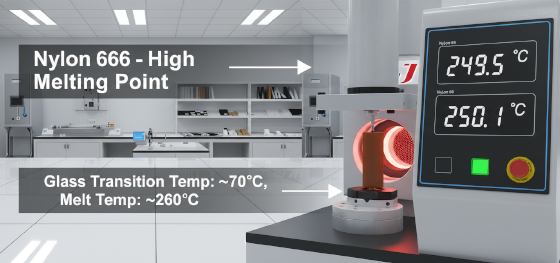
The primary difference between Nylon 6 and Nylon 66 is found at the atomic level, specifically in the arrangement of carbon atoms. Nylon 66 is synthesized from two monomers, each containing six carbon atoms, which results in a highly symmetrical and ordered molecular chain. This symmetry allows the polymer chains to pack more tightly together than those in PA6, creating a higher degree of crystallinity. This crystalline nature is what gives PA66 its superior mechanical properties. It is naturally harder, stiffer, and more resistant to deformation under prolonged stress, a trait known as creep resistance.
For the engineer, this means that parts machined from Nylon 66 can hold their shape better when subjected to continuous pressure. In structural applications like manifold spacers or heavy-duty bearing housings, the tighter molecular bond of PA66 ensures that the part does not "flow" over time. At Jucheng Precision, we recognize that this increased crystallinity also affects how the material reacts to cutting forces. Because the material is more rigid, it does not deflect as much as PA6 during nylon cnc machining, allowing us to hold tighter geometric tolerances on complex internal features. However, this same rigidity means the material is slightly more prone to internal stresses if the machining parameters are not perfectly optimized.
Thermal Superiority in the Engine Bay
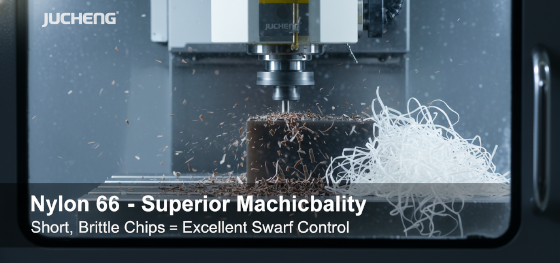
Temperature is often the deciding factor when choosing between polyamide grades. Nylon 66 boasts a significantly higher melting point than Nylon 6, typically around 255°C (491°F) compared to 220°C (428°F) for PA6. Furthermore, its heat deflection temperature is also higher, meaning it can maintain its mechanical strength at temperatures where other plastics would begin to soften or warp. This thermal stability makes it an indispensable material for automotive engine components, electrical connectors, and industrial machinery that generates significant heat during operation.
During the machining process, this higher thermal threshold is a massive advantage. It allows Jucheng Precision to run our spindles at higher speeds without the immediate risk of the material melting and fusing to the tool flutes—a common headache when working with softer polymers. However, we must still manage the heat carefully. While PA66 can handle more heat, it also expands more than many metals. If the part gets too hot during a heavy milling pass, its dimensions will swell. When it cools down later, it will shrink, potentially falling out of the required tolerance. We mitigate this through advanced cooling strategies and staged machining, ensuring the material remains stable throughout the entire production cycle.
Machining Rigidity: Clean Cuts and Chip Control
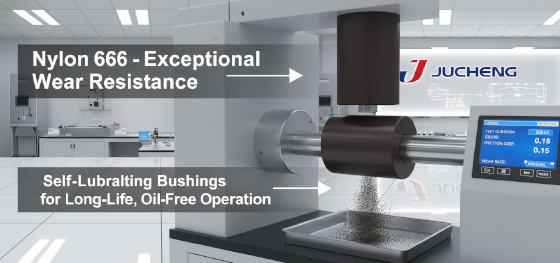
From the perspective of a CNC operator, Machining Nylon 66 is often a more pleasant experience than working with PA6. Because the material is harder and less gummy, it produces much cleaner, crisper chips. In many cases, the chips will fracture and break away from the tool naturally, reducing the risk of the dreaded "bird's nest" that can wrap around the spindle and ruin a surface finish. This improved chip control allows for more consistent automated production and smoother surface finishes directly off the machine.
To achieve the best results, JUCHENG utilizes specialized tooling geometries. We prefer sharp, polished carbide end mills with high rake angles to slice through the nylon fibers cleanly. For large-diameter turning, we use inserts with a specific nose radius to minimize friction and prevent heat buildup. By maintaining a high feed rate, we ensure that each rotation of the tool takes a definitive bite of material, carrying the thermal energy away in the chip rather than letting it soak into the workpiece. This precision approach is essential for components like gears and bushings where the surface integrity is directly linked to the mechanical performance of the final assembly.
Wear Resistance and Lubricity for Dynamic Parts
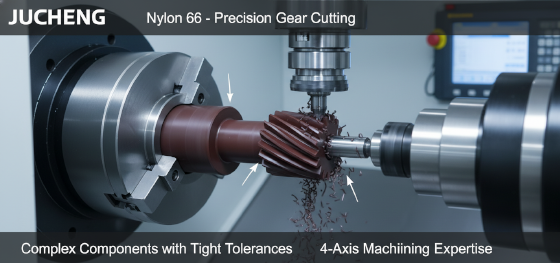
Nylon 66 is a natural choice for dynamic applications where parts are in constant motion against one another. It possesses an exceptionally low coefficient of friction and high wear resistance, even when operating without supplemental lubrication. This self-lubricating quality is why PA66 is the gold standard for industrial gears, pulleys, and sleeve bearings. It can survive in abrasive environments where metal-on-metal contact would lead to rapid seizing and failure.
At Jucheng Precision, we frequently perform nylon cnc machining for precision gear sets. The rigidity of PA66 allows us to mill sharp, accurate tooth profiles that can handle significant torque loads. Because the material is naturally slippery, these gears run quieter and cooler than their metal counterparts. Furthermore, PA66 is highly resistant to many industrial chemicals, oils, and greases, ensuring that if lubrication is added to the system, the plastic will not degrade or soften over time. This chemical resilience, combined with its inherent toughness, makes it a reliable partner for food processing equipment and chemical handling systems where cleanliness and longevity are paramount.
Dimensional Challenges: Swelling and Stability
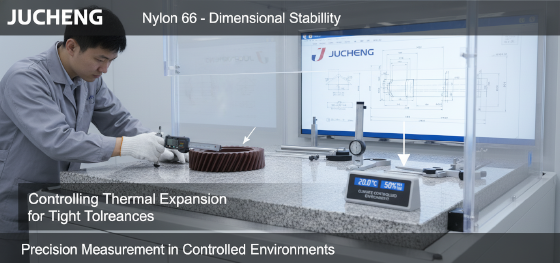
Despite its many strengths, Nylon 66 has a significant technical challenge: it is highly hygroscopic. It shares the same "moisture villain" trait as Nylon 6. In a high-humidity environment, a PA66 part can absorb significant amounts of water, which leads to a decrease in tensile strength and a noticeable increase in part volume. This dimensional swelling is the primary cause of failure in nylon parts that require high precision over a long period. If you machine a bearing to a perfect press-fit in a dry room, it may swell and lock up the system once it reaches a humid factory floor.
Jucheng Precision mitigates this through a sophisticated moisture-management protocol. For critical components, we recommend an annealing process before the final machining pass. By heating the material in a controlled oven, we release internal stresses and stabilize the molecular structure. Additionally, we provide "moisture-conditioned" parts to our clients. We pre-saturate the parts to their expected operating humidity before the final precision cut is made. This ensures that the part has already done its swelling and will remain dimensionally stable once it is in service. This level of foresight is what separates a professional plastic shop from a general manufacturer. We don't just cut the material; we account for its biological-like behavior.
JUCHENG Industrial Expertise in PA66
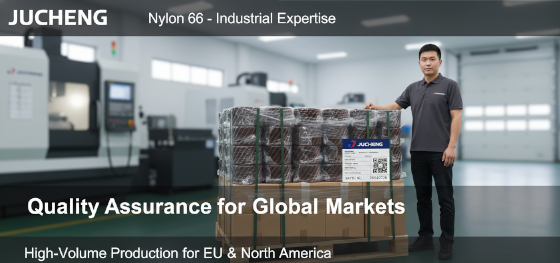
Processing Nylon 66 is as much a science as it is a craft. At Jucheng Precision, we have invested in high-speed, high-torque CNC centers that are perfectly suited for the demands of Machining Nylon 66. Our facility is climate-controlled to minimize moisture fluctuations during the production process, and our quality control department is equipped with precision CMM and optical inspection tools to verify every dimension. We understand that in high-volume industrial orders, consistency is everything.
Our engineers provide a comprehensive DFM review for every project, helping you decide if standard PA66 is sufficient or if you require an upgrade to a glass-filled or oil-filled grade for even greater performance. We treat every nylon part with the care and technical rigor usually reserved for aerospace metals, ensuring that your structural plastic components are delivered ready to perform. Whether you need a single prototype or a production run of ten thousand gears, Jucheng Precision has the expertise to manage the complexities of Nylon 66 and deliver excellence. Contact us today to see how our precision nylon cnc machining services can strengthen your next industrial project.

