


Precision is a promise made in the CAD software but often broken on the factory floor. When it comes to engineering plastics, achieving consistent Delrin Machining Tolerances is the ultimate test of a manufacturer's technical maturity. Delrin is a material that engineers love for its rigidity and machinability, but its high coefficient of thermal expansion makes it a "moving target" during the manufacturing cycle.
At Jucheng Precision, we don't view tolerances as a suggestion; we view them as a mandatory contract. Success in pom delrin acetal cnc machining requires a mastery of environmental variables that most shops simply ignore. Whether you are designing a high-speed miniature gear or a medical valve body, understanding the invisible forces that shift your dimensions is critical. This guide explores the engineering rigor required to hold acetal parts to the tightest possible specs.
Maintaining a +/- 0.02mm tolerance in plastic is not achieved through luck—it is achieved through a combination of thermal discipline, specialized tooling, and advanced metrology. In this deep dive, we will reveal the manufacturing protocols JUCHENG uses to stabilize Acetal and deliver results that other facilities claim are impossible for polymers.
Defining the Gold Standard: Precision Limits of Acetal
The Thermal Expansion Trap: Managing Environmental Shift
Tooling Dynamics: Why Dull Edges Destroy Tolerances
Internal Stress Management: Stability Through Annealing
Verification and Validation: The Role of CMM Inspection
Defining the Gold Standard: Precision Limits of Acetal
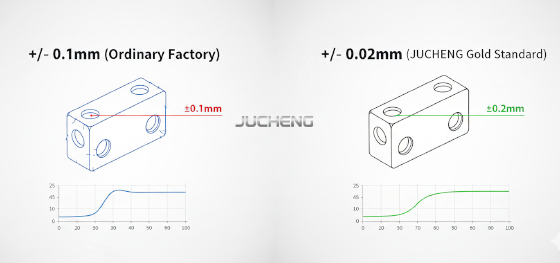
In the vast world of polymers, Delrin (Polyoxymethylene) stands as one of the most dimensionally stable materials available to engineers. However, the term "precision" varies wildly depending on who you ask. A general-purpose machine shop might consider +/- 0.1mm a success for a plastic part. At Jucheng Precision, we operate in a different echelon. For critical mechanical assemblies, we routinely achieve Delrin Machining Tolerances as tight as +/- 0.02mm on small-to-medium sized components. This level of accuracy is essential for press-fit bearings, high-speed gears, and sliding manifolds where any excessive clearance would lead to vibration or failure.
Achieving this gold standard requires a fundamental shift in how we approach pom delrin acetal cnc machining. We recognize that Delrin is a semi-crystalline material. Its crystalline regions provide the strength, while the amorphous regions provide the flexibility. If the machining process is too violent, it can disrupt this balance, leading to localized "spring-back" where a feature physically moves after the tool has retracted. By utilizing high-speed spindles and maintaining a constant chip load, JUCHENG ensures that the material is sheared cleanly, preventing the elastic deformation that often ruins tight-tolerance specifications. We set the bar at the highest level because we understand that in the world of high-end robotics and medical devices, a few microns are the difference between a prototype that works and one that is destined for the scrap heap.
The Thermal Expansion Trap: Managing Environmental Shift

The single greatest enemy of precision in plastic is heat. Delrin has a coefficient of thermal expansion that is roughly five times higher than that of common steels. This means that a part can physically grow or shrink based on the temperature of the room or the friction of the cut. If a part is measured immediately after a heavy roughing pass while it is still warm to the touch, the dimensions recorded will be entirely false once the part cools down to room temperature. This "Thermal Trap" is where most manufacturers fail to maintain consistent Delrin Machining Tolerances.
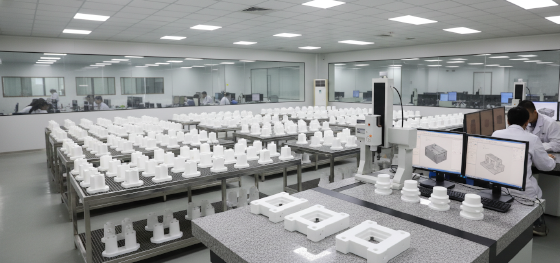
Jucheng Precision solves this through a rigorous "Thermal Equilibrium" protocol. Our facility is climate-controlled to a stabilized temperature of 20 degrees Celsius. We allow raw material blanks to acclimatize to the shop floor for 48 hours before the first chip is cut. During the pom delrin acetal cnc machining process, we utilize high-pressure air-cooling or specialized flood coolants to carry heat away from the shear zone. Crucially, we utilize "rest cycles" between roughing and finishing passes. This allows any thermal energy trapped in the part to dissipate, ensuring that the final precision cuts are made into a stable, cold material. By managing the thermodynamics of the manufacturing environment, we eliminate the uncertainty of size-shift, providing our clients with parts that remain within spec from the production floor to the final assembly site.
Tooling Dynamics: Why Dull Edges Destroy Tolerances
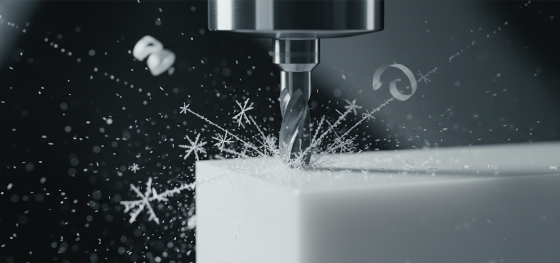
In metal machining, you can often "force" a tool through the material. In plastic, if the tool is not perfectly sharp, the material will simply deflect or bend away from the pressure. This deflection is the silent killer of Delrin Machining Tolerances. When a dull tool pushes against the plastic, it creates a compressive force. The tool thinks it is cutting the correct dimension, but once it moves away, the plastic "bounces back," leaving the part oversized or the bore undersized.
At Jucheng Precision, our tooling philosophy for pom delrin acetal cnc machining is built on the "Sharp Edge Mandate." We exclusively utilize high-positive rake carbide tools that are polished to a mirror finish. A sharp, polished edge reduces friction and allows the tool to slice through the acetal chains with minimal pressure. We also monitor tool life with extreme precision; the moment an edge shows even microscopic rounding, it is retired. This ensures that the cutting force remains constant throughout a production run, preventing the dimensional drift that occurs as tools wear down. Furthermore, we utilize specialized single-flute cutters for deep bores to ensure that chips are evacuated instantly. If chips are re-cut, they generate heat and localized pressure, both of which are fatal to maintaining tight tolerances. Our focus on the micro-mechanics of the cut is why JUCHENG can deliver complex acetal geometries that other shops simply cannot hold to print.
Internal Stress Management: Stability Through Annealing
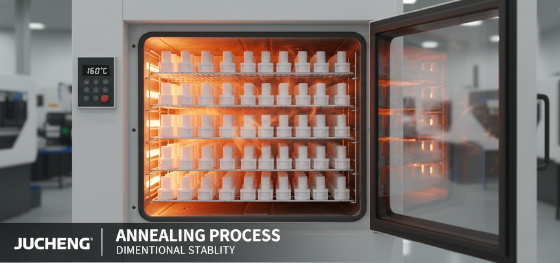
Residual internal stress is the "ghost" that causes parts to warp days after they are machined. All raw Delrin stock arrives at the shop with a certain amount of stress trapped inside from the extrusion process. When we remove large amounts of material during pom delrin acetal cnc machining, we are effectively cutting the "molecular ropes" that hold that stress in check. The result is a part that bows, twists, or cups. If your design features thin walls or a long aspect ratio, internal stress is the primary obstacle to achieving reliable Delrin Machining Tolerances.
Jucheng Precision employs a mandatory "Stress-Relief Annealing" cycle for all ultra-high-precision Delrin projects. We place the raw material or the rough-machined parts into a specialized oven, slowly heating them to a temperature just below their melting point and holding them there for several hours. This allows the polymer chains to relax and realign into their most stable state. The slow cooling phase that follows "locks" the material into this relaxed state. By the time we perform the final precision cut, the material is "dead"—meaning it no longer has the urge to warp or move. This extra technical step is what allows JUCHENG to deliver long, slender shafts and thin-walled manifolds that remain perfectly straight and within spec, even when exposed to fluctuating environmental conditions in the field.
Verification and Validation: The Role of CMM Inspection
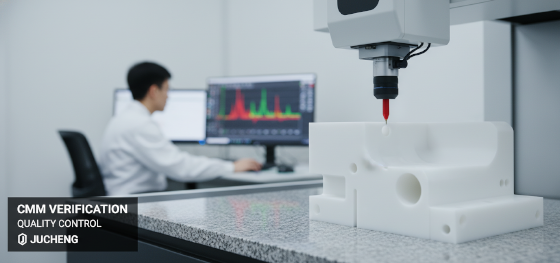
You cannot manage what you cannot measure. The final pillar of JUCHENG’s tolerance strategy is our investment in high-end metrology. While calipers and micrometers are fine for general work, they are insufficient for validating Delrin Machining Tolerances in the +/- 0.02mm range. The heat of a human hand holding a plastic part can change its dimension by several microns, leading to false readings and poor data.
Our quality control department utilizes high-resolution Coordinate Measuring Machines (CMM) and vision systems that measure parts without physical contact or excessive handling. We perform our measurements in a stabilized environment where the part has reached thermal equilibrium. Every high-precision order of pom delrin acetal cnc machining at Jucheng Precision comes with a comprehensive inspection report, providing a digital audit trail of every critical feature. This level of transparency is essential for our clients in the aerospace and medical industries, where documentation is as important as the physical part. When you partner with JUCHENG, you aren't just buying a part; you are buying the verified certainty that your Delrin components will fit and function exactly as intended. Contact our engineering team today for a free technical review and see how our precision manufacturing protocols can stabilize your next project.

